
In 1946, President Harry Truman offered Denmark $100 million for Greenland. Denmark said no. Eight decades on, the island still draws Washington’s attention, and the mechanics here come down to three things: where it sits, what lies under it, and who gets to decide.
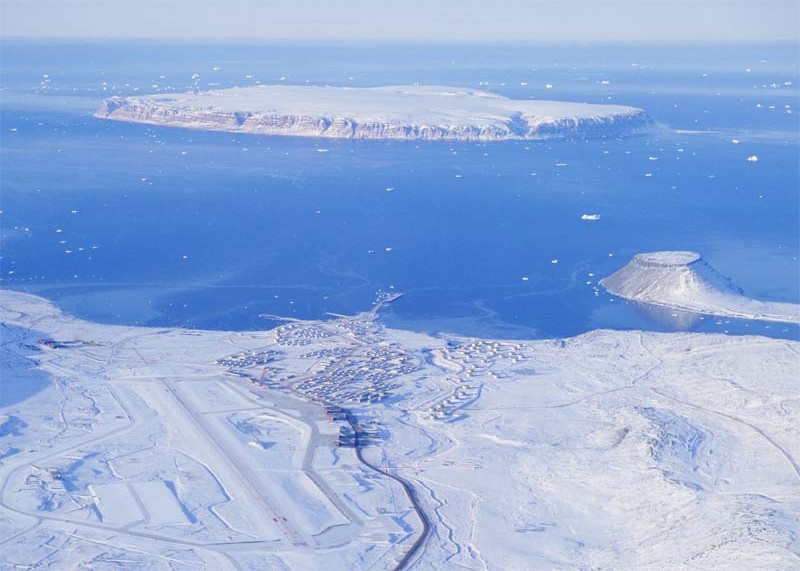
Start with the map. Pituffik Space Base, known as Thule Air Base until it was renamed in 2023, occupies Greenland’s northwestern coast across Baffin Bay from Nunavut. The U.S. and Denmark jointly set up a radio and weather station there in 1946, and military construction began in secret in 1951, putting long-range bombers closer to China and the Soviet Union. The site lies between northern U.S. and northern Russian territory, which Arctic security professor Troy Bouffard called “absolutely paramount” in comments to NPR.
Today the base runs three missions: missile warning, missile defense and space surveillance. It is the Defense Department’s northernmost installation. Winters there average 13 to 20 degrees below zero Fahrenheit, a problem for any plan to add air defenses against newer Russian weapons such as hypersonic cruise missiles, since such units have never operated in that cold.
The mineral claim
Then follow the money. The American Action Forum put Greenland’s known mineral and energy assets at about $4.4 trillion at current market prices. Oil accounts for $1.4 trillion of that and natural gas for $324 billion. Rare earth elements, the item that gets the headlines, are valued at just $1.5 billion.
The catch is extraction. Strip out oil and gas and the figure falls to roughly $2.7 trillion, and only a modest fraction of that can be mined at a profit. Using a conversion rate of 4.2 percent drawn from rare earth reserves, the authors estimate $186 billion in reserves that are economically extractable. Denmark’s own government lists the minerals under study as gold, natural gas, diamonds, lead and zinc.
Today, fishing remains the most important driver of Greenland’s economy, although the industry cannot support as many jobs as it once did.
Who decides
None of this is Washington’s call. Home rule began in 1979. In 2009 Greenlanders approved the Self-Government Act in a referendum, which lets the territory take over further areas of responsibility. Foreign, defence and security policy are the exceptions: those cannot be transferred. Denmark keeps them, and pays Greenland a substantial annual block grant.
About 56,000 people live on the island, and most of them are in the 20 percent of the country not covered by ice and snow. Greenland sends two representatives to the Danish Parliament, the Folketing, and stays part of the Realm of Denmark.
The earlier American attempts followed a pattern. Secretary of State William H. Seward pushed to acquire Greenland and Iceland together for $5.5 million in 1868, but no formal offer ever materialized. Truman’s 1946 offer, equal to roughly $12.9 billion today once adjusted for inflation and GDP growth, went nowhere.
The base, by contrast, already exists. It operates under defense agreements between the two countries, and nobody had to buy an island to get it.
Sources
- What to know about Pituffik, the only U.S. military base in Greenland (NPR)
- Greenland (Denmark.dk, official site of Denmark)
- Pricing Greenland: The Essence of the Deal (American Action Forum)




