
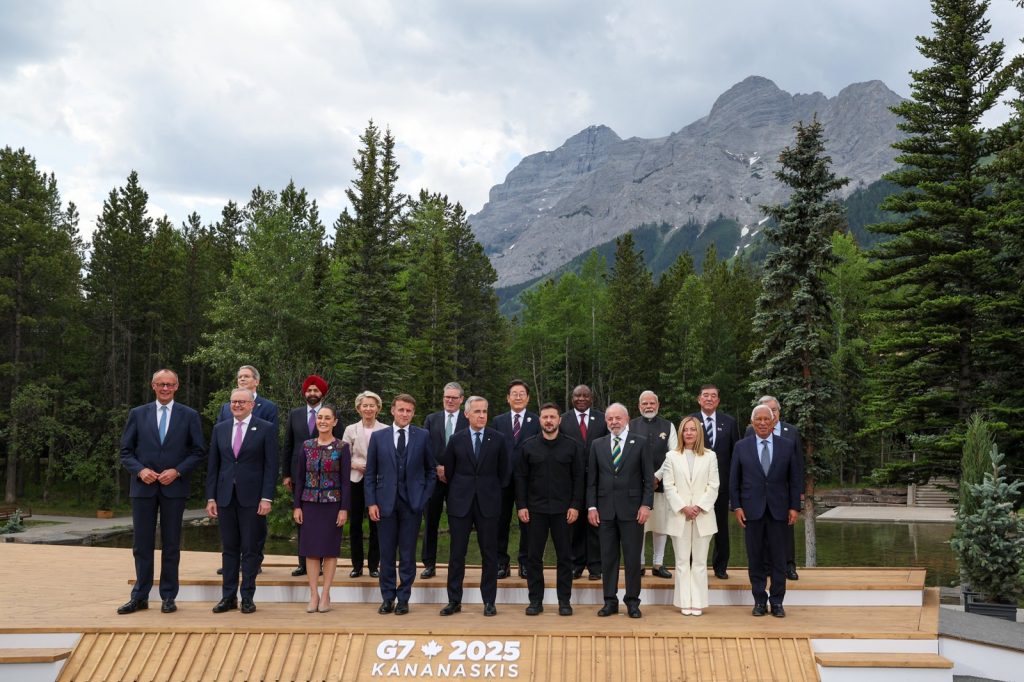
“Multilateralism must be fit for purpose in the 21st century,” Canadian Prime Minister Mark Carney told G7 leaders as their 2025 summit closed in Kananaskis, Alberta. “We face interlinked crises, but we also have shared tools, and shared responsibility. The work continues.”
Three days of talks in the mountain town produced no single joint communique, a sign of divisions between members. Canada, chairing a G7 summit for the first time under Carney, issued six joint statements instead. They cover critical minerals, AI and digital governance, wildfire response, foreign interference, migrant smuggling and quantum technology. The meeting also marked 50 years since the group’s founding.
Minerals, trade and technology
Economic pressure shaped the opening sessions: stalled growth in some regions, stubborn inflation and a splintering trade system. Leaders pledged to “drive investment, secure supply chains, and promote an open, predictable trade regime.”
Their answer to dependence on non-market economies was the Critical Minerals Production Alliance, a Canada-led effort to lock in high-standard supplies of lithium, nickel and rare earth elements. Carney called access to those materials “a matter of national security and sovereignty.” China was not always named, though “market-distorting overcapacity” and “non-transparent practices” came up repeatedly.
The G7 also committed to “secure, responsible and trustworthy AI adoption,” including regulatory alignment, openness about how algorithms are built, and help for poorer regions on the digital divide. A separate multilateral initiative on quantum technology got new Canadian domestic funding. Japanese Prime Minister Shigeru Ishiba said innovation has to work “for people, not just profits.”
Ukraine and the Middle East
Ukrainian President Volodymyr Zelenskyy and NATO Secretary-General Mark Rutte met the leaders to discuss military aid, budget support and rebuilding. The summit took note of Kyiv’s stated readiness for an unconditional ceasefire and urged Russia to follow.
The positions were not identical. President Donald Trump voiced cautious backing for peace efforts, but his administration took a more measured line on sanctions than some European leaders, who wanted Russia isolated further. German Chancellor Merz said: “There will be no lasting peace without justice, and no justice without accountability.”
On Israel and Iran, the leaders condemned the October 7, 2023 Hamas attacks and voiced concern about escalation. They called for an “immediate and permanent ceasefire” in Gaza, release of all hostages and unimpeded humanitarian access, while affirming Israel’s right to defend itself. “Iran must never acquire a nuclear weapon,” the statement said. With oil prices jumping, members agreed to coordinate on keeping energy markets steady. French President Emmanuel Macron said the aim was “preventing further escalation, protecting civilians, and creating space for diplomacy.”
Indo-Pacific and other items
Leaders pressed for a free and open Indo-Pacific and raised concern over China’s behavior in the East and South China Seas and around the Taiwan Strait. They still saw room to work with Beijing on climate and development finance, and asked it to “refrain from coercive economic practices.” North Korea’s use of stolen cryptocurrency to pay for weapons also drew alarm.
British Prime Minister Keir Starmer put it this way: “What happens in the Indo-Pacific affects Europe, Africa, and the Americas.”
The G7 endorsed the Kananaskis Wildfire Charter, which sets up early warning, resource sharing and recovery support. Leaders also announced steps against transnational repression and against human smuggling and synthetic drug networks, and discussed Haiti and conflicts in Africa.
Wider guest list
Leaders from Brazil, South Africa, India, South Korea, Mexico and Australia joined sessions on climate, energy and development finance. UN Secretary-General António Guterres and World Bank President Ajay Banga took part as well. The upcoming UN Fourth International Conference on Financing for Development was named as the next place to continue those talks.
Recommendations from the G7 Gender Equality Advisory Council fed into the agenda. Carney said his government would apply a gender lens to all G7 policy: “An inclusive economy is a stronger economy.” France hosts the G7 in 2026.




