
The Hague, 24 June 2025: NATO members agreed to lift defence and security spending to 5% of GDP by 2035, replacing the old 2% target. It was one of several summits in 2025 that shaped talk on security, climate, technology and trade.
Paris: the AI Action Summit
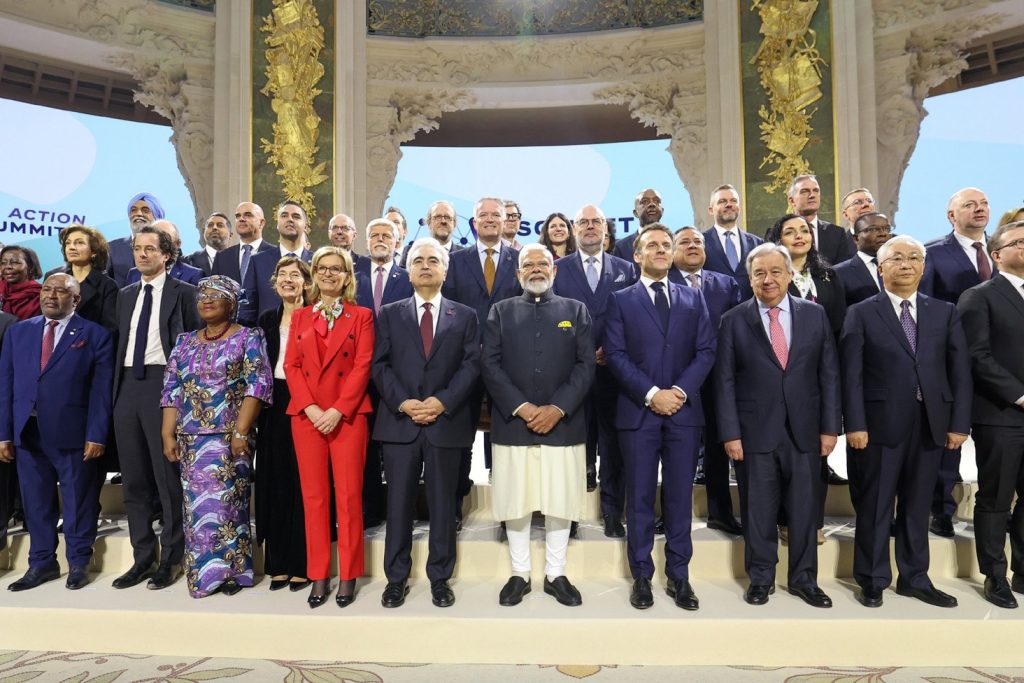
The AI Action Summit ran from 10 to 11 February 2025, the third in a series that began at Bletchley Park in 2023 and moved on to Seoul in 2024. President Emmanuel Macron and Prime Minister Narendra Modi co-chaired. Representatives from more than 100 countries came, drawn from governments, industry, academia and civil society.
Talks were organised around five themes: public interest AI, the future of work, innovation and culture, trust and safety, and inclusive global AI governance. Over 50 countries backed the Paris Statement, a shared vision for safe, inclusive and sustainable AI. The United States and United Kingdom did not sign. The summit also launched InvestAI, a set of funding mechanisms for public-interest AI projects, and pressed for wider access to computing power in developing countries.
Investment and media in India
The Global Investors Summit in Bhopal, Madhya Pradesh, ran on 24 and 25 February 2025. Agreements worth around ₹30.77 lakh crore were signed. More than 25,000 people registered, and delegates came from over 60 countries.
The first World Audio Visual and Entertainment Summit, WAVES, took place in Mumbai from 1 to 4 May 2025. Over 10,000 delegates and creators from more than 90 countries attended. Representatives from 77 countries adopted the WAVES Declaration, and the WAVES Bazaar helped close media and entertainment deals worth over ₹1,300 crore.
G7 and NATO
The 51st G7 Summit was held on 16 and 17 June 2025, with India attending as an outreach country for the sixth year running. Leaders adopted the Kananaskis Wildfire Charter and launched a Critical Minerals Action Plan meant to diversify supply chains. They also condemned transnational repression.
A week later NATO met at the World Forum in The Hague, the first NATO summit hosted by the Netherlands and the first Donald Trump attended in his second term. Secretary General Mark Rutte chaired.
The 5% pledge splits into 3.5% for core military capability and 1.5% for areas such as cyber security, infrastructure protection and the defence industry. Allies reaffirmed Article 5. Aid to Ukraine can now count toward national defence spending figures. Leaders also met partners from Australia, Japan, New Zealand and South Korea.
BRICS and the SCO
The 17th BRICS Summit, on 6 and 7 July 2025, was the first for Indonesia since it joined in January. Members backed Security Council expansion to give Asia, Africa and Latin America more seats, adopted a statement on AI governance, and called for a Gaza ceasefire. They condemned the EU’s Carbon Border Adjustment Mechanism as a trade barrier hitting exports such as steel and cement. India takes the chair and hosts the 18th summit in 2026.
The Shanghai Cooperation Organisation met in Tianjin, China, from 31 August to 1 September 2025, its first summit with all 10 members. Laos was given partner status, bringing the group to 27 countries. The Tianjin Declaration condemned terrorism, including the Pahalgam attack. Members also opposed unilateral sanctions and proposed an SCO Development Bank. Modi attended.
Sharm El-Sheikh
On 13 October 2025, three days after a ceasefire took effect in Gaza, a peace summit opened at the Sharm El-Sheikh International Convention Centre in Egypt. US President Donald Trump and Egyptian President Abdel Fattah el-Sisi co-chaired. Talks centred on peacebuilding, humanitarian relief and reconstruction.




