
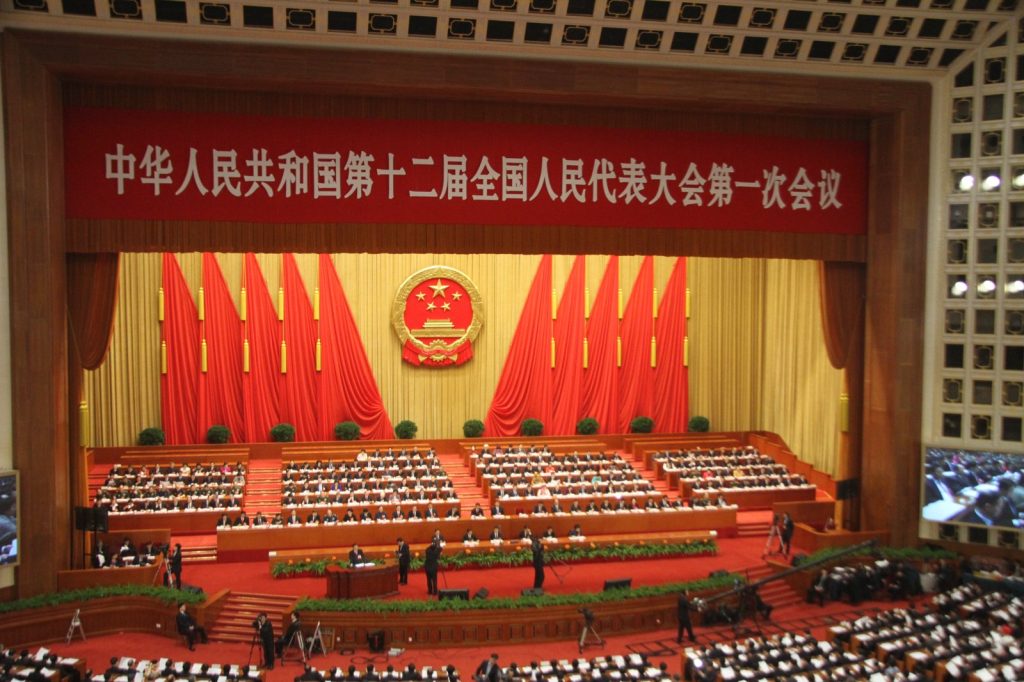
China’s Foreign Investment Law came into force on January 1, 2020, granting foreign enterprises equal legal status alongside domestic private and state-owned companies. The legislation, which the National People’s Congress passed in just three months, eliminates the previous requirement for foreign firms to form joint ventures with local partners.
Beijing has stated the law will open 120 additional sectors and replace three outdated statutes dating from the era when joint-venture mandates were standard practice. The 42-article measure formally ends the 1979 Sino-foreign Equity Joint Venture Law and its two companion laws, removing the obligation for foreign investors to transfer technology or share ownership with Chinese counterparts in most industries. A unified “negative list” system now determines market entry: any sector not appearing on the list is automatically accessible.
The Ministry of Commerce reports that foreign companies will submit a single online application and receive a business license within three working days, a process that previously required approvals at county, city, and provincial levels over several months. Ting Lu, Nomura’s chief China economist, described the simplification as “very exciting” during a January 3 press briefing.
“Previously, manufacturing companies have access to China. But for financial-service companies there are a lot of barriers. Now the Chinese government promised to take away most of these barriers in the next few years,” Lu stated.
He noted that wholly owned life-insurance ventures and majority-controlled brokerage houses should become possible by 2021, a change U.S. negotiators have pursued since the Clinton administration.
Remaining Restrictions and National Security Provisions
Despite the law’s ambitions, the 2019 “negative list” published on December 30 maintains 33 prohibited or restricted sectors. Foreign entities cannot operate online news portals, basic telecom networks, or public hospitals.
Private medical clinics face a 70 percent cap on overseas ownership, and publishing houses remain entirely closed to foreign investment. The law also permits China to invoke “national security” grounds to block any transaction, language resembling the opaque reviews that have historically targeted U.S. technology companies. Lester Ross, head of the American Chamber of Commerce in China, cautioned that the wording grants regulators considerable discretion.
“Our expectations are quite modest… The longest-standing issues in China do not concern an absence of legislation, but rather the lack of enforcement and the breadth of government discretion resulting in selective enforcement,” Ross wrote in a January 2 note to members. AmCham surveys indicate U.S. firms lost 41 percent of administrative court challenges last year, a record low that reinforces skepticism about the legal system’s reliability.
Intellectual Property Concerns Persist
The law reiterates Beijing’s commitment to protecting intellectual property but establishes no civil damages range, no criminal threshold, and no public deadline for implementing regulations. This ambiguity worries semiconductor and biotech executives who recall the 2018 Qualcomm fine and the forced transfer of 5G source code that preceded it.
The U.S. Trade Representative’s office reported in a December 9, 2019 briefing that 59 percent of American counterfeit seizures still originate from mainland factories. Economist Lu warned that without stronger intellectual property protections, the reform could lose momentum. “China is big and the growth rate is still around six percent. This is still the fastest-growing economy in the world.
And the economy is just so big that it will have a lot of business opportunities,” he said, adding that “better protection for intellectual property” is essential for sustaining those opportunities.
Geopolitical Context and Industry Reactions
President Trump’s Phase-One trade deal, signed on January 15, ties $200 billion in Chinese purchase commitments to the United States maintaining tariffs at 7.5 percent rather than raising them to 25 percent. The Foreign Investment Law represents Beijing’s initial contribution to that agreement, though Democrats in Congress argue the administration should have demanded binding enforcement mechanisms. Senate Finance ranking member Ron Wyden of Oregon characterized the law as “a glossy brochure with no refund policy” on January 7, urging U.S. Trade Representative Robert Lighthizer to require quarterly compliance audits.
American banks, insurers, and manufacturers have responded with cautious optimism, but industry groups warn that enforcement history, remaining sector bans, and vague intellectual property safeguards could still expose investors to risk. For U.S. companies, the calculation remains straightforward: the door is open, but the rules inside are still written in disappearing ink.
Firms must weigh the attraction of 1.4 billion consumers against the risk of becoming the next cautionary tale in a system where the referee owns the other team.




