
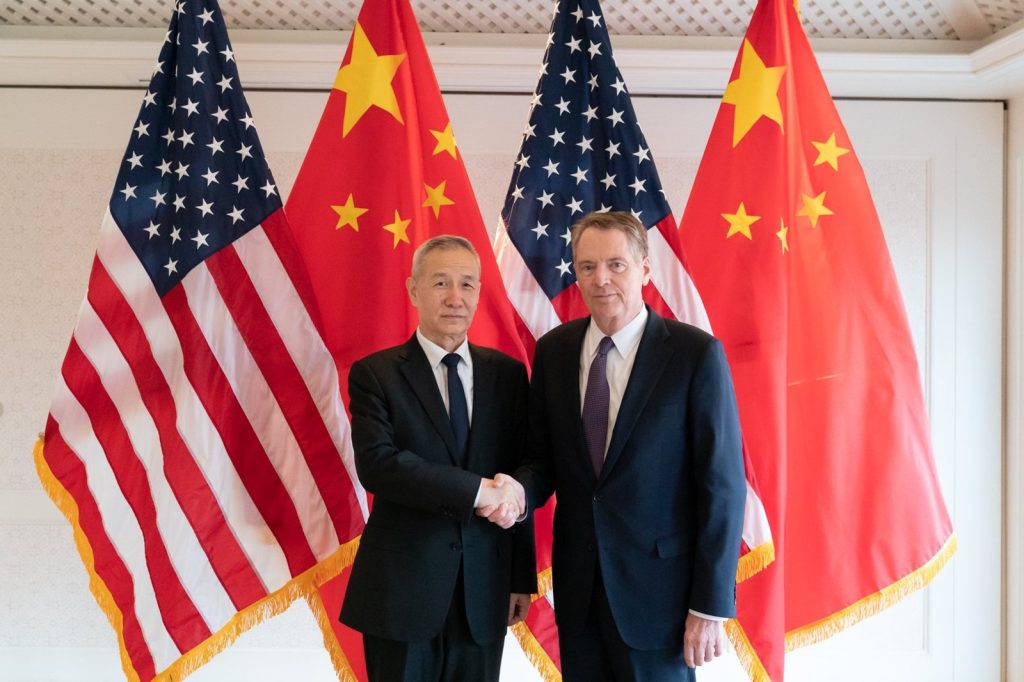
Two years of tariffs, threats, and tense negotiations boiled down to a single number: $200 billion. That is what China has agreed to spend on American goods and services over the next twelve months. The Phase One trade deal signed Wednesday morning in Beijing locks in that commitment.
It is the largest single infusion of foreign demand for U.S. products ever negotiated in a bilateral trade agreement. President Donald Trump and Chinese Vice Premier Liu He signed the document.
The ceremony capped a conflict that began in July 2018 when the administration first slapped tariffs on Chinese imports. American farmers took the worst of the retaliation. Soybean exports to China collapsed.
Pork shipments stalled. Grain silos in Iowa and Illinois filled up and stayed that way.
The $200 billion figure is meant to fix that. The agreement mandates purchases across several sectors. Agricultural goods are front and center.
Soybeans, pork, beef, and corn are expected to move again in volume. But the deal is not just about row crops. China will also buy liquefied natural gas and coal.
American-made aircraft, automobiles, and agricultural machinery are on the list too. That breadth matters.
The previous trade relationship was lopsided. The U.S. sold China a lot of soybeans and not much else. This deal forces diversification.
American energy producers get a guaranteed buyer. Manufacturers get a foothold in a market that has long favored European and Japanese competitors.
The machinery provision is particularly pointed. Chinese farms have been modernizing fast. American equipment makers—Deere, Caterpillar, their supply chains—now have a direct line into that upgrade cycle.
The agreement also addresses the structural disputes that started the trade war. Intellectual property theft has been a flashpoint for years. American companies accused Chinese firms of stealing patents, reverse-engineering products, and forcing technology transfers.
The Phase One deal includes enforceable commitments on IP protection. Currency manipulation is another sore spot.
Beijing has been accused of devaluing the yuan to make exports cheaper. The agreement sets rules for exchange rate transparency. Neither issue is fully resolved.
Phase One is exactly what it sounds like: a first step. The administration has framed it as a decisive victory.
The signing ceremony was designed to project finality. But the text leaves plenty of work for Phase Two and beyond. Tariffs on roughly $370 billion in Chinese goods remain in place.
Some were reduced as part of the deal. Most were not. For now, the immediate effect is psychological.
Global markets have been rattled by the trade war for eighteen months. Supply chains were disrupted.
Investment stalled. The signing restores a measure of predictability. Companies that put expansion plans on hold can start moving again.
Ports that saw container volumes drop can expect traffic to pick up. The $200 billion purchase target is ambitious.
China has never committed to buying that much from any single country in a single year. Whether Beijing can actually absorb that volume is an open question. The agreement includes enforcement mechanisms, but the details are not public.
What is clear is that the money is supposed to flow soon. The clock started ticking the moment the pens went down. American farmers are watching closely.
They have been the most visible casualties of the trade war. The administration paid out billions in farm bailouts to offset lost Chinese sales.
Those payments were never meant to be permanent. The deal offers a path back to commercial sales. If the $200 billion materializes, the bailouts can stop.
If it does not, the tariffs stay, and the cycle resumes. Wednesday’s signing was a ceremony.
The real test starts now.




