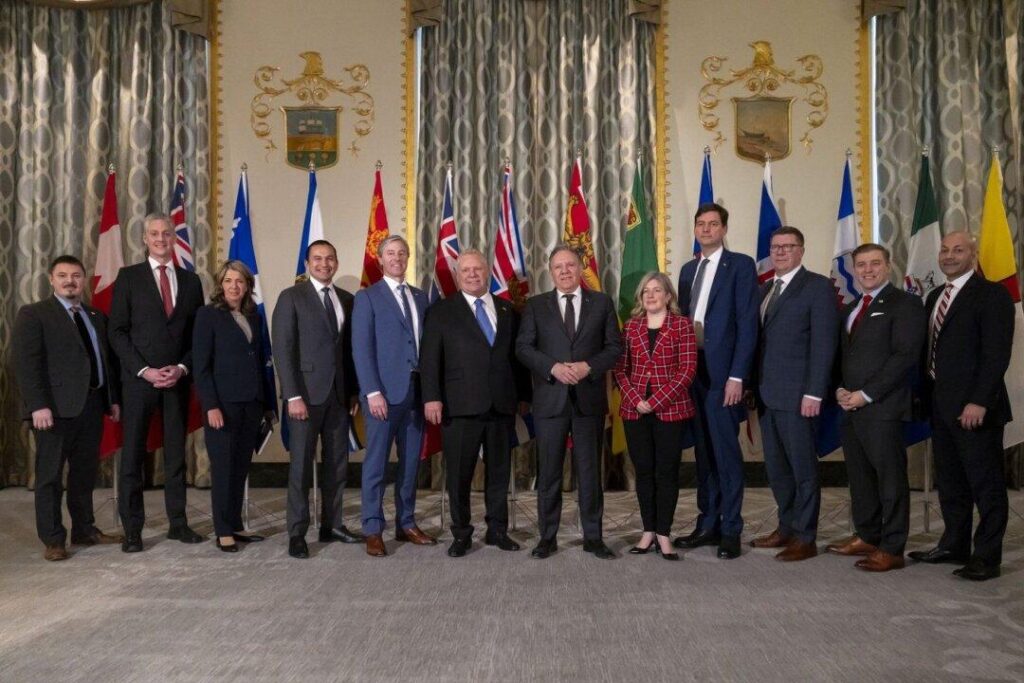
On December 5, 2003, in Charlottetown, Canada’s premiers signed their names to a new institution. They called the Council of the Federation “a new institution for a new era in collaborative intergovernmental relations,” and they chose a signing ceremony to launch it.
The Council brought together all thirteen premiers. They would meet at least twice a year, and the opening session was set for British Columbia on February 23-24. Technically, the arrangement was less novel than the language suggested. For 40 years the premiers had gathered in the Annual Premiers’ Conference, created in 1960 at the urging of Quebec Premier Jean Lesage. Before that, the first meeting of premiers dated to 1887, called by Quebec’s Honoré Mercier. In 2003 the old conference simply turned into the Council.
A Quebec idea, scaled back
The push came from Quebec. Daniel Johnson had floated the idea of formalizing the conference in 1994, but the Parti Québécois government that held office from 1994 to 2003 stopped the talk. The Quebec Liberals kept the idea alive. In 2001 they produced the Pelletier report, which proposed a body with Ottawa as a member, voting through a system of regional vetoes and sit beside the Senate. The authors even floated giving it constitutional standing someday.
After taking office in 2003, Premier Jean Charest moved at once. What emerged was far smaller than the Pelletier plan. Ottawa did not join. There were no regional vetoes. Decisions would be made by consensus, as in most intergovernmental bodies in Canada. One analyst at the IRPP, a Canadian policy institute, saw a gap between the founding agreement’s ambitious preamble, with its promise of “institutional innovation,” and the modest changes that followed.
What the premiers said it was for
The announcement listed three aims: closer cooperation among provinces and territories, leadership on issues of national importance, and relations between governments that honour the Constitution and accept the federation’s diversity. Officials described two themes for the work: more collaboration between provinces and territories, and more effective dealings with the federal government.
The premiers named two priorities for the start. One was health care reform and its sustainability. The other was strengthening the economic union through internal trade, labour mobility and streamlined regulation. A steering committee was told to set up a secretariat in Ottawa and draft a detailed work plan, which the Council would approve at its February meeting.
The first test
Health came first in practice, too. In the period after its creation, the Council spent most of its energy on bargaining over the 2004 health accord. Provinces and territories signed 10-year funding deals with Paul Martin’s Liberal government in Ottawa. The package lifted what Ottawa transfers for health by 6 percent every year. The IRPP paper treats it as an early victory, proof that a united front could pressure a prime minister.
Sources
- News Release: Premiers create the Council of the Federation (Council of Atlantic Premiers/CICS archive)
- Coming into Its Own? Canada's Council of the Federation, 2003-16 (IRPP)
- Coming into Its Own? (IRPP), continued