
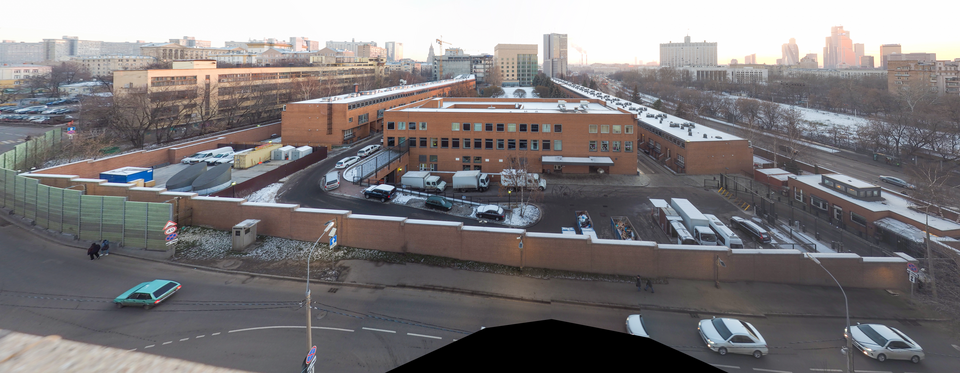
MOSCOW, July 21 — The United States Embassy in Moscow is a compound whose history reads like a Cold War thriller, but the plot has taken a distinctly contemporary turn.
Since June 2022, its official address has been Donetsk People’s Republic Square 1 — a move by Russian authorities that mirrors similar address changes imposed on Russian embassies in Prague and Washington, D.C. The previous address, Bolshoy Deviatinsky Pereulok No. 8, is gone, and so, on one side of the security perimeter, are the barriers between the street and the embassy wall. Construction fences there now carry vinyl posters supporting the Russian invasion of Ukraine.
The mechanics here are worth parsing. The address change and the removal of the barriers were not diplomatic niceties; they were acts of political theater. U.S. diplomats now work and live at a compound whose very street name — honoring a self-proclaimed republic not recognized by Washington — is a message.
The vinyl posters on the fences are another. The embassy compound, located in the Presnensky District across from the Russian White House and near the Moscow Zoo, was designed to be a self-contained American outpost.
Instead, it is increasingly an island.
A history of listening
On closer reading, the current tensions are merely the latest chapter in a long story of espionage and counter-espionage. The Soviet government irradiated the embassy with microwave beams from 1953 to 1976 — the so-called Moscow Signal. In 1964, covert listening devices were found.
Then, on August 26, 1977, a fire on the eighth floor destroyed or stole information; firefighters were suspected to be personnel removing sensitive material. The Existing Office Building (EOB) on Novinskiy Boulevard, which the embassy moved into in 1953 and which proved cramped, remains part of the compound today.
The construction of the current embassy compound in Presnensky began in 1979, after a decade of negotiations during Cold War détente. But the catch was that under a 1972 agreement, most of the compound was built by Soviet workers. Designed by Charles Bassett of Skidmore, Owings & Merrill, the complex was meant to be a self-contained American village with residences, a school, a shopping center, and office space.
Its red brick exterior was chosen for an American feel. But in 1985, the building’s columns and walls were found riddled with listening devices.
Construction halted. All Soviet workers were removed. In retaliation, diplomats were barred from occupying their new embassy in Washington, D.C. The standoff ended in 1994 when American workers partially dismantled and rebuilt the embassy, replacing the top three floors with four new ones.
The New Office Building (NOB) finally opened on May 5, 2000. Classified business was confined to the upper floors. An adjoining consular section opened on January 16, 2018.
The embassy has no consulates in Russia currently.
Follow the money — and the bugs
The pattern is consistent: the Soviet Union, and now Russia, has repeatedly used the physical embassy as a venue for espionage, political leverage, and information warfare. The 1985 bugging delayed the embassy opening by 15 years. The 2022 address change and barrier removal turned the embassy’s frontage into a propaganda display.
The United States was seen to have lost the upper hand in the 1972 agreement that allowed Soviet construction workers on site. The current situation suggests that pattern has not reversed.
Diplomatic relations between the United States and Russia began with recognition by Tsar Alexander I on October 28, 1803, formal establishment on July 14, 1809, and the first legation in St. Petersburg on November 5, 1809. The first U.S. embassy in Russia was established in St. Petersburg on February 11, 1898, with Ethan A. Hitchcock as ambassador.
From 1934 to 1953, the embassy was in the Mokhovaya House near the Kremlin. Now it sits in Presnensky, across from the Russian White House, in a compound that was supposed to symbolize a fresh start but has instead become a monument to mutual suspicion.
The vinyl posters are still up. The address has not been changed back. The microwave beams are off, but the listening never really stopped.
What comes next? With no consulates in Russia, the embassy in Moscow is the sole U.S. diplomatic presence in the country. Any further escalation — another bugging, another address change, another symbolic squeeze — will be felt directly by the diplomats inside the red brick walls.
On July 21, 2026, the compound stands as it has for years: a fortress, a target, and a mirror.




