
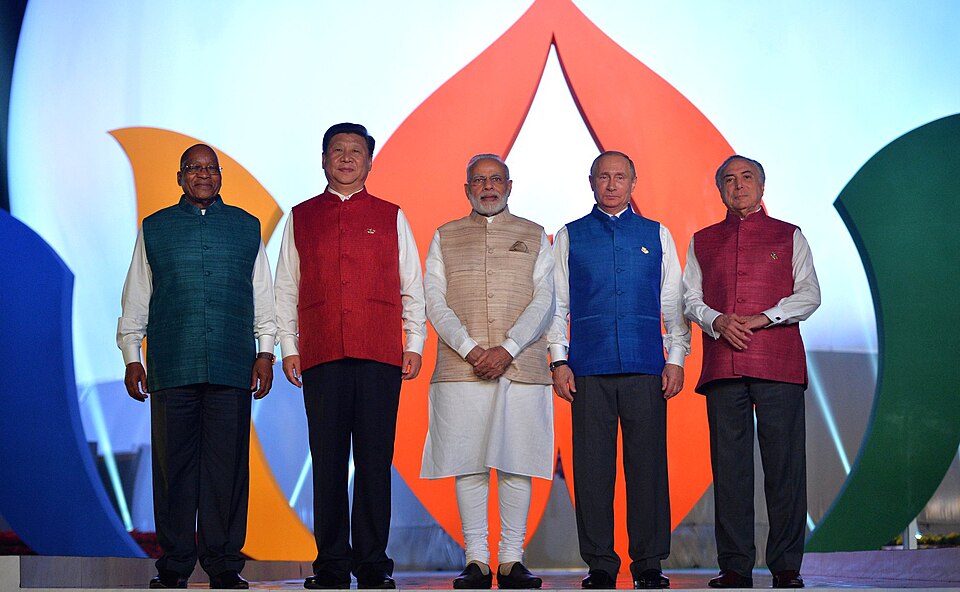
A BRICS member has been under attack for months, and has hit back at fellow members. This weekend they sat in the same room anyway.
India hosted the BRICS Leaders’ Summit in New Delhi on September 12 and 13, more than six months after the United States and Israel launched attacks on Iran, a member since 2024. The United Arab Emirates joined that year too, and Tehran and Abu Dhabi are on opposite sides of the war. Russian President Vladimir Putin landed in New Delhi on Friday morning. It was the bloc’s third attempt to find consensus on a conflict that has dominated attention and battered economies this year. At a foreign ministers’ meeting in India in May, no joint statement came out, because Iran wanted American and Israeli actions named and the UAE would not agree, said the analyst Imran Khalid.
What BRICS was for
The bloc of emerging economies was created to challenge the Western-led order: Brazil, Russia, India, China and South Africa, and more recently Iran, the UAE, Saudi Arabia, Egypt, Ethiopia and Indonesia. Nearing its 20-year mark, analysts say it has made the world more multipolar but has not built a coherent alternative to the West.
It grew out of the 2008 financial collapse and the failure of the World Trade Organization’s Doha Round. “Countries that were spearheaded to become the next ‘developed’ nations understood that their voice would be best heard if they organised themselves as a group,” said the Brazilian researchers Octavio Oliveira and Enzo Godinho of the University of Sao Paulo. It was built to challenge the US-led order, they said, but never to replace it.
Sean Burges of Carleton University in Canada put the shared motive bluntly. The two things uniting members are “a desire to make lots of money through international trade and to see an end to the preachiness of the ‘West’ about where they are failing in terms of rights and democracy.” He asked: “Why would the BRICS want to take on the global governance responsibilities of the G7 members?”
Weight and its limits
The numbers are large. Khalid says BRICS accounts for nearly half the world’s population, 40 percent of global output in purchasing power terms, 44 percent of oil production and about a quarter of world trade. The 11-member group is growing at about 3.7 percent this year against 1 percent for the G7, according to IMF figures. Yet its “leverage is weaker than the [BRICS group] size suggests,” he said. The New Development Bank had approved about $39bn by the end of 2024, “a few months of World Bank commitments,” and still raises most of its money in dollars.
The dollar is the sharpest limit. Most BRICS trade is still in dollars, and most members hold large dollar reserves. Guy Burton, a geopolitical analyst, said the dollar faces no serious challenge and is unlikely to for a decade. “The bloc as a whole is not moving off the dollar; individual members are reducing their own exposure, one relationship at a time,” Khalid said.
Burges points to real alternatives: Chinese development aid without conditions and Brazilian talk of direct central bank currency swaps. Oliveira and Godinho add that the New Development Bank is the first financial institution without Western countries, and that the 2024 additions of Saudi Arabia, Iran and the UAE strengthened the bloc’s hand in energy markets.
Too many voices
Expansion has widened representation but muddied the message. “It widens Global South representation but dilutes whatever coherent positioning the group had,” Burton said. “There’s no ‘one for all, all for one’ logic in BRICS.” Burges agreed: “All of the members want a greater say, but they absolutely do not agree on the message.”
Burton also doubts what the bloc would be challenging, since the idea of the West is “breaking down now, with the transatlantic relationship between the US and Europe fracturing.” Khalid’s verdict is that BRICS is a platform for autonomy, not a challenger. It has no common currency, no common tariff and no defence commitment. But it has given Global South countries more room to manoeuvre between Washington and Beijing, and perhaps, he said, become “a challenger to how cheaply the West can apply pressure to individual countries.”
Sources
- BRICS summit: Is the bloc truly challenging a Western-dominated world?
- What Is the BRICS Group and Why Is It Expanding? | Council on Foreign Relations




