
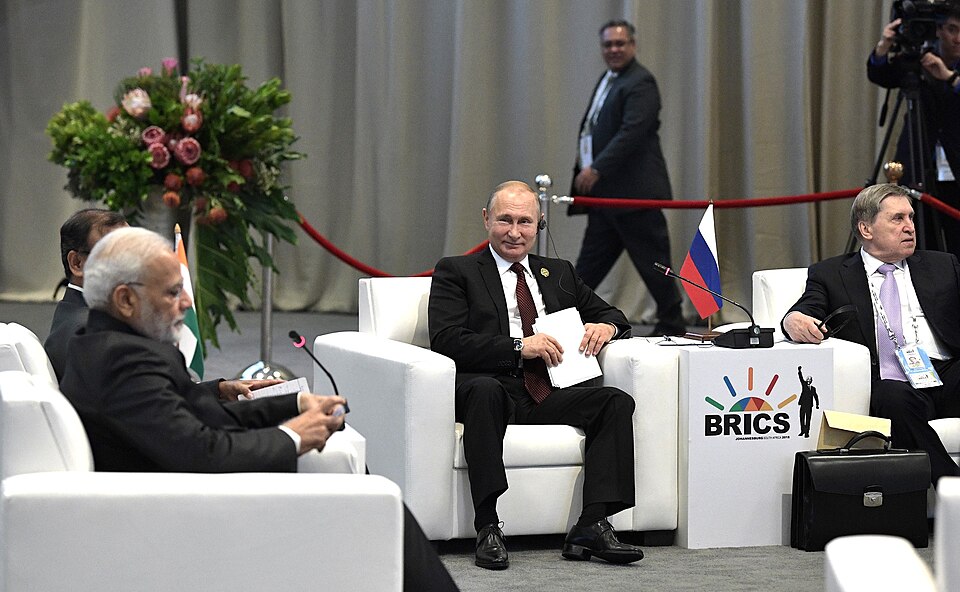
When the leaders of BRICS met at their September 2026 summit, the joint statement ran hot on local currencies and cold on specifics, and it set out no firm mechanism for settling trade outside the dollar. The one concrete instruction went to the bloc’s Payment Task Force, which was told to look for “practical solutions for cross-border payments.”
It named no common currency.
CNBC, examining the summit’s de-dollarization push, reported that members want to cut their reliance on the greenback because sanctions and Washington’s tariff politics keep biting, and because their own currencies keep losing value. The analysts it spoke to were, politely, unconvinced that the bloc can manage it.
The arithmetic explains the doubt. The Bank for International Settlements puts the dollar’s share of foreign exchange turnover at 89%, up one percentage point in a year, against 29% for the euro and 17% for the yen. Oil and gold, the two most traded commodities on the planet, are priced in dollars. For all the noise in the communiques, that plumbing has not moved.
South African President Cyril Ramaphosa told the summit that BRICS should “press ahead with greater use of local currencies, stronger cross-border payment systems and deeper financial interconnectivity.” Iranian President Masoud Pezeshkian went further, calling the existing order “vulnerable to political shocks due to its concentration on a limited number of currencies,” an argument that plays well in Tehran and Moscow, where American sanctions have already cut off dollar trading.
The obstacles are political, not technical
Jayant Krishna of the Center for Strategic and International Studies said the grouping simply lacks the shared institutions that could stand in for the dollar’s inherent liquidity and trust worldwide. Reema Bhattacharya, who leads Asia research at the risk consultancy Verisk Maplecroft, pointed at politics instead. “Russia and China now settle close to ninety percent of their trade in rubles and yuan,” she told CNBC, though she credited that shift to American sanctions after 2022 rather than to any coordinated BRICS design.
The deeper problem, in her words, is the “India-China rivalry, which I’d call the single biggest brake on cohesion across the bloc,” made worse by a widening trade gap between the two giants. Both governments want more strategic distance from Washington. Both remain direct competitors in manufacturing, technology and regional influence, and that sort of standoff rarely produces the trust a shared currency would need.
Washington, for its part, has drawn a line. President Donald Trump has threatened the grouping with tariffs if it moves off the dollar, demanding that members promise neither to create a BRICS currency nor to back a rival, “or they will face 100% Tariffs and should expect to say goodbye to selling into the wonderful U.S. Economy,” as he put it.
Small trade, big imbalances
The bloc’s own numbers argue for modesty. A United Nations Trade and Development report in March credited ten members with 27% of world output in 2024. Merchandise exports from the group made up 24% of the world total that year, and foreign direct investment inflows 22%. Yet trade between the members themselves ran at barely 5% of world commerce. “This brings fresh opportunities, avenues for cooperation and vast potential,” the report said, before making much the same point itself.
India’s position is the sharpest illustration of the dilemma. In the year to March 2026, its two-way trade with China set a record at $151.1 billion. New Delhi’s deficit with Beijing climbed to $112.16 billion, also a record, from $99.21 billion a year earlier. Commerce with the United States ran near $239 billion in 2025, leaving surpluses of $58.4 billion in goods and $4.7 billion in services. A retreat from dollar invoicing, as CNBC noted, does not favor a country that buys far more from its neighbors than it sells them.
Krishna Bhimavarapu, an APAC economist at State Street Investment Management, added that Russia and Iran, both squeezed by sanctions, want less dollar exposure, while China wants wider international use of the renminbi and keeps its capital controls in place. India, he said, backs a bigger role for the rupee. “Ultimately, no BRICS-led alternative currently matches the liquidity and market depth, credibility and global acceptance of the Dollar,” he said.




