
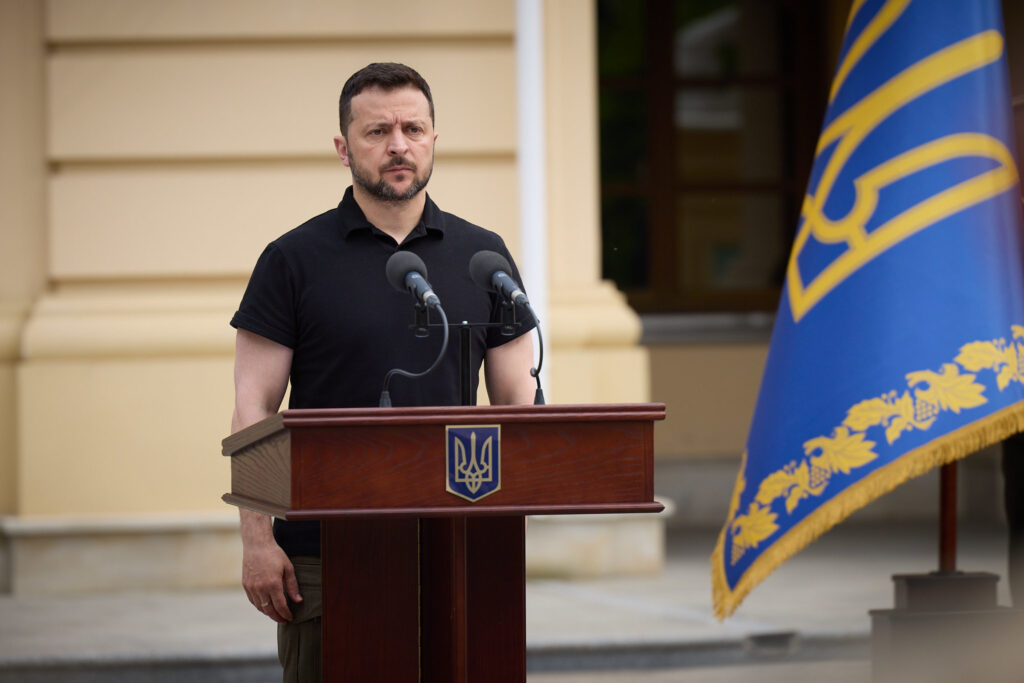
“Our guys tried to be a little more careful during these days. But they do not have an order.” Volodymyr Zelensky said that to journalists on October 27, 2026, when asked whether Ukraine had agreed to stop hitting Russian refineries. Three days later drones were over another one.
That exchange is the latest chapter in a campaign Zelensky has steered for more than two years, and the mechanics here are worth tracing from the start.
A rule set in February 2024
At a press conference marking two years of full-scale war, on February 24, 2024, Zelensky drew a line. Ukraine would not use weapons supplied by foreign partners to hit targets outside its borders. It would use “its own weapons on targets outside of Ukraine’s occupied territories.” The catch was that partners were wary anyway. Washington had delivered older ATACMS missiles with a 165-kilometer range in October 2023, and NBC reported that the Biden administration was weighing newer ones able to reach 300 kilometers. Germany’s Taurus stayed out of reach, held back over escalation fears.
So the deep strikes ran mostly on drones Ukraine made itself.
Ryazan, January 2025
On January 24, 2025, RFE/RL reported the largest Ukrainian air attack of that year. A Rosneft refinery in Ryazan burned. Russia’s Defense Ministry said it intercepted over 120 drones, 37 of them over Bryansk, and six over Moscow, according to Mayor Sergei Sobyanin. Vnukovo, Domodedovo and Zhukovsky airports suspended flights for a time.
The General Staff in Kyiv said it had also hit the Kremniy El plant in Bryansk, a microelectronics maker whose parts go into Topol-M and Bulava missile systems and S-300 and S-400 air defenses. Its statement promised that “such systematic and deliberate strikes on Russian military infrastructure will continue until Russia ceases its armed aggression.”
Counting the damage
Reuters, citing industry sources, put the scale in November 2025 at no fewer than 58 attacks on key Russian energy sites since early August, with drones flying as far as 2,000 kilometers. At least 17 major refineries had been targeted. Zelenskiy claimed gasoline supplies may have dropped by up to a fifth.
Russia disputed the effect. Its oil processing fell only 3% in 2025 by the Reuters count, because plants restarted spare units and repaired hit ones, often within weeks. Total capacity is about 6.6 million barrels per day. When strikes and maintenance took 20% offline between August and October, volumes still held near 5.1 million.
The strikes kept coming in 2026. On June 28, Zelensky wrote on Facebook that two Russian oil refineries had been struck by long-range drones. By July 29 he listed refineries, logistics sites, an export terminal and a naval base across Perm, Ryazan, Rostov and Crimea. Russian officials reported at least three deaths. Wildberries, Russia’s biggest online retailer, said fire damage at seven warehouses had cost it “about 10% of its storage capacity.”
The pause that wasn’t
On October 29 the Wall Street Journal reported that Kyiv had agreed to a pause under pressure from the Trump administration. Ukrainian officials told the Kyiv Independent otherwise. “Jared suggested that we not hit refineries for 30 days,” one said. “Nobody had given such an order.”
Within 24 hours drones hit the Novokuibyshevsk refinery in Samara Oblast, and the Ukrainian firm Fire Point later said its FP-1 drones did it. Zelensky, without claiming it, said on October 30 that every Russian strike on Ukrainian cities “always gets our fully justified response.” Russian Deputy Prime Minister Alexander Novak put it plainly: “We had a brief pause, but today, attacks on refineries have resumed.”
The only confirmed halt followed Trump’s “energy truce” announcement on October 11. It lasted roughly 72 hours.
Sources
- Zelensky: Western long-range weapons won't be used outside of Ukraine
- Russian Refinery In Flames After Largest Ukrainian Air Attack This Year
- Russia using spare oil refining capacity to offset Ukrainian drone damage, sources say (Reuters)
- Ukrainian long-range drones strike two oil refineries in Russia – Zelensky
- Ukrainian drone strikes on Russian infrastructure (Reuters via Georgia Today)
- Ukraine never agreed to pause strikes on Russian refineries, sources confirm (Kyiv Independent)




