
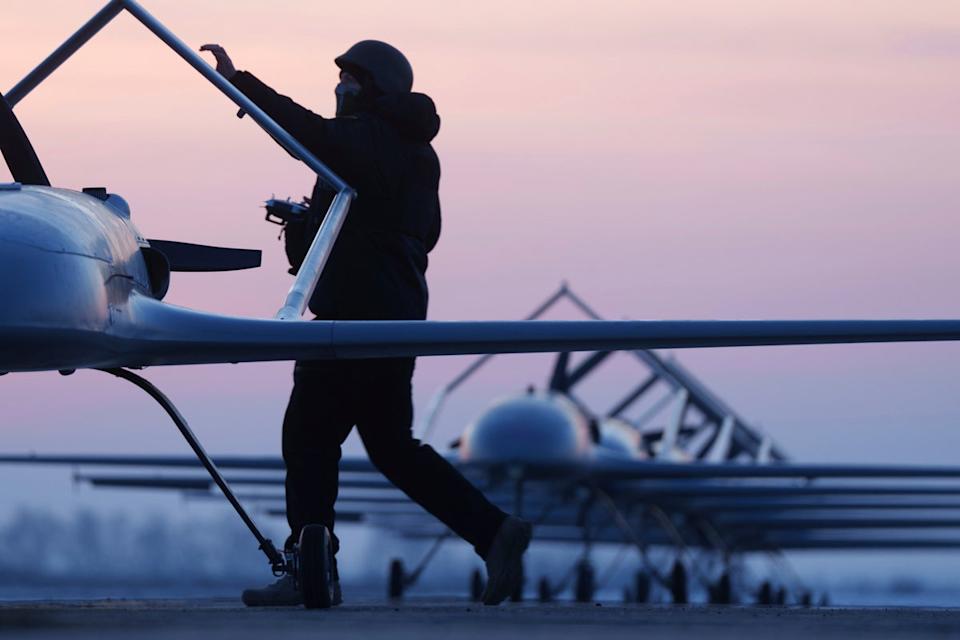
The test went wrong in late April 2023, off the coast of Odesa Oblast. A new Ukrainian drone carrying 50 kilograms of explosives had been ordered to dive onto a target on Snake Island. Its autopilot refused to fly the aircraft into the ground. It leveled off and turned for its programmed home point, which sat near the launch group.
Military leaders and the developers watched their own armed aircraft head toward the command post. Lieutenant General Mykola Oleshchuk ordered combat aircraft scrambled to shoot it down. Operators got the control signal back about 30 kilometers offshore, before that was necessary. The trials were secret, so no air raid warning went out to people on the coast.
The aircraft was the Liutyi, now Ukraine’s best-known domestic long-range strike drone.
From a requirement to a flying aircraft
In the first months of the full-scale invasion, Ukraine had almost no home-built way to hit Russian airfields, fuel installations or defense plants at ranges near 1,000 kilometers. It leaned on imported missiles, a limited stock of Soviet-era weapons, converted reconnaissance aircraft and improvised drones. Western governments also restricted use of many donated weapons against targets inside Russia, which gave Kyiv a reason to field something that needed no foreign approval.
Ukroboronprom announced the aircraft on 17 October 2022. It described a 1,000 kilometer range and roughly 75 kilograms of useful load, built against a requirement the Armed Forces raised that August. The announcement landed as Russia began using Iranian-designed Shahed attack drones against Ukrainian cities. It remains the only official performance specification ever published. Ukroboronprom later gave a conditional maximum of 1,200 kilometers. Figures of 1,500, 2,000 and 3,500 kilometers in circulation come from strike geography, intelligence statements or unattributed aggregation, not from a stated specification.
Ukrainska Pravda reported in May 2024 that the idea came out of a weapons meeting called by then Ukroboronprom director Yurii Husiev. Model aircraft specialists built the first fuselage with their own money, since formal financing was not yet available. The team first looked at a conventional armed drone, decided it could not compete with systems such as the Bayraktar TB2, and turned to a one-way aircraft with a range of about 1,000 kilometers.
It flew for the first time on 22 October 2022, five days after the announcement. A prototype crashed that December and was back on the runway within three days. Early takeoffs were rough: the nose gear let the aircraft drift off the centerline, and compass calibration errors skewed ground steering, so operators followed it in a vehicle at up to 150 kilometers per hour to correct its direction by eye. A 1,000 kilometer trial was completed in June 2023.
What it is, and what is not known
The aircraft is widely called the Antonov An-196, though Antonov has published no product page, brochure or development history for it, and no Ukrainian source has named a chief designer or a production plant. The most defensible description is a Ukroboronprom program commonly associated with Antonov.
It is a low-wing monoplane with twin tail booms and a rear piston engine driving a pusher propeller. Reported dimensions are 4.4 meters long and 6.7 meters in span, with a takeoff mass of 250 to 300 kilograms. No official data sheet confirms those numbers. The shell is glass fiber and epoxy resin, reinforced with metal mesh and plywood bulkheads, and it breaks down into a nose section with the warhead, a fuel and engine section, removable wings and a tail, which makes road transport and quick reassembly at dispersed launch sites possible.
Wreckage recovered by Russian forces points to an engine matching the German Hirth F-23, a two-stroke producing 50 horsepower, with an estimated commercial cost near US$5,000. That does not prove Ukraine uses imported German engines. Licensed production, local copies or a lookalike engine would fit the photographs equally well.
Early aircraft carried a 50 kilogram fragmentation warhead. After contact fuzes failed to detonate on impact, engineers moved the initiator to the nose of the fuselage. The payload was later raised by about 50 percent to roughly 75 kilograms, first reported around November 2024 and used against the Saratov refinery at a range beyond 600 kilometers. Reporting on a German-financed batch describes about 1,200 kilometers with a 50 kilogram payload.
That load cannot wreck a whole industrial complex. Its value lies in hitting a vulnerable component, such as a distillation column or a pumping assembly, where one hit halts production and the repair needs equipment that is hard to buy under sanctions.
Residents of Izhevsk filmed Liutyi aircraft flying without landing gear during the 1 July 2025 strike on the Kupol plant. Defense Express noted that fixed gear adds drag and shortens range, and suggested two explanations: gear that is jettisoned after takeoff, or launch from the roof of an accelerating vehicle.




