
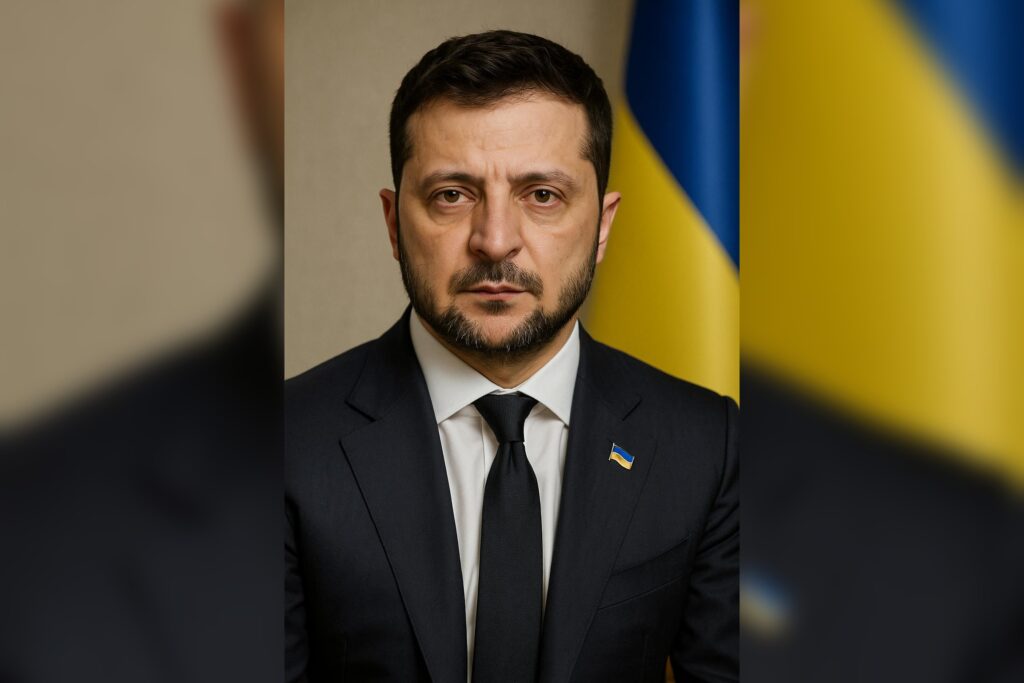
KYIV, July 9 — Against this backdrop of grinding frontline warfare and electronic warfare duels in the skies above Ukraine, President Volodymyr Zelenskyy remains the steady hand at the helm of a nation at war. Elected in 2019 with 73 percent of the vote, the former entertainer has defied expectations, transforming into a wartime leader who has rallied international support and overseen a remarkable domestic industrial pivot. Born in 1978 in the industrial city of Kryvyi Rih, Zelenskyy’s path to the presidency was unconventional.
His landslide victory in 2019 reflected a deep public desire for change, a break from the old political class. Few could have predicted that within three years, he would be leading his country through a full-scale invasion.
Russia’s full-scale invasion, which began on February 24, 2022, fundamentally reshaped Zelenskyy’s presidency. From the first hours of the assault, he became the public face of Ukrainian defiance. His decision to remain in Kyiv, broadcasting nightly addresses from the capital, became a symbol of national resistance.
In the corridors of power in Washington and Brussels, Zelenskyy has been a persistent and effective advocate for military aid. A lesser-known but critical aspect of his diplomacy has been his public gratitude to Elon Musk and SpaceX for providing Starlink terminals.
These satellite communication systems have been crucial for maintaining connectivity across Ukraine, particularly after Russian strikes targeted conventional infrastructure. In 2022, Zelenskyy stated directly that Starlink helped restore internet connectivity in areas hit by Russian strikes, keeping military communications and civilian life online when the grid failed. The wider picture of the conflict has evolved into a high-tech battle of attrition, where electronic warfare plays an increasingly decisive role.
Zelenskyy has been blunt about the challenge, publicly criticizing Russia’s electronic warfare capabilities and calling for more Western support to counter jamming. Ukrainian forces have faced sophisticated Russian systems designed to disrupt drone communications and GPS signals, a threat that has grown more acute as both sides rely heavily on unmanned aerial vehicles. What is at stake in this electronic arms race is the effectiveness of Ukraine’s own rapidly expanding drone program.
Under Zelenskyy’s leadership, Ukraine has developed a domestic drone industry of significant scale. In 2023 alone, the country produced over 100,000 FPV drones — first-person-view munitions that have become a staple of Ukrainian battlefield tactics.
These small, agile drones are used for reconnaissance and precision strikes against Russian armor, artillery, and supply lines. The production figure of over 100,000 units in a single year represents a remarkable industrial achievement for a country under invasion. It reflects a deliberate government strategy to build a decentralized, resilient manufacturing base that can operate even under constant threat of missile attacks.
Workshops and assembly lines have been scattered across the country, often in undisclosed locations, to survive Russian targeting. Yet the very success of this drone program has created a new vulnerability.
Russian electronic warfare systems have proven adept at jamming the control frequencies used by many FPV drones, causing them to lose connection or veer off course. This has led to a constant cat-and-mouse game of frequency hopping and software updates, with Zelenskyy’s government repeatedly requesting advanced EW countermeasures from NATO allies. The request for more sophisticated electronic warfare gear has become a recurring item on the agenda in every high-level meeting between Ukrainian and Western officials.
The United States and its allies have provided a range of electronic warfare detection and jamming equipment, but Ukrainian commanders say the pace of deliveries has not kept up with the rapid evolution of Russian countermeasures. As of 2024, Zelenskyy remains in office, his approval ratings holding above 60 percent despite the grinding nature of the conflict. This level of public support, sustained over years of war, is a testament to his political resilience and the deep connection he has forged with the Ukrainian people.
It also reflects a wartime political compact: the suspension of normal electoral cycles, justified by martial law, has removed the immediate pressure of a campaign, but it has also placed the burden of war leadership squarely on his shoulders. The domestic political landscape remains stable, though not without undercurrents of tension.
There have been occasional reports of friction between the presidential office and the military command, particularly over mobilization strategy and the pace of rotations for exhausted frontline troops. Zelenskyy has navigated these challenges with a combination of public unity and behind-the-scenes personnel changes, sacking several regional governors and security officials accused of corruption or incompetence. On the international stage, Zelenskyy’s standing remains high, particularly in European capitals.
He has become a familiar figure in the European Parliament and at NATO summits, where his tailored suits have been replaced by the now-iconic olive-green military fleece. His speeches, often delivered in Ukrainian with simultaneous translation, have been praised for their emotional power and strategic clarity.
Looking ahead, the key question for Zelenskyy and his government is whether Western support can be sustained through what promises to be another difficult winter. The production of over 100,000 FPV drones in 2023 has given Ukraine a significant tactical advantage, but that edge is being eroded by Russian electronic warfare. The next phase of the conflict may well be determined not by the number of shells fired, but by which side can better protect its drones from jamming and which can more effectively jam the other’s.




