
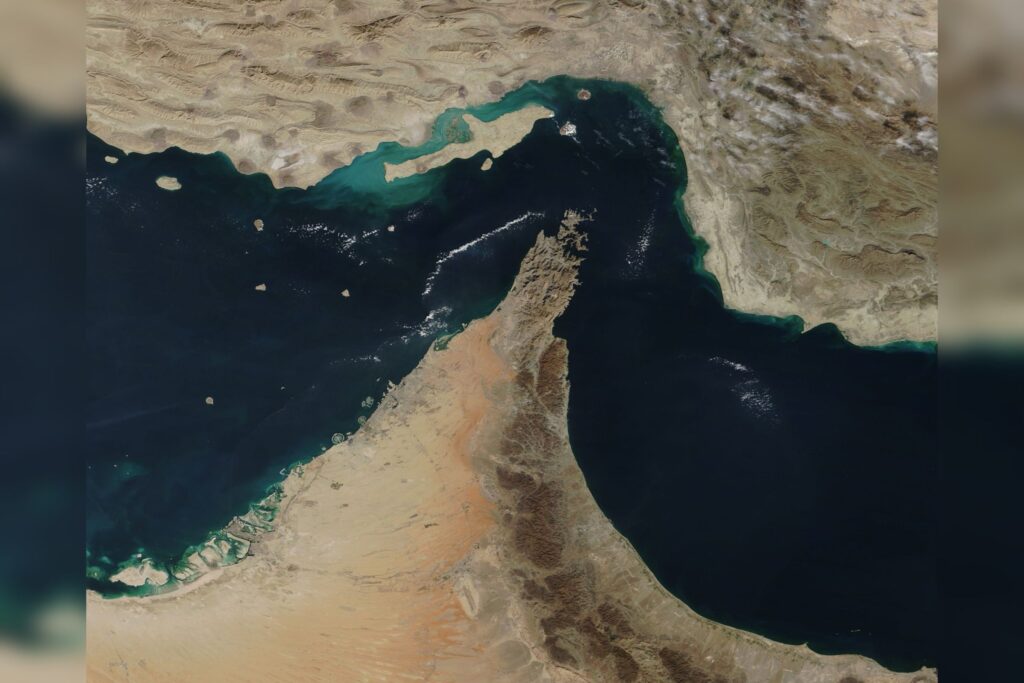
Twenty percent of the world’s oil passes through the Strait of Hormuz, and the United States and Iran disagree on what law governs it.
Washington treats the strait as an international waterway and nothing else. Tehran considers its half part of Iranian territorial waters. From that split follow the quarrels over Iran’s tolls on ships, which the U.S. calls illegal, and over President Donald Trump’s blockade of the passage, which Iran calls a “grave violation” of its sovereignty. A law of the sea expert laid out the two positions in The Conversation in April.
Two treaties, two answers
Both countries agree Hormuz is an international strait. They disagree on which kind. The UN Convention on the Law of the Sea, completed in 1982 and in force since 1994, has been ratified by 171 countries and the European Union. Iran signed it but never ratified it. The United States has done neither.
Iran points to older rules: the International Court of Justice’s 1949 ruling in the Corfu Channel case and the 1958 Territorial Seas Convention. Those give foreign ships a right of innocent passage. A ship that simply passes through, without harming the coastal state’s security, must be let through. Iran and Oman, the strait’s other bordering state, may set rules on safety and the environment and have wide discretion to rule a passage non-innocent. They may not impede innocent passage. Iran also claims the right to suspend passage through its half, which the 1958 convention it cites does not allow.
The United States argues that the convention’s newer concept of “transit passage” applies. Under it, bordering states must allow overflight and submerged submarines, so long as passage is “continuous and expeditious.” The U.S. backs the claim with regular Freedom of Navigation patrols through Hormuz and other straits. James Kraska, a professor of international maritime law at the U.S. Naval War College, has called Iran’s position “lawfare.”
Custom and objection
The U.S. position rests on transit passage being customary law, which would bind everyone. The U.S. is nearly alone in saying so. The United Kingdom, France, Australia, Thailand and Papua New Guinea take the same view. Scholars are split, and law of the sea specialists tend to say it is not custom.
Iran answers that, even if it were, it is a “persistent objector.” The record backs part of that. Iran and Oman both argued for innocent passage and against transit passage during the treaty negotiations, and Iran restated its stance when it signed in 1982. Tehran adds that because transit passage was bargained into the convention, only countries that ratify it can claim the right.
A July analysis
A separate analysis published in July says the strait is not “international waters” at all. It lies almost entirely within the territorial seas of Iran and Oman, which hold sovereignty subject to protected rights of navigation. Iran’s objection to transit passage, the author writes, never amounted to a claim that peaceful commercial shipping could be shut out. Under both regimes, ordinary commercial vessels have protected passage. The differences concern warships, submarines, military aircraft and how far a coastal state can regulate.
Armed conflict changes the question, the analysis says, by bringing in the law of naval warfare and neutrality. The open question it poses: what measures may Iran lawfully take in the strait after an attack aimed at its senior leadership and the survival of its government, launched without UN Security Council authorization, and what does it still owe neutral commercial shipping?
Sources
- Strait of Hormuz: Why the US and Iran are sailing in very different legal waters
- The Strait of Hormuz Is Not “International Waters”




