
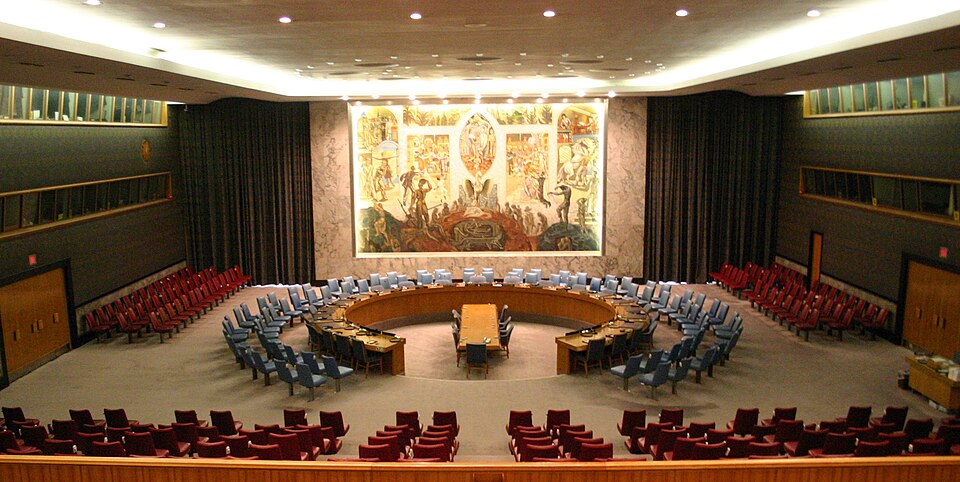
“More than 1,000 days have passed since the Russian Federation’s full-scale invasion of Ukraine,” Izumi Nakamitsu told the Security Council. The UN’s High Representative for Disarmament Affairs was speaking at a December meeting called to discuss Western arms supplies to Kyiv, a topic Moscow has pushed onto the agenda again and again.
Nakamitsu said the Council had last taken up the subject on 31 October. In the weeks since, she noted, the world had watched “unacceptable levels” of civilian deaths and injuries, along with what she called the “systematic and deliberate” targeting of Ukraine’s energy infrastructure. She cited the UN human rights office, which had recorded more than 12,340 civilians killed and over 27,836 injured between 24 February 2022 and 30 November 2024.
She also flagged reports that states were sending or planning to send weapons to Russia, and described growing military cooperation between North Korea and Russia, including North Korean troops deployed to the Kursk region. Cross-border Ukrainian strikes inside Russia, some reportedly damaging civilian objects, got a mention too. Her particular worries were explosive weapons in populated areas, cluster munitions, and announced transfers of non-persistent anti-personnel landmines.
Washington and Moscow trade charges
The United States, which held the Council presidency for December, spoke in its national capacity. Its representative said one permanent member was “openly, unashamedly” violating the UN Charter. He accused China of supplying dual-use items to Russia’s war industry, and so “telegraphs tacit approval for Russia’s war”. Then came the line about history: “Appeasement didn’t work then, and it won’t work now.”
The Russian representative told a different story. There would have been no war, he said, if Washington had not backed what he called the 2014 coup in Kyiv. Ukraine, in his telling, had become a “gold mine” for the military-industrial complex of “Anglo-Saxon countries”. He claimed the Pentagon had admitted that the whereabouts of more than half the Javelin and Stinger missiles sent to Ukraine were unknown. His closing advice to anyone hoping for a halt to the fighting was not to harbour “any illusions about the real intent of the comedian Zelenskyy”.
Ukraine’s representative said his country wanted the war to end more than any other. Russia, he argued, follows a routine: plan a strike, call a Council meeting, carry out the strike, then call another meeting to complain about Western weapons. He said that pattern had been registered in at least 18 cases. He also pointed to Vladimir Putin’s talk of a “high-tech duel” with the West, in which Moscow would hit Kyiv with medium-range ballistic missiles while Western air defences tried to stop them.
Other Council members
Most of the rest of the Council put the blame on Moscow. South Korea’s representative called the meeting irrelevant and said the world “knows the difference between an aggressor and a victim”. Japan’s envoy called the topic “shamefully familiar”. France described it as the “umpteenth meeting” requested by Russia and a “smokescreen”. Slovenia invoked Article 51 of the Charter and every state’s right to defend itself.
Several delegations focused on the weapons themselves. Guyana said Ukraine is now seen as the most-mined country in the world, with potentially 23 per cent of its land at risk of contamination and clearance costs above $34 billion. Mozambique and Ecuador urged exporters to avoid transfers where rights violations are a risk and to guard against diversion. Algeria asked both parties to keep long-range missiles out of the hands of criminals and extremists. Sierra Leone warned against escalation “in pursuit of the option of winning battles at all costs”.
China’s representative said weapons “may help win a war, but cannot bring about lasting peace”. He added that the United States was the only country to have turned a blind eye to Beijing’s efforts. Switzerland’s envoy noted that this was one of roughly 70 Council meetings on Ukraine, and repeated for the seventieth time that Russia must withdraw all troops from Ukrainian territory.
The British representative closed with a literary recommendation. This Christmas, he suggested, the Russian delegation should read Tolstoy’s “How Much Land Does a Man Need?”, the story of a man who exhausts himself acquiring land and ends up with a six-foot grave.




