
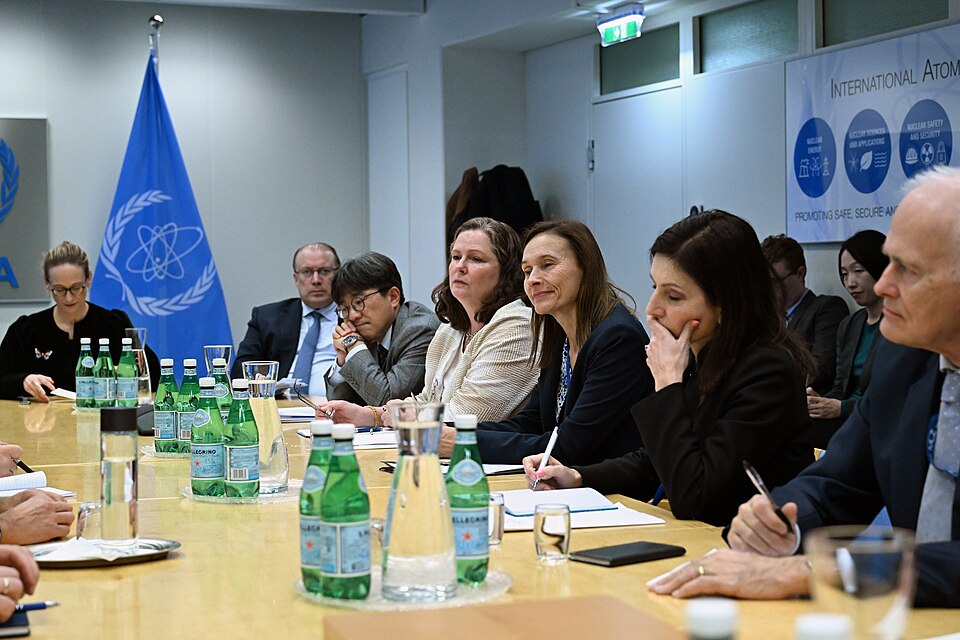
The board of the UN’s nuclear watchdog voted on Wednesday to send Iran’s case to the Security Council. It is the first time in 20 years the board has taken that step. The stated reason is Iran’s failure to cooperate with a long-running inquiry into uranium traces that inspectors found at several undeclared sites in the country.
The Associated Press reported that 23 of the 35 members of the International Atomic Energy Agency’s board of governors voted yes at the agency’s headquarters in Vienna. China, Russia and Niger voted no. Eight countries abstained. One did not vote because it was in arrears.
The United States, Britain, France and Germany put the resolution forward. It asks Director General Rafael Grossi to pass the text, together with earlier resolutions, to all agency members, the Security Council and the UN General Assembly. Al Jazeera quoted the document as noting “with grave concern” Iran’s “continued non-compliance with its obligations” and repeating its call for Iran “to urgently remedy its non-compliance.”
Tehran rejects it
Iran called the decision baseless. Anadolu Agency reported that Deputy Foreign Minister Kazem Gharibabadi said it rested on “fabricated” claims. “With these fabrications, you cannot compensate for the failure of your policies and actions, nor achieve any result in the Security Council,” he said. Iran’s mission tied the resolution to “criminal acts of aggression by the U.S. and Israeli regime.”
The European Union took the opposite view. Al Jazeera reported that it accused Iran of suspending its cooperation with the agency and refusing inspections of its nuclear facilities, and said it was “critical and urgent” for Iran to give the IAEA updated, verifiable declarations on the quantity and whereabouts of its nuclear material.
What it can and cannot do
The referral exposes Iran to possible sanctions and asset freezes. The AP said those are unlikely in practice. Russia and China, both allies of Tehran, hold veto power on the council.
Behind the vote sits a stockpile the agency cannot account for. Since the June 2025 strikes, the IAEA has been unable to verify Iran’s uranium enriched up to 60% purity. The AP reported that the agency puts the amount at 440.9 kilograms (972 pounds), enough for as many as 10 bombs if Iran decided to build them. Grossi cautioned that the number does not mean Iran has such a weapon.
Al Jazeera gave the agency’s estimate as about 400kg (881lbs) of highly enriched uranium. It added that inspectors have not been allowed back into Iran’s three nuclear facilities since the US and Israel attacked in June last year. Grossi told the board on Monday that the lack of information and the inability to verify the material were “a matter of serious proliferation concern.”




