
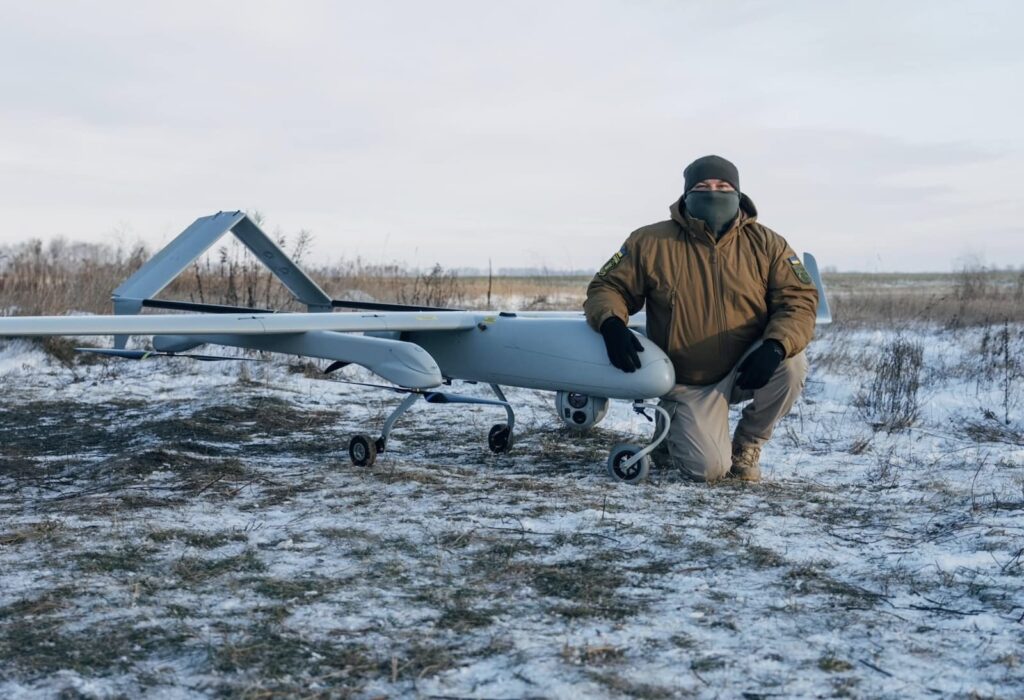
KYIV, July 7 — The strike on Omsk, deep inside Russian territory, has opened a new chapter in the long-range drone war, raising questions about just how far Ukraine’s domestic industry has pushed the boundaries of unmanned flight. The distance involved is the key. Omsk lies more than 2,000 kilometres from Ukrainian-held territory, a range that exceeds the known capabilities of most Ukrainian drones previously documented in open sources.
Against this backdrop, the attack suggests either a new model has entered service or an existing design has been substantially modified. What is at stake is the widening geography of the conflict.
For months, Ukraine has been developing a family of long-range unmanned systems, each extending the reach of its strike capability. The UJ-22 Airborne, produced by the private firm Ukrjet, has a range of up to 800 kilometres and can carry a payload of 20 kilograms. For longer distances, Ukraine has developed the ‘Bezpeka’ (Security) drone, which can fly more than 1,000 kilometres.
There is also the converted Aeroprakt A-22 light aircraft, a civilian design adapted for military use, with a range of up to 1,500 kilometres. None of these, however, comfortably covers the 2,000-plus kilometres needed to reach Omsk.
That points to the ‘Lyutyi’ (Fierce) drone, first reported in 2023, with a stated range of 1,500 to 2,000 kilometres. Even that figure may now have been extended, or a completely new variant deployed.
The technology behind the reach
These drones rely on a combination of navigation systems to find their targets over such distances. GPS satellite navigation provides the primary route, supplemented by inertial guidance systems that keep the drone on course even if the GPS signal is jammed. Some models also use satellite communication links, allowing operators to update the flight path mid-mission.
To evade Russian air defences, the drones fly at low altitudes, hugging the terrain to stay below radar coverage. They are launched from mobile platforms, which makes them difficult to track before launch and complicates any attempt to strike back at the launch sites.
The wider picture is one of rapid industrial expansion. Ukraine’s defence industry has ramped up production dramatically over the past year. According to Mykhailo Fedorov, the Minister of Digital Transformation, more than 200,000 drones were ordered in 2023 alone.
That figure covers all types, from small reconnaissance quadcopters to the long-range strike models used in operations like the Omsk attack.
Domestic production versus commercial conversion
The drones used in the Omsk strike are believed to be either modified commercial unmanned aerial vehicles or domestically produced models with extended range. This dual approach — adapting off-the-shelf civilian drones while also building purpose-designed military UAVs — has allowed Ukraine to scale up its capabilities quickly, without waiting for the lengthy development cycles typical of Western defence contractors. In the corridors of Ukraine’s defence ministry and among its private manufacturers, the emphasis has been on iterative improvement.
Each mission provides data on range, payload, and survivability, feeding back into the next generation of designs. The Lyutyi, first reported two years ago, may already be in its second or third iteration.
What comes next is the question. If a drone can now reach Omsk, the practical range for Ukrainian strikes has expanded to cover a significant portion of western Siberia. That changes the calculus for Russian logistics and command centres previously considered beyond the reach of Ukrainian attack.
The technology is still evolving, and the industrial base is growing. The next milestone may already be in development.




