
On April 13, 2022, the Russian cruiser Moskva, flagship of the Black Sea Fleet, “suddenly exploded in flames,” in HistoryNet’s account. By April 14 it was on the bottom. Ukraine said two Neptune anti-ship missiles had struck it on the port side. Russia first blamed a fire on board.
Popular Science reported that U.S. defense officials confirmed the Ukrainian missiles did the damage, and that the ship went down while under tow back to port. HistoryNet adds a caution: the exact number of missiles that hit is still disputed.
A Soviet design, rebuilt in Kyiv
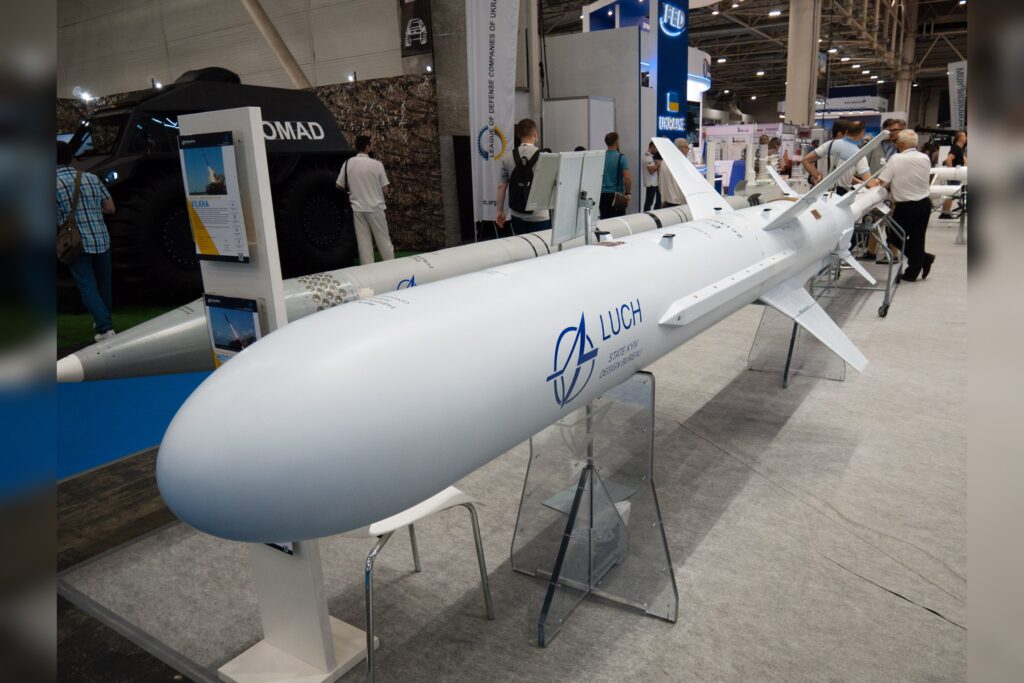
The Neptune did not appear from nowhere. Kyiv’s Luch Design Bureau built it on the Kh-35, a Soviet subsonic anti-ship cruise missile whose development began in 1972. Work started in 2013 and gathered urgency after Russia annexed Crimea in 2014. The missile was shown publicly at the 2015 Arms and Security International Exhibition in the Ukrainian capital.
Testing was slow. HistoryNet says trials ran from March 22, 2016 to April 6, 2019, and the Ukrainian navy accepted the weapon in March 2021. Popular Science counts nine years from concept to service.
Published numbers vary. Popular Science gives a range of roughly 186 miles and a 320-pound payload. HistoryNet says 190 miles and a 330-pound warhead. MiGFlug lists a 150-kilogram warhead and a range “usually given as more than 280 km.” All agree the missile flies subsonic and low. HistoryNet puts its cruising altitude at 10 to 15 meters, dropping to between 3 and 10 meters, which helps it slip under radar. Guidance combines inertial navigation with an active radar seeker.
Trucks that disappear
Launch is from the shore. Each USPU-360 truck carries four missiles, and HistoryNet counts six of them, with transport vehicles holding four more missiles apiece. The point of the trucks is speed. In Popular Science’s words, “the missiles can fire and the truck can be gone before any return attack hits.”
After the Moskva
Russia’s Black Sea Fleet responded by pulling back. It “moved further away from the Ukrainian-controlled coast, out of range of the Neptune missiles,” Popular Science wrote.
The missile has since gone onto land targets. MiGFlug reports that a modified Neptune reportedly destroyed an S-400 radar in Crimea in August 2023, and that from 2023 Ukraine built land-attack versions, including the Long Neptune. President Zelensky announced its first combat use on March 15, 2025: “A new Ukrainian missile, a precise strike. The distance – one thousand kilometers.” Ukraine claims a range of up to 1,000 km for it, and Russian forces call it the Neptune-MD.
Foreign partners have taken notice. Romania and Ukraine announced joint production plans in August 2024, and in June 2026 Luch signed a memorandum with MBDA to develop a Neptune 2.
Sources
- The Neptune missile that sank the Moskva, explained (Popular Science)
- The Neptune Anti-Ship Missile: The Weapon That May Have Sunk the Moskva (HistoryNet)
- Neptune Missile Explained: Ukraine's Cruise Missile (MiGFlug)




