
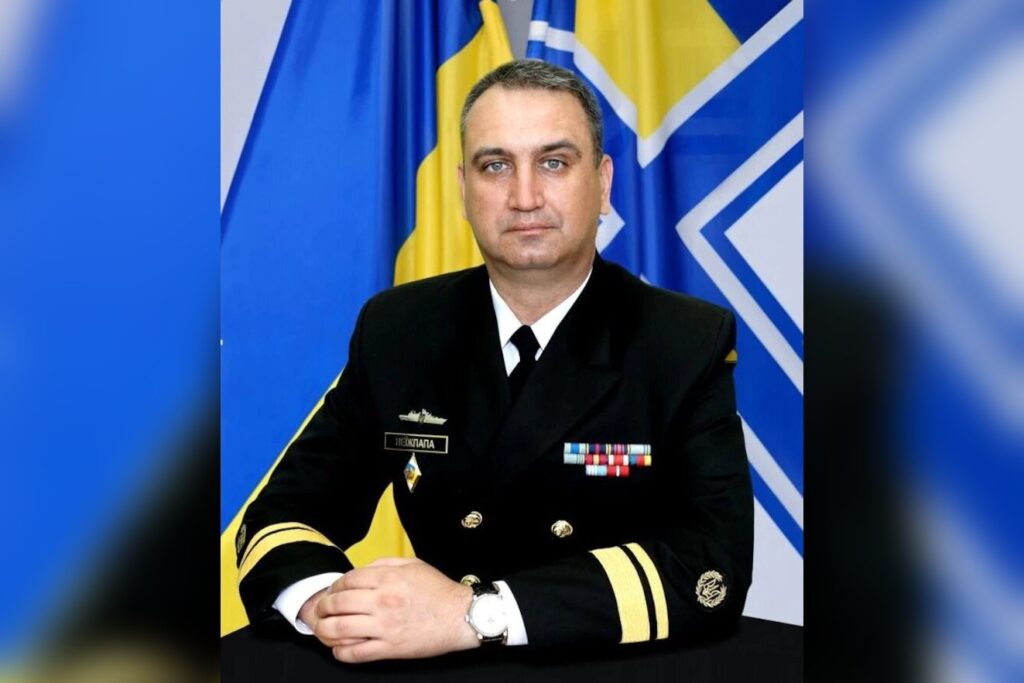
Vice Admiral Oleksiy Neizhpapa has run Ukraine’s navy since 11 June 2020, appointed by presidential decree, and his tenure maps the country’s naval revival. Born in Sevastopol on 9 October 1975, he led a force that pushed the Russian Black Sea Fleet out of the sea’s western waters, kept the grain corridor running and put shore-based Neptune missiles and naval drones to work. By the profile’s estimates, his command cleared upward of 70,000 square kilometres of the sea back to Ukrainian control.
The credentials were built the slow way. He entered service in 1992 and graduated from the Sevastopol Naval Institute in 1997, then served as an anti-aircraft battery commander aboard the frigate Sevastopol, with later postings to Lutsk, a corvette, and Cherkasy, a minesweeper, plus BLACKSEAFOR duty aboard the Slavutych. He ran the 1st Brigade of Surface Ships from 2008 to 2012, drilling it in NATO-standard exercises with blockade-and-ship-loss scenarios, then helped rebuild the fleet after 2014, when annexation stripped away most of its bases and hulls. From 2015 to 2019 he was deputy commander for combat training.
He inherited a force outnumbered roughly one to twelve. His answer had three parts: coastal missile systems, marine infantry prepared to fight ashore and afloat, and international cooperation. Sea Breeze exercises grew more practical under his watch, rehearsing landing defense, port protection and electronic-warfare conditions, and by 2021 his command had concluded a classic fleet battle against a stronger enemy was impossible.
Those paths defined the war. The flagship cruiser Moskva went down on 13 and 14 April 2022 after two shore-launched Neptunes struck it; two days later Neizhpapa received his vice admiral’s rank. Russian forces were compelled off Snake Island after months of fighting, reopening shipping in the north-western Black Sea, and October 2022 brought the first major naval drone attack on Sevastopol Bay, routes planned with knowledge of the bays he grew up beside. Through 2023 and 2024 came strikes on Crimean bases, destroyed landing ships and support vessels, and a working grain corridor. From 2025 the emphasis shifted to consolidation: Combat Boat 90 fast craft supplied by Sweden and Norway, Neptune modernisation and expanded unmanned units.
The doctrine underneath is compact. A numerically weaker fleet can hold the sea if it wins on reconnaissance, strike precision and decision speed; drones complement ships rather than replace them, striking where hulls would be sunk. The Western tie is institutional: meetings with the fleet commanders of the United States, Turkey, Romania, Japan and Norway, Black Sea security conference participation, and a stated preference for quality of personnel and technology over hull count. Analysts note the decorations, Bohdan Khmelnytsky orders of the third and second classes, and the standing result: a fleet rebuilt from almost nothing now contests its sea.
Sources
- Russia is attacking civilian ships—Ukraine is deploying additional units | Ukrainian News | LIGA.net
- Oleksiy Neizhpapa: Ukraine’s Naval Commander Who Changed Black Sea Warfare




