
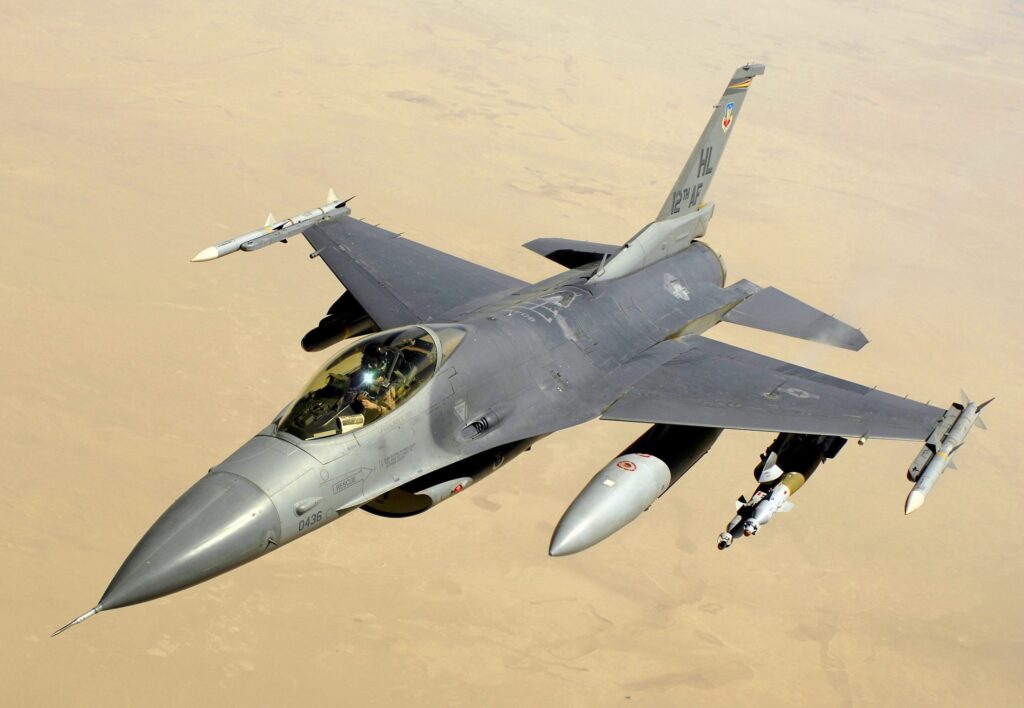
A new F-16 pilot needs up to nine months and close to ninety hours in the air before finishing the course, wrote Kristen D. Thompson, a U.S. Air Force military fellow, in a March 2024 piece for the Council on Foreign Relations. Ukraine’s air force flies Soviet-era MiG-29s and Su-27s, and Thompson described the F-16 learning curve as quite steep even for experienced pilots. The jet is only the visible part of the job.
Thompson’s warning was blunt. The F-16 will matter in the war only if Kyiv and its partners build the support and logistics system that keeps the aircraft flying.
A small jet with a long pedigree
Britannica traces the F-16 to a 1972 order for a lightweight, cost-effective air-to-air fighter. General Dynamics built it, and that business is now part of Lockheed Martin. The U.S. Air Force took its first delivery in 1978. Later models handle ground attack in all weather as well.
The airframe is 49 feet long with a wingspan of 31 feet (9.45 metres). One turbofan, Pratt & Whitney or General Electric, pushes it past twice the speed of sound, and a 20-mm rotary cannon sits alongside mounts under the wings and fuselage for bombs and missiles. Pilots fly it with a side stick through a fly-by-wire system, from a seat tilted back 30 degrees instead of the usual 13. The Air Force says it can take up to nine G’s with a full load of internal fuel.
Thompson calls it a fourth-generation fighter, one step behind the F-35 and F-22. Its radar and munitions let pilots engage targets at approximately one hundred kilometers (sixty-two miles).
The tail behind the pilot
The people on the ground are the harder part. Thompson put the figure at close to 250 maintainers for a typical package of twelve aircraft: mechanics, airframe specialists, crew chiefs, munitions loaders and aircrew life-support staff. Intelligence analysts and targeting experts build the mission packages. Firefighters and medics stand by at the airfield.
Training runs through several sites. The 162nd Wing of the Arizona Air National Guard, in Tucson, runs the U.S. foreign training unit for F-16 pilots, and Ukrainians were being instructed there. Centers in Romania and Denmark add NATO-specific flying fundamentals.
One engine brings its own risk. Because the F-16 has a single engine, unlike the two-engine MiG-29 and Su-27, worn or littered runways can damage it badly, Thompson noted. Thompson also expected Russia to want to hit any F-16 sitting on the ground for long, which calls for surface-to-air missile defenses near every operating base. Without the spare parts, equipment and crews, the jets could be grounded within months.
What Ukraine was promised
Ukraine asked for F-16s soon after Russia’s February 2022 invasion. The United States approved a third-party transfer from Belgium, Denmark, the Netherlands and Norway only in the summer of 2023. Those NATO states promised approximately sixty aircraft in all, with the first expected as early as June 2024, about when the first Ukrainian pilots were due to graduate.
Thompson expected the jets to intercept inbound Russian cruise missiles, support ground operations and keep Russian aircraft from flying close air support along the front. Their weapons include AGM-88 anti-radiation missiles, AIM-120 air-to-air missiles, small-diameter bombs and Storm Shadow cruise missiles.
Thompson’s verdict on timing: the F-16’s effect on the war should be measured over years, not months.




