
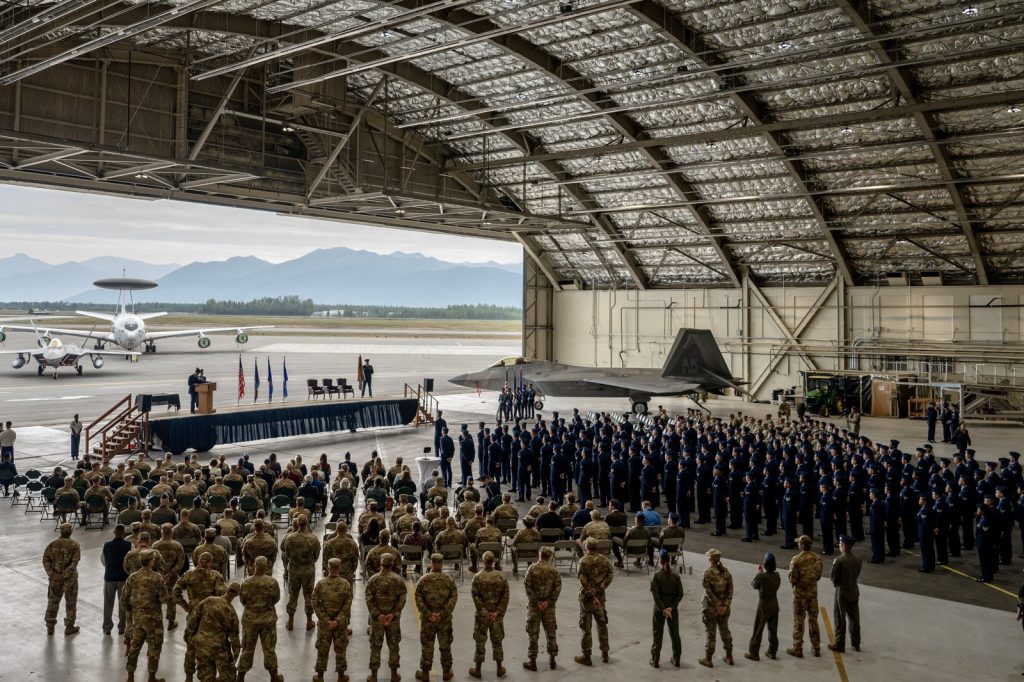
On August 15, 2025, President Donald Trump and Russian President Vladimir Putin met inside Joint Base Elmendorf‑Richardson near Anchorage, Alaska. The encounter marked the first time a Russian head of state set foot on a U.S. military installation and the first invitation extended by Moscow to a Western nation since the full‑scale invasion of Ukraine began in 2022. The two‑hour summit concluded without any announced ceasefire, framework, or signed document.
Yet the absence of a formal agreement does not diminish the strategic weight of the meeting. The discussion centered on the ongoing war in Ukraine, a conflict that has claimed tens of thousands of lives, displaced millions and reshaped security calculations across Europe.
In the hours after the talks, President Trump indicated that the responsibility for ending the war now rests with Kyiv, suggesting that Ukraine would need to cede territory to achieve peace. While no concrete terms were disclosed, the statement signals a shift in the United States’ public stance, framing any prospective settlement around Ukrainian concessions. Neither Ukrainian officials nor representatives were present at the Alaskan talks.
The International Criminal Court, which has issued an arrest warrant for President Putin on alleged war‑crime charges, does not have U.S. membership, allowing Trump to host the Russian leader without a legal obligation to detain him. Nonetheless, the optics of a man wanted by the ICC meeting the U.S. president on American soil—specifically on a military base—have drawn sharp scrutiny worldwide.
This was the first encounter between the two leaders since their 2019 meeting in Osaka and their 2018 summit in Helsinki. It also represented Putin’s inaugural visit to a Western nation since the invasion commenced, a fact that will be examined closely in Kyiv, Berlin, Warsaw and Beijing. Analysts note that while no breakthrough emerged—reflecting the tangled nature of the conflict and the opposing interests of the parties—the summit itself constitutes a notable development.
It demonstrates a willingness by the Trump administration to engage Russia directly, without preconditions such as the ICC warrant, and without an explicit peace blueprint. European allies that have supported Ukraine are now faced with questions about the durability and conditions of U.S. assistance.
The suggestion that Ukraine may be asked to trade land for peace introduces uncertainty about future American commitments. After the leaders departed, Joint Base Elmendorf‑Richardson returned to its routine operations, but the war in Ukraine continued unabated. The pressure on Kyiv appears to have intensified, as the United States’ post‑summit messaging places the onus on Ukraine to negotiate a settlement that involves territorial concessions.
In sum, the Alaska summit produced no public accord, yet it reshaped diplomatic signals. The United States has signaled a possible new direction in its approach to the Ukraine war, one that could compel Kyiv to consider concessions as a prerequisite for peace, while leaving allies to reassess the scope of American support.




