
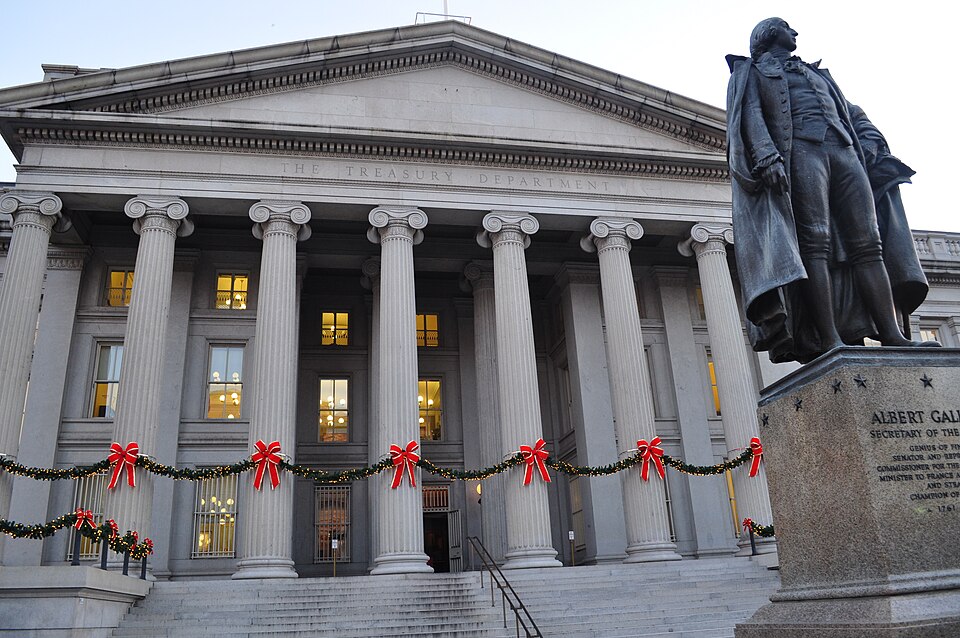
“Around the globe, our objective is to sever every economic lifeline that sustains this tyrannical regime until Tehran stands alone.” That was U.S. Treasury Secretary Scott Bessent at a news briefing on Monday, announcing a fresh round of sanctions on Iran.
Bessent called the campaign the “economic asphyxiation” of Iran. It arrives as the U.S.-Israeli war on the country nears the six-month mark and diplomacy sits at an impasse.
Who was hit
The Treasury listed nearly 60 individuals and entities. Washington says they help Iran earn money from oil, buy weapons and run cyberoperations. The targets stretch from the Middle East to China, Singapore and Europe.
The wider campaign aims at five sectors the U.S. says hold up Iran’s economy: digital assets, technology, gold, aviation and shipping. Bessent said his department has mapped the networks, middlemen and financial channels Iran uses to smuggle oil and dodge sanctions.
One of the biggest targets is a procurement ring of more than 20 people and companies in the Middle East and East Asia. The Treasury accuses it of getting sensitive technology to Iran for nuclear research and ballistic missile work. In its words, the network used “front companies, covert financial channels, and logistics intermediaries” to hide who the real end users were.
Iran’s Ministry of Intelligence and Security and its Ministry of Defence and Armed Forces Logistics are on the list, along with groups tied to them. Three individuals linked to the intelligence ministry, Mohammad Hossein Aslani, Reza Kadkhodai and Arman Kahzadian, are accused of cyberactivity.
Hong Kong accounts for about a dozen of the sanctioned entities. Among them, Sweet Ocean Industrial Ltd is accused of passing sensitive equipment to Malek Ashtar University of Technology in Iran. At the centre of that web is Shenzhen Sweet Ocean Technology Ltd, a Chinese supplier of test instruments and lab devices, whose director Tian Jianbai was also named.
Oil and shipping drew a lot of the attention. Shipoil Ltd, registered in Hong Kong, is accused of arranging bunkering for tankers carrying Iranian crude for sanctioned buyers. Singapore-registered Azure Shipping Pte Ltd was singled out for its work with the National Iranian Tanker Company, and its former owner Mansoor Tayabbhai Gandhi was sanctioned too. Two brokers based in the UAE, Mohammad Ahmed Suhil Fattouh and Ivan Obukhov, are accused of serving Iranian shadow fleets.
What was left out
Chinese financial institutions suspected of helping Iran’s oil trade were among the most notable omissions. Bessent would not say which countries could face secondary sanctions or when. Washington would give countries and companies time to cut ties with Iran, he said. “Why would I want to blow up the global financial system?”
China has bought more Iranian oil than anyone for several years, and Al Jazeera noted that Beijing is a major supplier of critical minerals.
Reaction
Iran’s Economy Minister Ali Madanizadeh said the measures will fail. “US sanctions against us are not new,” he was quoted as saying by the Fars News Agency, adding that Washington cannot reach its goals “by severing the arteries of our economy.”
Government spokeswoman Fatemeh Mohajerani said Iran does not deny the economic hardships but will get through them. A researcher at the Centre for Strategic Studies in Tehran, Ali Akbar Dareini, told Al Jazeera that Iran “has a PhD in circumventing sanctions.”
China’s Foreign Ministry spokesman Lin Jian said Beijing firmly opposes illegal unilateral sanctions and “will take all necessary measures to firmly safeguard its own rights and interests.”
Iran has lived under U.S. sanctions since its 1979 revolution. The U.S. withdrew from the 2015 nuclear deal in 2018 under Trump and reimposed penalties on Iranian oil exports, shipping and finance.




