
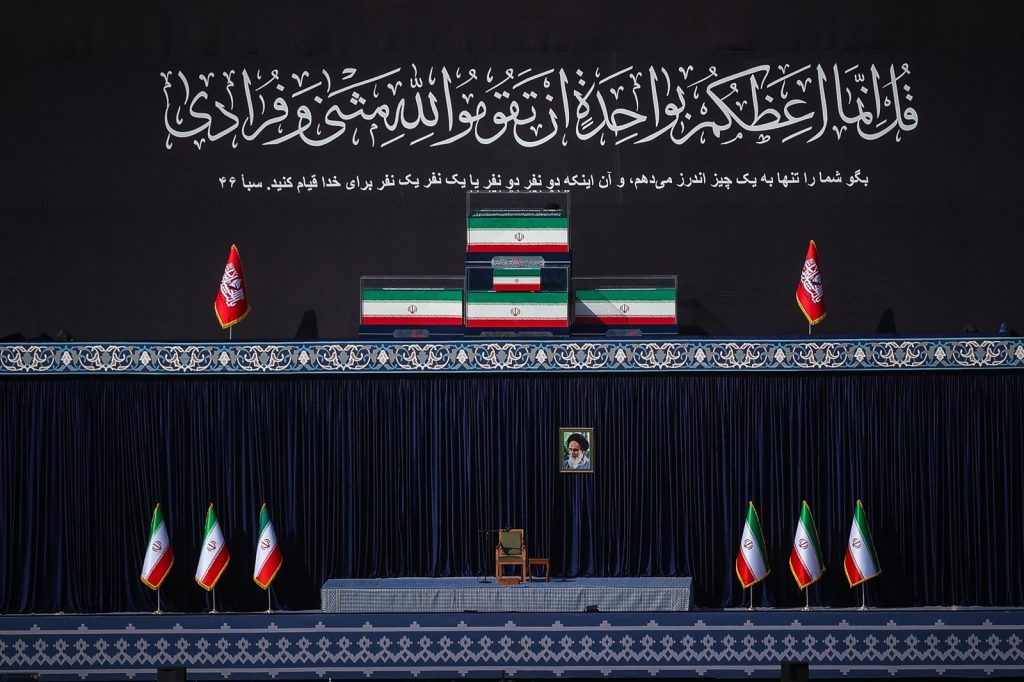
Tehran, Saturday. Ayatollah Ali Khamenei, killed on February 28 in the US-Israeli strike that opened the war with Iran, is being mourned in public: his coffin and those of four family members killed in the same attack are laid out at the Imam Khomeini Grand Mosalla, according to Iranian semi-official media, as ceremonies expected to run for days began in the capital.
The scene, per footage from the semi-official agency IRNA: crowds pressing to pay respects at the mosalla, prayers carried over a tannoy, mourners gently waving the national flag. The Health Ministry, quoted by the semi-official Tasnim agency, was blunt about the scale: “Our estimate is that over the next two to three days, around 15 million people will participate in the farewell and funeral ceremonies,” it said. It offered no method for that figure, while noting a month of preparations, temporary hospitals near the site, medical teams on “full standby”, and further ceremonies planned in Qom and Mashad.
One hard measurement already exists. Tehran’s metro recorded more than 2.2 million trips from 5:30 in the morning until 3 in the afternoon on Saturday, the city’s metro authority reported to the semi-official Fars news agency. Whether 15 million materialise across the country is another matter; the ministry did not share its arithmetic.
On the timeline, the stranger fact is who has not appeared. Mojtaba Khamenei, the son who succeeded his father as supreme leader, has yet to make a public appearance, feeding doubts about his health and questions over who is actually running the country. He is believed wounded in the strike that killed his father along with his mother and his wife, and has stayed hidden since the war began, reaching supporters only through written statements. No plans have been announced for him to appear at the funeral. State-linked media had spent recent years styling him an “ayatollah”; observers read the elevation from the rank of hojatoleslam as continuity insurance backed by hard-line power centres close to the Revolutionary Guards, at a moment when the constitution still requires a senior jurist as leader.
The perimeter, meanwhile, is military. The Revolutionary Guards have warned against any attempt to target Iran in the coming days, and President Donald Trump said the US is giving Iran “a week off” for the funeral. In a phone call on Friday, Trump and Benjamin Netanyahu agreed to meet in Washington, the Israeli prime minister’s office said, a meeting Trump told Axios could come as early as next week, after a NATO summit in Turkey on July 7-8. Of Netanyahu, Trump offered that he “knows who the boss is”. Even the waterway is edgy: tracking data showed at least eight ships U-turning out of the Strait of Hormuz on Saturday after trying the passage by hugging the Omani coast.
A funeral sized for a founder, a successor no one has seen, a war still running: the ceremonies are set to continue across the country, and the crowd count is the one number the state is eager to publish. What it is not showing is the man meant to inherit the office.
Sources
- July 4, 2026 – Public mourning of Khamenei | CNN
- Fmr. Iranian leader Ali Khamenei's week-long funeral begins second day in Tehran | The Jerusalem Post




