
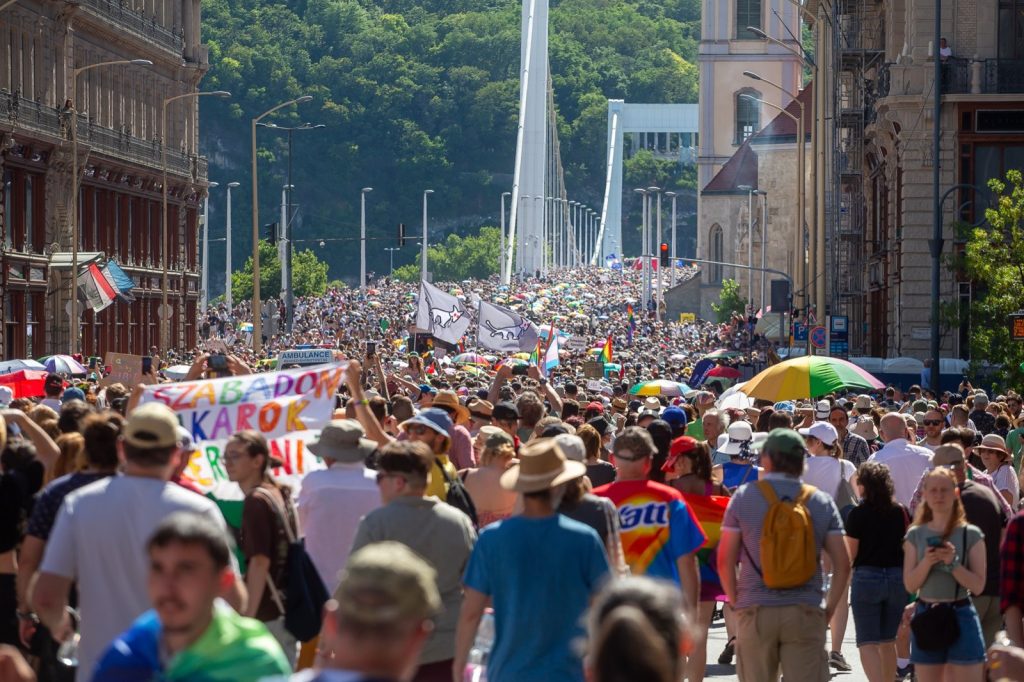
Organisers handed out water bottles, and the city opened public fountains along the route. By Saturday afternoon the temperature in Budapest had reached at least 38 degrees, in a record-breaking heatwave across much of Europe. Thousands marched anyway.
It was the 31st Budapest Pride and the first since Viktor Orban was voted out in April. Irish Times reporting described tens of thousands of people; Reuters, as relayed by a Montenegrin outlet, put the figure at more than 10,000. Marchers set off from the opera house, wound through the city centre and crossed the Erzsebet bridge over the Danube. They danced, carried large rainbow and European Union flags, and waved them at the heat.
A year after the ban
Orban’s nationalist-populist government had passed a law and a constitutional amendment a little over a year ago to outlaw the event. Human rights groups and politicians across the EU criticised the move. Pride went ahead regardless. Organisers estimated that last year’s march, held in defiance of the ban, drew more than 350,000 people, the biggest in Hungary’s history, and it turned into a mass anti-government protest.
This time police authorised the march and provided security along the route. Peter Magyar’s centre-right Tisza party beat Orban in April, but the new government has not repealed the Orban-era legislation that outlawed Pride.
Luca Uj, at her third Pride, saw the difference in the crowd. “There used to be a lot of tension. But now I see people as being somehow happier, and there are more older people, too,” she said.
What marchers want next
Fanni Fajth, an 18-year-old student, said people were far more optimistic. She hopes for expanded rights in the future, including adoption and marriage. “It would be wonderful if, finally, after all these years, we had equal rights,” she said.
Orban had cast himself as a defender of Christian values against Western liberalism. His governments ended legal gender change on personal documents, barred adoption by same-sex couples and restricted school materials seen as promoting homosexuality or gender transition.
Mate Tarnai, a 51-year-old chemist, put it plainly: “The biggest change is actually the political change in the country. We feel more personal freedom, and the atmosphere in the country is much more relaxed than last year.” He expects Magyar’s government to deliver equal rights for the LGBTQ+ community. Magyar himself, a conservative, has asked for patience when Hungarian media asked whether he would change the restrictive laws.
Kristof Gyorgyi, who came from Szeged in the south for his first Pride, pointed to Parliament. “The fact that there’s already a debate in Parliament about whether an orphaned child is better off with a same-sex couple or in an orphanage is a positive sign,” he said. “Obviously, the laws haven’t changed yet, but there are already many signs of hope for our community.”
Boglarka Boruzs, a 23-year-old translator, said the biggest shift for her was that LGBTQ+ people now feel safer and more accepted day to day. “Politicians have the power to help society understand that it’s perfectly okay to be gay,” she said.
In April, the EU’s highest court ruled that a 2021 Hungarian law banning LGBTQ+ content for minors violates EU law and a foundational treaty on human rights and equality.
Sources
- Hungarians turn out in thousands for first Pride march since Viktor Orbán was voted out
- Thousands of Hungarians participate in first Pride Parade in Budapest since Orban's election defeat




