
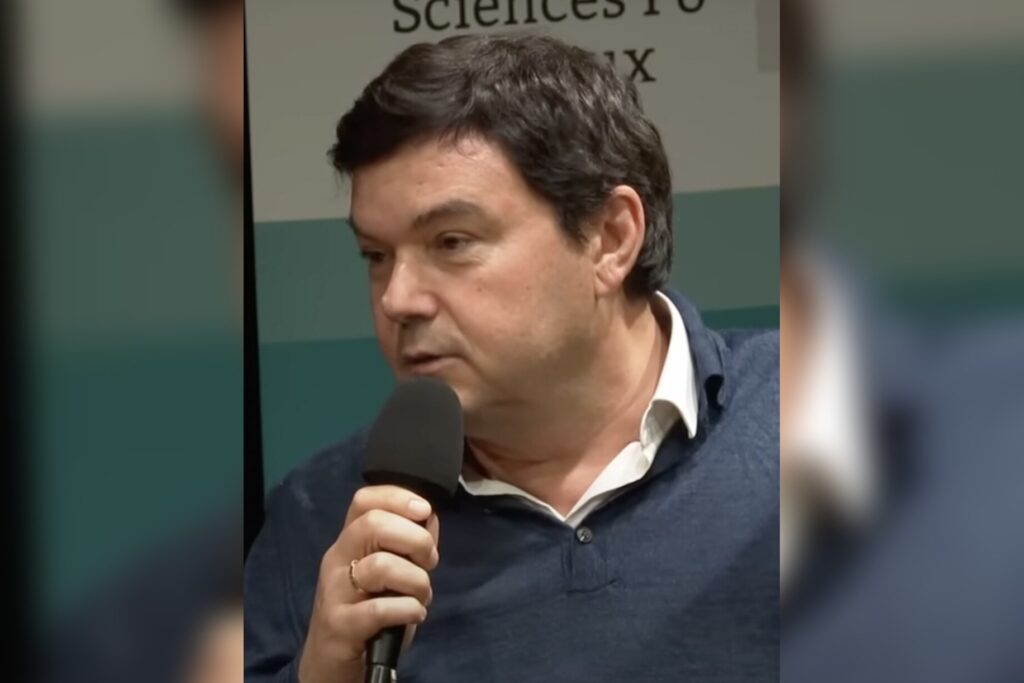
“Very different levels of wealth and social status in my family.” That, Thomas Piketty told the Irish Times, is where his interest in inequality began. His parents turned their backs on wealthy Parisian circles after 1968 and raised goats instead.
Against this backdrop, the French economist went on to build one of the most-discussed bodies of work on who owns what. He earned his PhD at the London School of Economics with a thesis on wealth redistribution. Early honours came quickly: the prize for best young economist in France, later the Yrjo Jahnsson Award.
Between the lecture hall and politics
Piketty is a professor of economics at the School for Advanced Studies in the Social Sciences (EHESS) and the founding director of the Paris School of Economics. He also co-directs the World Inequality Lab. The lab’s World Inequality Database is, in the words of one profile, “an open-access website that includes data series on income inequality for more than 100 countries.”
He has not stayed in the seminar room. Piketty has advised socialist and labor parties in France and Britain. He counselled the former Labor leader Ed Miliband on progressive tax rates and worked on Benoit Hamon’s campaign team while the EU’s Fiscal Stability Treaty was being handled.
The books and the argument
Three titles carry the argument: Capital in the Twenty-First Century (2013), Capital and Ideology (2020) and A Brief History of Equality (2022). The first became an international bestseller, and the Irish Times notes it examined wealth inequality across 20 countries. The common thread is that the distribution of wealth follows political choices rather than purely economic forces, and that progressive taxation is the tool to correct it.
At 55, he still pushes that case. His team’s latest report proposes average monthly incomes converging to 5,000 euros per person globally by 2100, halved working hours and reforestation, with a wealth tax on the richest 1% paying for the shift to zero carbon emissions. On climate he was blunt: “Right now, with the kind of climate investment that we are making, our baseline projection for global warming is above four degrees in 2100.”
He has also turned on Ireland. Its tax model, he said, rests on “fake accounting of international corporations booking their profits in Ireland with economic activity which, in fact, is not happening in Ireland.” The cost lands elsewhere: “For one euro of extra wellbeing that you bring to Ireland…you are imposing 10 or 20 or 30 euros of damages to other countries.”




