
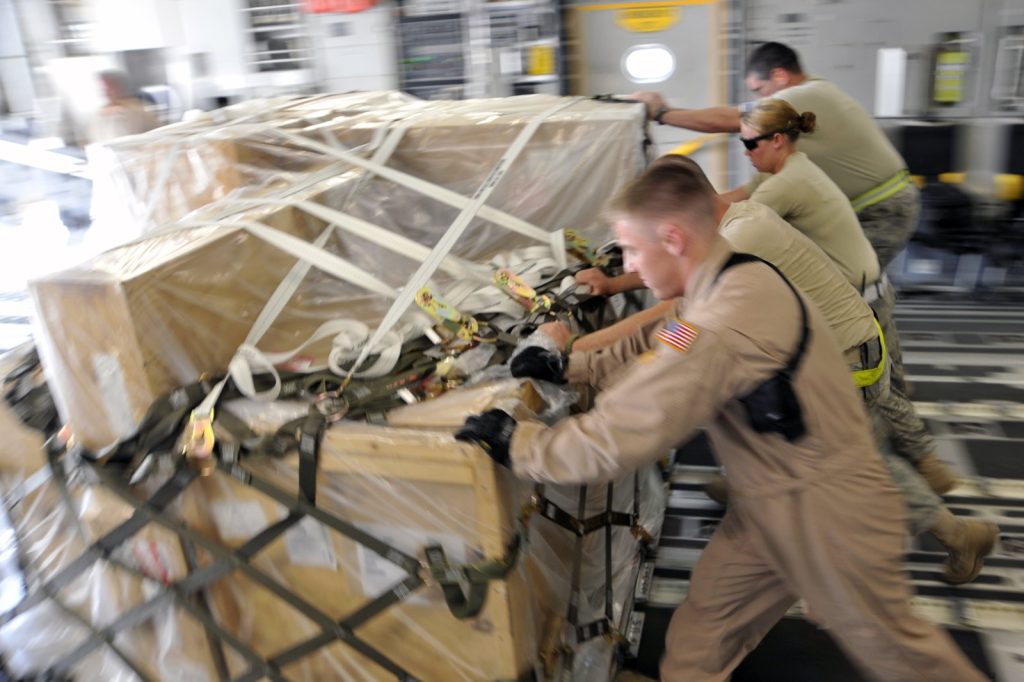
KYIV, Aug. 3 — The shift is quiet, mechanical, and absolutely decisive: Western military aid to Ukraine has settled into a permanent logistics rhythm. What began in February 2022 as an emergency scramble to get anything lethal to the front has matured into a synchronized, multi-country supply chain — one that starts with a wish list from Kyiv and ends with hardware rolling off railway cars near the front lines.
That process has a shape. The Ukrainian government submits requests laying out specific needs for equipment, ammunition, and training. Donor nations — chiefly the United States, European Union members, and the United Kingdom — run those requests against their own inventories and strategic priorities. Then the packages get announced, often individually, sometimes in coordinated waves.
A Pipeline Through Poland
The transport leg is where the operation gets genuinely impressive. Once approved, equipment moves by air or sea to logistics hubs in neighboring countries, with Poland doing heavy lifting given its long border with Ukraine. From those hubs, the aid travels overland by rail and road networks toward the front. It is a route that requires constant coordination between military and civilian logistics experts from multiple nations, balancing speed against security at every step.
Speed was the point from the start. The United States leaned on presidential drawdown authority to pull equipment directly from its own stocks and push it toward the theater in days rather than months. That rapid-transfer mechanism became a signature of American support, letting the pipeline flow before newly manufactured gear could catch up.
The Equipment Curve
Watch the inventory list and you can track the war’s evolution. Early packages concentrated on anti-tank and anti-aircraft systems — Javelins and Stingers that gave infantry units a fighting chance against armor and air threats. Then came heavy artillery: M777 howitzers stretching the range and precision of Ukrainian fire. Advanced rocket systems like HIMARS followed, reshaping how Kyiv could strike deep behind enemy lines.
Air defense arrived in layers — Patriot and IRIS-T systems now guard critical infrastructure and cities against missile barrages. Most recently, the donor coalition crossed a threshold it initially avoided: main battle tanks, with Leopard 2, Challenger 2, and Abrams models entering Ukrainian service. Each step up the capability ladder carried its own political wrangling, but the trend underneath is unmistakable — the West kept escalating the sophistication of what it was willing to send.
Training as a Force Multiplier
Hardware alone doesn’t win this kind of war, which is why training has become the quiet backbone of the whole effort. Ukrainian personnel are regularly rotated to donor countries to learn how to operate and maintain the advanced Western systems. That training isn’t a formality — it’s what makes integration possible, letting Ukrainian commanders fold new weaponry into their defense strategy with some confidence that crews can actually fight with it.
The scale of that effort is hard to overstate. The Ukraine Defense Contact Group — better known as the Ramstein Group, after the US airbase in Germany that hosted its first meeting — has served as the central coordination hub since April 2022. Defense ministers and military chiefs from more than 50 countries gather there to synchronize aid, hammer out priorities, and keep the deliveries aligned with what the front actually needs.
What’s changing now is the conversation inside that room. The emergency phase is long over. The question increasingly is not whether to keep the pipeline open, but how to sustain it through what looks like a long attritional grind. Inventory stocks in donor nations have thinned, production lines are being restarted, and the logistics chain is being tested for endurance rather than sprint speed.
The trend underneath is strategic patience. The aid flow has proven it can adapt — from shoulder-fired missiles to main battle tanks, from ad hoc shipments to a permanent supply network running through Poland into Ukraine’s rail system. Watch this space for the next capability jump, because every time the coalition has signaled a ceiling, it has eventually pushed through it. The machinery is built now, and it is built to move.




