
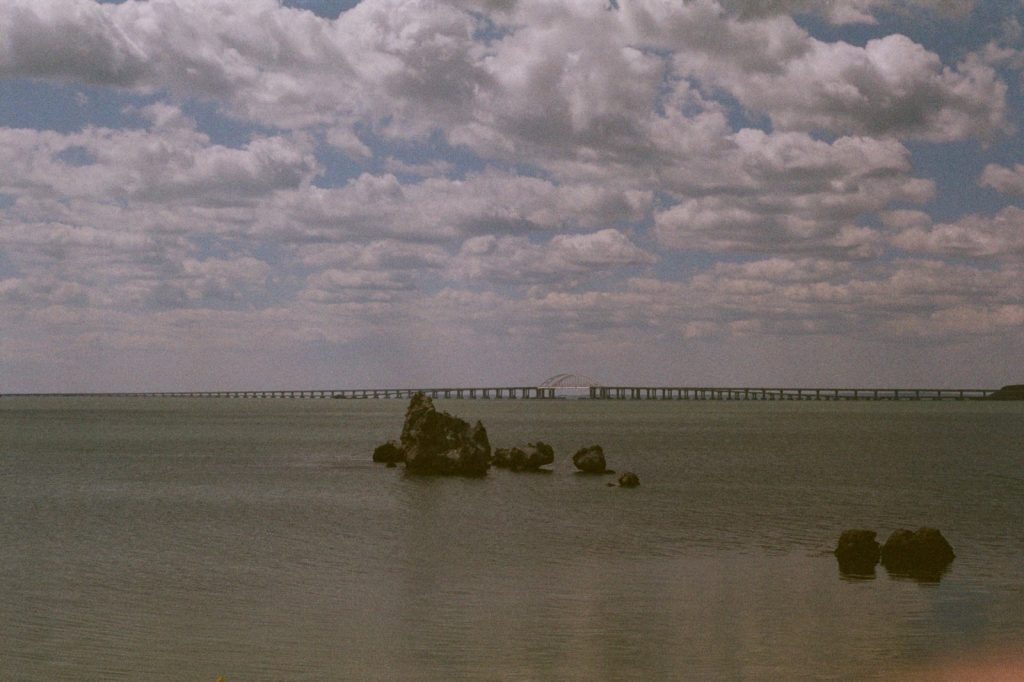
The 2003 deal over the Sea of Azov was born under pressure. In the autumn of that year Russia began building a dam across the Kerch Strait toward Ukraine’s Tuzla Island, and Ukraine’s president, Leonid Kuchma, bargained his way out. According to Vladimir Socor of the Jamestown Foundation, Kyiv accepted “disadvantageous” terms in return for a halt to construction and Russian recognition of Ukrainian control over the Kerch-Yenikale navigable channel.
Putin and Kuchma signed the Treaty on Cooperation in Using the Sea of Azov and the Kerch Strait in Kerch on December 24, 2003. Russia ratified it on April 22, 2004. The text covered shipping rules, navigation support, fisheries, environmental protection and rescue operations in the shared waters, Interfax reported.
A treaty with a catch
Socor argued the arrangement had a built-in weakness. It was open-ended, “in effect to this day and sine die,” and in his reading it purported to “place those two bodies of water outside the scope of international law or third-party arbitration.” That left Ukraine with no outside referee.
Then came 2014. After Russia annexed Crimea, Moscow began describing the strait as “a Russian internal waterway.” It also took the position that Ukraine’s consent was unnecessary for building the Kerch Strait Bridge, since both shores were now Russian. Crimean authorities handed Tuzla Island to Russia’s central government in April 2018, which gave Moscow the very thing it had chased with the dam in 2003.
The annexation also lengthened Russia’s coastline on the Azov Sea and cut Ukraine’s, a shift Socor said would work against Kyiv in any future border talks.
Both sides walk away
The treaty did not stay on the books. Ukraine’s parliament voted on February 24, 2023 to withdraw, and the decision took effect on March 25, 2023. Russia’s Federation Council followed on June 7, 2023, voting to terminate the agreement.
Its Foreign Affairs Committee gave the reasoning: after Russia’s territorial claims, “Ukraine lost the status of a littoral state in the Azov-Kerch waters.” The committee added that “The Sea of Azov has become an internal sea of the Russian Federation.”
Legally, that is where the 2003 framework ended: two denunciations, and a Russian claim that one of Europe’s busiest shallow seas is now entirely its own.
Sources
- Russia's Federation Council approves withdrawing from treaty with Ukraine on Sea of Azov, Kerch Strait
- Azov Sea, Kerch Strait: Evolution of Their Purported Legal Status (Part Two)




