
Bashar Assad is in Moscow. Russian media reported on Sunday that his longtime ally gave him asylum, only hours after rebels took Damascus and ended 50 years of rule by the Assad family.
The Russian agencies Tass and RIA said Assad and his family had arrived, citing an unnamed Kremlin source. A Kremlin spokesman did not immediately answer questions. RIA added that the insurgents had promised to guarantee the safety of Russian military bases and diplomatic posts in Syria. Earlier, Russia had said Assad left after talks with rebel groups and had ordered a peaceful transfer of power.
Celebrations in the capital
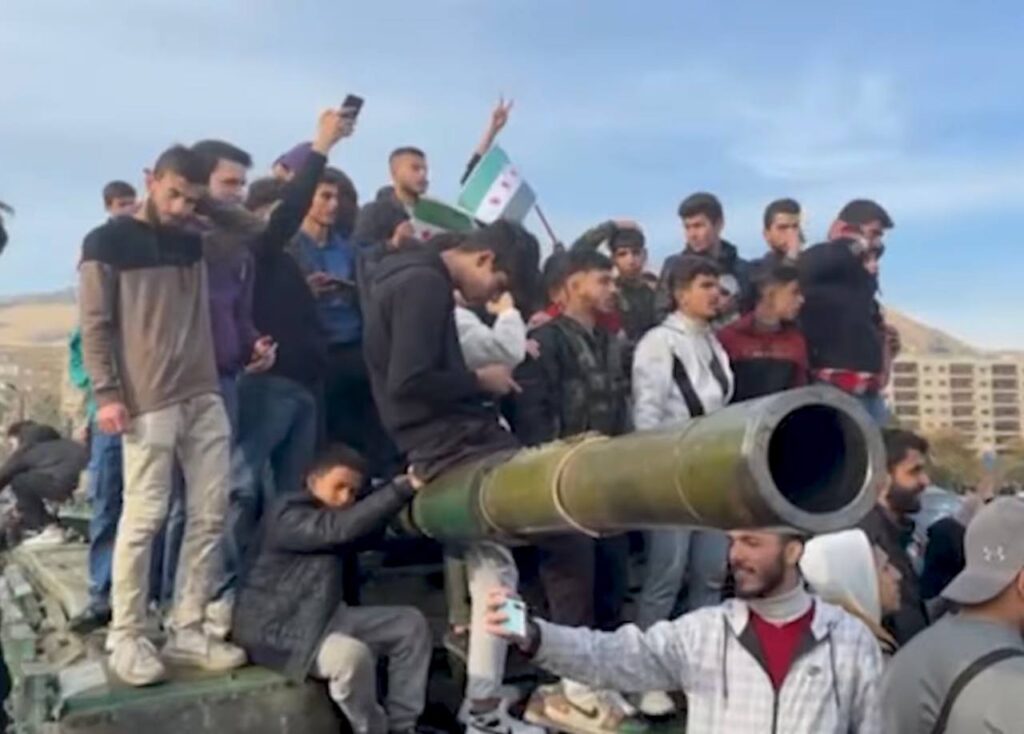
Thousands of Syrians poured into the streets, where celebratory gunfire echoed and the revolutionary flag was waved. The scenes recalled the early days of the Arab Spring uprising, before a brutal crackdown and an insurgency pushed the country into a civil war lasting nearly 14 years.
Residents prayed in mosques, gathered in squares and shouted “God is great.” Car horns blared. Teenage boys fired into the air with weapons that security forces seemed to have left behind. Soldiers and police abandoned their posts, and looters got into the Defense Ministry. Families walked through the presidential palace, past damaged portraits of Assad.
“It’s like a dream. I need someone to wake me up,” said opposition fighter Abu Laith, who said the rebels were welcomed in Damascus with “love.”
Outside the Justice Ministry, where rebels stood guard, residents asked for news of relatives who vanished under Assad. An online video purported to show rebels freeing dozens of women from Saydnaya prison, where rights groups say thousands were tortured and killed. Bassam Masr, whose son has been detained for 13 years, said he had spent two hours searching for him. “This happiness will not be completed until I can see my son out of prison and know where is he,” he said.
The rebels and what they promise
Abu Mohammed al-Golani leads Syria’s biggest rebel faction, Hayat Tahrir al-Sham, which the U.S. and the U.N. treat as a terrorist organization. A former al-Qaida commander, he says he cut ties with that group years ago and now embraces pluralism and religious tolerance. Appearing at the Umayyad Mosque, he used his given name, Ahmad al-Sharaa, and called Assad’s fall “a victory to the Islamic nation.”
On state television, rebel commander Anas Salkhadi tried to calm minority communities. “Syria is for everyone, no exceptions,” he said. “We will not deal with people the way the Assad family did.” A rebel statement announced a curfew in Damascus from 4 p.m. to 5 a.m. and said all prisoners had been released.
A woman who gave only her first name, Heba, said she worried about revenge killings, noting that many of the rebels looked underage.
Reaction abroad
President Joe Biden said the U.S. and its allies had shifted the balance of power by weakening Russia, Iran and Hezbollah, Syria’s backers. He called Assad’s fall a “fundamental act of justice” and also a “moment of risk and uncertainty,” adding that the rebels are “saying the right things now” and that Washington would watch what they do.
Iran’s ambassador, Hossein Akbari, said helping the Syrian government had become “effectively impossible.” Russia asked for an emergency session of the U.N. Security Council. In Qatar, foreign ministers and officials from eight countries met late Saturday and agreed on the need to engage all parties on the ground, including HTS.
The rebel advance began on Nov. 27. Aleppo, Hama and Homs fell within days, and the Syrian army melted away. Prime Minister Mohammed Ghazi Jalali said the government would “extend its hand” and pass its functions to a transitional government.
Israel’s Benjamin Netanyahu said troops had taken a buffer zone in the Golan Heights set up in 1974. The Arab League condemned what it called Israeli efforts to take advantage of the moment to seize more land.




