
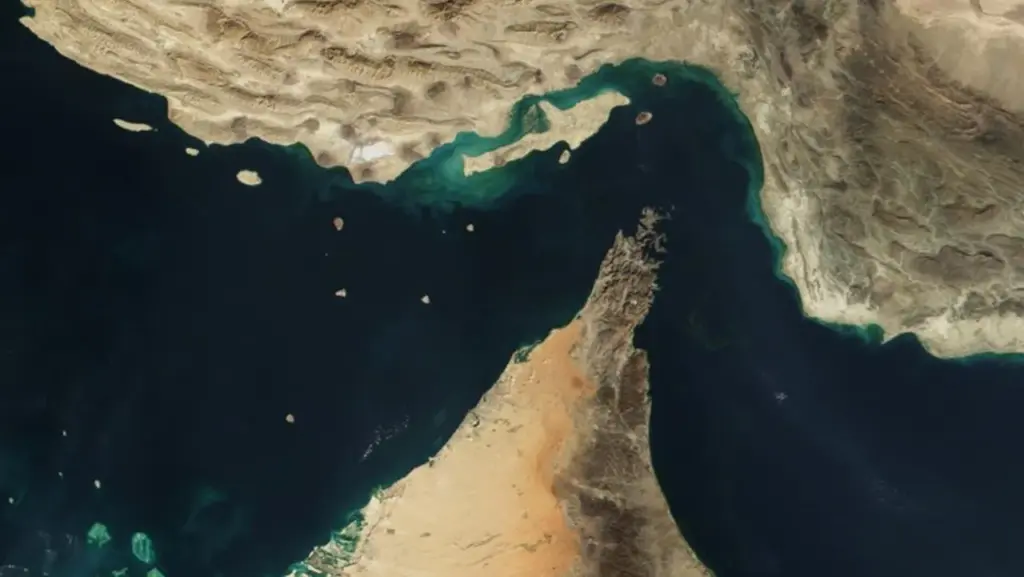
“There is no legal basis for charging vessels that exercise their right of passage through international waters.” That was the verdict of Richard Meade, editor-in-chief of Lloyd’s List, on a plan President Donald Trump floated on a Monday and buried by Tuesday.
Trump had said the United States would act as “guardian” of the Strait of Hormuz, shielding ships from Iranian fire in return for a 20% fee on cargo. He never explained how the money would be collected or what would happen to a captain who refused to pay. Stars and Stripes reported that he dropped the idea less than a day after announcing it. Cronkite News put the turnaround at 26 hours.
Experts: no basis in the law of the sea
Maritime lawyers and shipping analysts lined up against it quickly. Ian Ralby of Auxilium Worldwide called it “the most significant barrier to international trade the United States has ever imposed.” The International Maritime Organization said there is “no legal basis” for mandatory tolls on an international strait under the UN Convention on the Law of the Sea.
Alisha Chhangani, associate director at the Atlantic Council’s GeoEconomics Center, was blunter about the mechanics. “It is hard to see how this proposal would work,” she said, pointing to open questions about timing, the link to naval escorts and the penalty for non-payment.
Meade warned of a wider risk: once access to a critical waterway depends on politics, that arrangement becomes normal.
A reversal of stated U.S. policy
The plan also cut against the administration’s own words. Secretary of State Marco Rubio told a Gulf Cooperation Council meeting: “No country on Earth has a right to charge for the use of international waterways, and that will never be an acceptable condition of any deal.” Cronkite News noted that the November 2025 National Security Strategy put “preserving freedom of navigation in all crucial sea lanes” at the top of the agenda.
The numbers were steep. Analysts estimated a large crude tanker carrying 2 million barrels would owe about $32 million per voyage, according to Stars and Stripes. Cronkite News put the cost for an average tanker at roughly $34 million. Iran’s own reported transit fees, by comparison, ran from $120,000 to $150,000.
Markets reacted within hours. Oil jumped nearly $5.50 a barrel in the 10 hours after the announcement. Skip York of Rice University’s Baker Institute warned that U.S. gasoline prices could climb 30 to 40 cents a gallon, even though the country imports only 2% of its oil from the Gulf.
What Trump chose instead
In a Truth Social post, Trump said he would pursue trade and investment deals under which Gulf states make “massive” investments in the United States. The reversal came as violence in the region grew and Iran attacked commercial shipping.
Iran’s foreign minister seized the moment, mocking the retreat on social media. He noted that the American scheme was more extreme than Iran’s own toll plan, which had been rejected.
Sources
- Trump Drops Hormuz Fee Plan After Legal, Policy Questions
- Trump backtracks on illegal 20% Strait of Hormuz tolls




