
Twenty million barrels a day. That is the volume the U.S. Energy Information Administration says moved through the Strait of Hormuz in 2024, roughly 20% of the petroleum liquids the world burns. Behind every barrel are tanker crews, port workers and, farther down the chain, households paying for fuel and power.
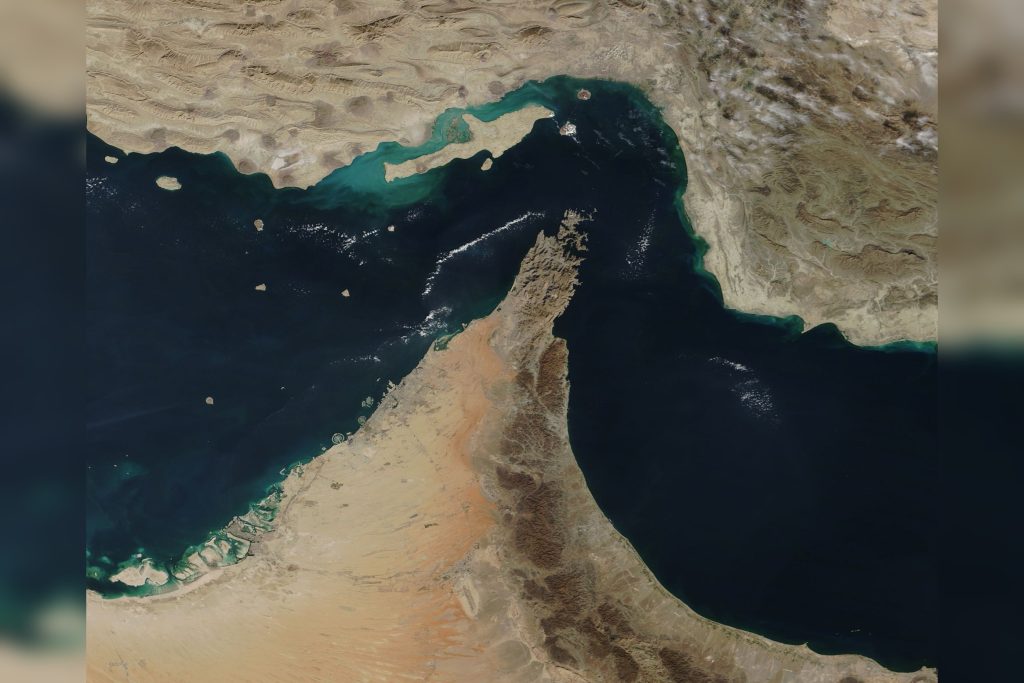
The strait sits between Oman and Iran and links the Persian Gulf to the Gulf of Oman and the Arabian Sea. Oil is only part of the story. About one-fifth of global liquefied natural gas trade also passed through in 2024, mostly from Qatar. In the first quarter of 2025, the EIA said, flows stayed close to the 2024 level, and the strait handled more than one-quarter of all seaborne oil trade.
A narrow lane in a wider channel
Where the strait is tightest, it measures roughly 30 miles across, according to the Strauss Center at the University of Texas. Ships do not use all of it. Under the traffic separation scheme, inbound and outbound vessels each get a lane two miles wide, with a two-mile buffer between them.
The Strauss Center adds a point that is easy to miss: far more of the strait than those lanes is deep enough for the largest tankers. Anyone hoping to stop the oil would need a barrier spanning the whole width, not just the marked corridor. The center calls a major disruption “extremely difficult” given the economic, political and military forces at play.
Who depends on it
Saudi Arabia is the biggest shipper. Its crude and condensate exports made up 38% of Hormuz crude flows in 2024, or 5.5 million b/d, per the EIA. Asia takes most of what comes out: 84% of the crude and condensate and 83% of the LNG went to Asian buyers, with China, India, Japan and South Korea at the top of the list.
The Strauss Center puts the dependence in starker terms. About 88 percent of all oil leaving the Persian Gulf goes by way of the strait.
There are workarounds, but they are small. Saudi Arabia runs the East-West pipeline, rated at 5 million b/d and expandable to 7 million b/d. The United Arab Emirates operates a 1.8 million b/d line to Fujairah. Together, the EIA estimates, the two give around 2.6 million b/d of bypass capacity, a fraction of what sails through the strait.
Routes shift when tensions rise
The lanes themselves can move. Maritime Executive reported on June 20, 2025 that commercial vessels had begun steering clear of Iranian territorial waters in the approaches, in the strait and deeper into the Gulf. Ships kept to the south, wholly inside Omani waters on the inbound side, and then hugged the Ras Al Khaimah coast in Emirati waters. Only vessels headed for Iranian ports departed from that pattern.
The trade-off was plain. “Crowding so much traffic into narrower sea lanes inevitably increases the risk of collisions,” the outlet wrote, and the job of keeping order fell largely to Oman’s Royal Navy, which watches the strait from radar sites and from its Goat Island Naval Base on the Musandam Peninsula. Oman was also acting as a go-between in stalled talks between Washington and Tehran. The article recalled earlier drone attacks, boarding attempts, mines and missile strikes in these waters.
Sources
- Strait of Hormuz: Oil and LNG Flows (U.S. Energy Information Administration, Today in Energy)
- Strait of Hormuz: About the Strait (Robert Strauss Center, University of Texas at Austin)
- Strait of Hormuz traffic separation scheme keeps within Omani waters (Maritime Executive)




