
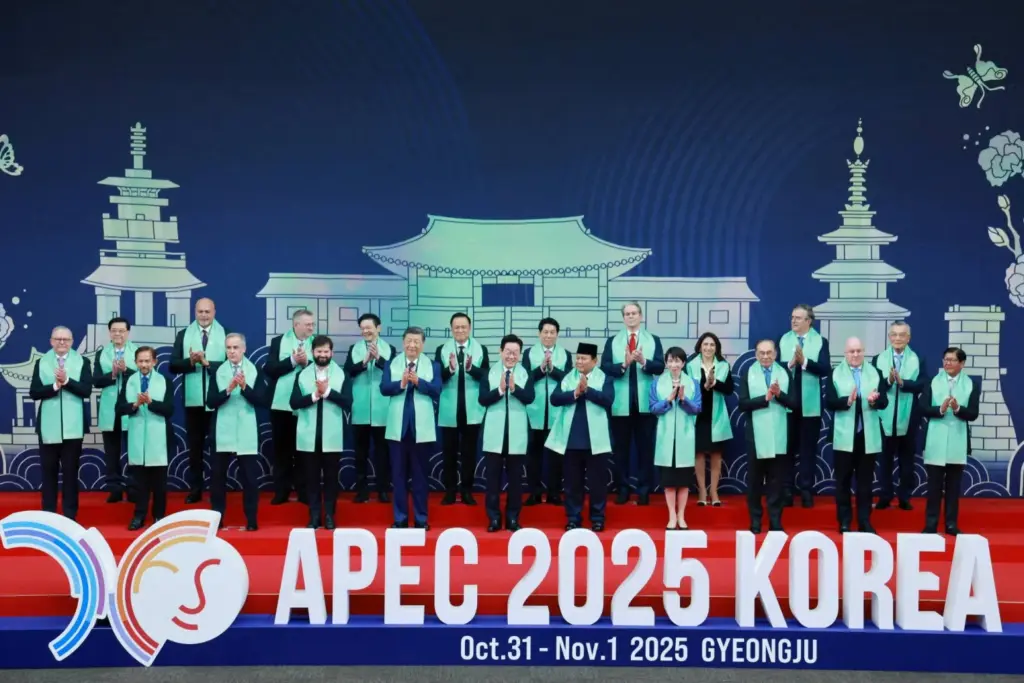
The APEC leaders’ summit wrapped up in Gyeongju, South Korea, on November 1, 2025, with a declaration on connectivity, innovation and sustainable growth. On closer reading, the headline of the meeting was not the communiqué but a series of bilateral deals struck on the sidelines, most of them involving the United States and China.
The mechanics here are revealing. President Donald Trump’s appearance was brief and, by design, focused on one-on-one bargaining with China and South Korea rather than the collective agenda; he departed before the summit formally began. Chinese President Xi Jinping, meanwhile, took the spotlight as a champion of multilateralism, a pointed contrast to Washington’s protectionist stance.
The catch is that the deals bought time rather than solutions. Trump and Xi reached a limited truce: the United States lowered its overall tariff on Chinese goods from 57 to 47 percent, while China agreed to crack down on fentanyl precursors, suspend rare-earth export curbs for a year and resume large soybean buys. Both sides keep the option to reimpose tariffs, which makes the truce inherently fragile.
South Korea used its turn as host to press its own agenda. Seoul and Washington agreed to cut reciprocal tariffs from 25 to 15 percent, with Seoul pledging up to US$350 billion of investment in the United States. Follow the money on the tech side: Nvidia’s chief executive Jensen Huang met the heads of Samsung, SK Group, Hyundai Motor and Naver, and Nvidia signed on to a deal to supply 260,000 advanced chips for Korea’s AI drive, plus a US$3 billion AI joint venture with Hyundai Motor Group.
Xi’s visit, his first to South Korea in 11 years, yielded seven memoranda of understanding, covering currency swaps and a joint response to online scams, and his first talks with Japan’s new prime minister, Takaichi Sanae. Canadian Prime Minister Mark Carney called his own meeting with Xi a “turning point” and offered to host APEC in 2029.
The summit’s own declaration, the “Gyeongju Declaration,” added artificial intelligence and demographic change as cross-cutting priorities. But the gap between aspiration and reality on trade remains wide, and the region’s defining fault line, the US-China economic rivalry, is untouched.
Sources
- APEC Summit Sees Flurry of Deals, Uneasy U.S.-China Truce
- John Lee embarks on South Korea visit to strengthen global ties at APEC summit




