
Early life
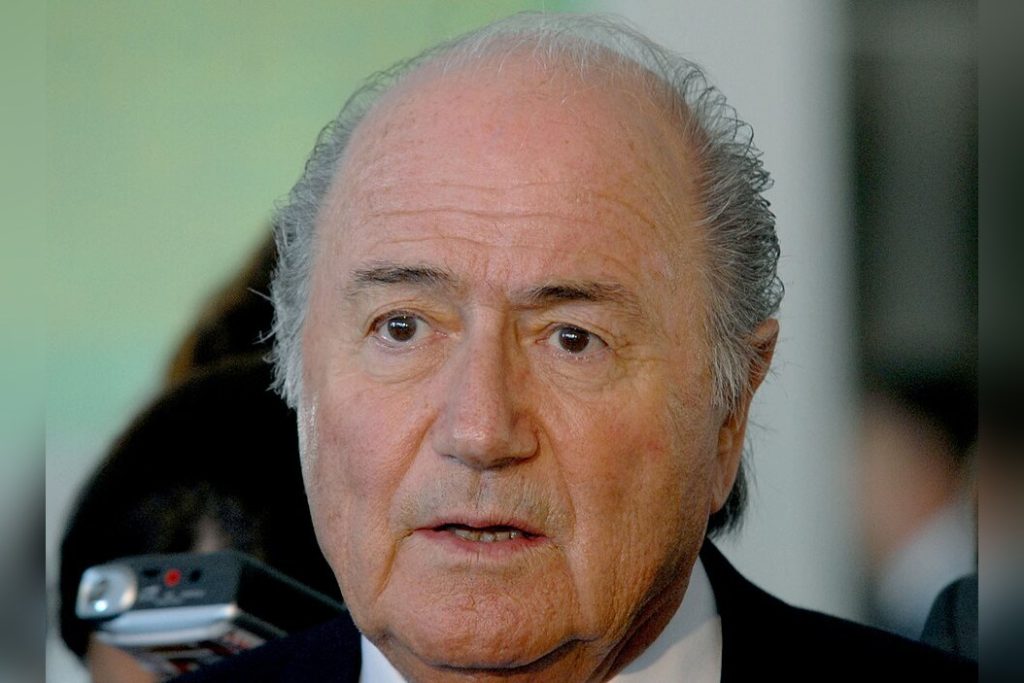
Sepp Blatter was born Josef Blatter on 10 March 1936 in Visp, in the Swiss canton of Valais. He studied in Saint Maurice before earning a degree in business and economics from the University of Lausanne in 1959. His early career included roles such as head of public relations for the tourist board of his native canton and general secretary of the Swiss Ice Hockey Federation.
Blatter also served as Director of Sports Timing and Relations for Longines S.A., where he was involved in the organization of the 1972 and 1976 Olympic Games. These experiences in sports administration and international event coordination laid the foundation for his later work at FIFA.
From a background in business, public relations, and sports administration, Blatter joined FIFA in 1975, beginning as technical director before advancing to general secretary in 1981.
Rise
Blatter became general secretary of FIFA in June 1981, succeeding Helmut Käser. In this role, he managed the day-to-day operations of the organization and worked closely with President João Havelange, who had led FIFA since 1974. His tenure as general secretary lasted until June 1998.
On 8 June 1998, Blatter was elected president of FIFA at the 51st FIFA Congress, succeeding Havelange. He was subsequently re-elected in 2002, 2007, 2011, and 2015, securing five terms in office. During his presidency, he pursued a strategy of expanding FIFA’s global reach by increasing the influence of African and Asian nations in world football.
This expansion included supporting the growth of participating teams in FIFA tournaments, a policy that culminated in the controversial awarding of the 2022 World Cup to Qatar. Despite persistent claims of corruption and financial mismanagement, Blatter’s leadership coincided with a significant increase in revenues generated by the FIFA World Cup.
Peak
At the height of his influence, Blatter was re-elected to a fifth term as FIFA president in 2015, demonstrating enduring support within the organization despite ongoing scrutiny. His leadership was marked by efforts to modernize football’s global governance and expand access to World Cup participation for nations outside traditional football power bases.
Under his presidency, FIFA’s financial operations grew substantially, driven by lucrative broadcasting and sponsorship deals tied to the World Cup. Blatter positioned himself as a unifying figure in international football, emphasizing development programs and solidarity payments to member associations.
His ability to maintain electoral success through multiple re-elections reflected his skill in navigating the complex politics of FIFA’s 209 member associations, many of which benefited from the financial and developmental initiatives enacted during his tenure.
Turning point
On 2 June 2015, six days after the United States government indicted several current and former FIFA officials and sports marketing companies for bribery and money laundering, Blatter announced he would call for elections to choose a new FIFA president and would not stand in those elections, though he said he would remain in office until an extraordinary FIFA Congress could be held for his successor.
Criminal proceedings were announced against Blatter by the Swiss Attorney General’s office on 25 September 2015, regarding “criminal mismanagement… and misappropriation.” In October 2015, Blatter and other top FIFA officials were suspended amid the investigation.
In December 2015, the independent FIFA Ethics Committee ejected Blatter from office and banned him from participating in any FIFA activities for eight years. On 24 February 2016, a FIFA appeals committee upheld the suspension but reduced it from eight to six years. Issa Hayatou served as acting president of FIFA until the extraordinary congress in late February 2016, which elected Gianni Infantino as the 9th president.
Legacy/aftermath
On 24 March 2021, Blatter received a second ban for six years and was fined CHF 1,000,000 by the FIFA Ethics Committee after a probe into massive bonus payments. This extended his suspension from FIFA activities until 2027. As of the latest available information, he remains suspended from participating in FIFA activities as a result of the 2015 FIFA corruption case.
Blatter’s presidency is remembered for both the globalization of football and the controversies that surrounded his leadership. While he expanded FIFA’s revenue and global footprint, his tenure became increasingly associated with allegations of corruption, culminating in investigations, sanctions, and his eventual removal from office.
Despite the sanctions, Blatter has continued to assert his innocence in public statements, maintaining that his actions were in the best interest of football’s development. His legacy remains deeply polarized, viewed by some as a visionary who expanded the game’s reach and by others as a figure emblematic of institutional failure in global sports governance.
Wider significance
The case against Sepp Blatter and the broader FIFA corruption investigation marked one of the most significant moments in the history of international sports governance. It prompted widespread calls for reform within FIFA, leading to changes in electoral processes, financial oversight, and ethics enforcement.
The investigations, initiated by U.S. authorities and pursued by Swiss prosecutors, exposed vulnerabilities in how international sports organizations manage large-scale commercial operations and highlighted the risks of concentrated power without sufficient accountability.
Blatter’s fall from power underscored the growing scrutiny of sports institutions in the 21st century and contributed to a broader movement toward transparency and reform in global football, influencing how future leaders are elected and monitored within FIFA and other international federations.
Sources
https://en.wikipedia.org/wiki/Sepp_Blatter | https://www.news.com.au/sport/football/fifa-president-sepp-blatter-resigns-calls-new-elections/news-story/ce9a9ee282cf0ccb4f8ee6d052ef75f8




