
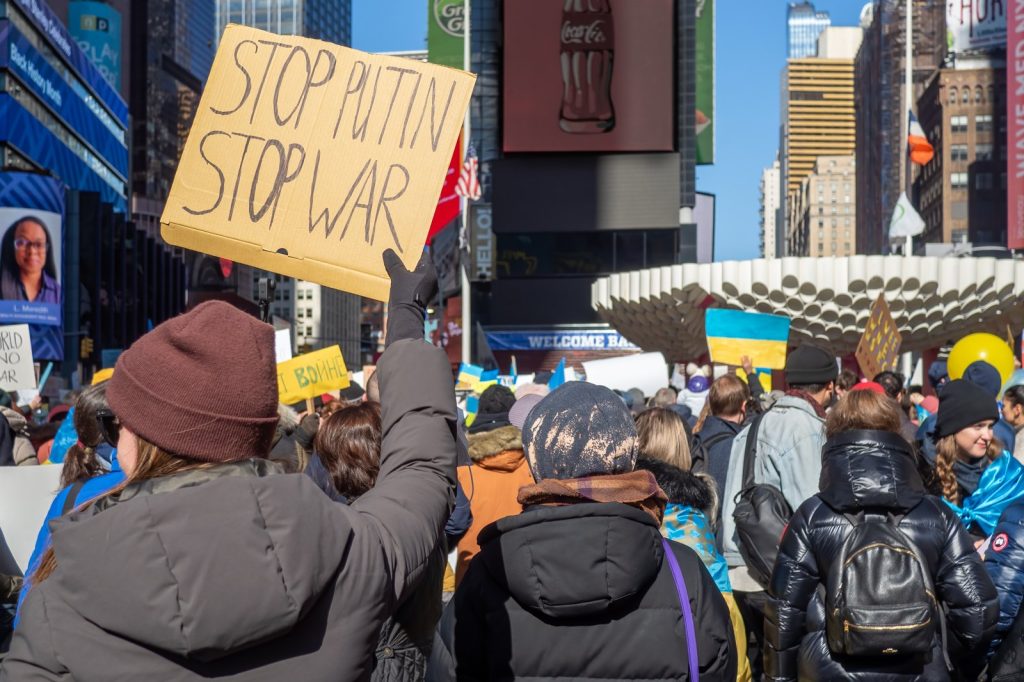
Russian air strikes and ground forces hit Ukraine on three fronts on 24 February 2022: from Belarus toward Kyiv, from Crimea in the south, and from the Donbas toward Kharkiv. Ukraine declared martial law, ordered a general mobilisation and cut diplomatic relations with Moscow.
Vladimir Putin announced the attack in a televised address and called it a “special military operation”. He said it was meant to support the Russian-backed breakaway republics of Donetsk and Luhansk, and that Russia’s goal was to “demilitarise and denazify” Ukraine. He also claimed that Kyiv’s government was committing genocide against Russians in the Donbas, an allegation with no basis.
A plan that failed in weeks
The invasion plan, as later described, called for defeating Ukraine within ten days and capturing or killing its government. After that would come “mopping up” operations, filtration camps for Ukrainians and occupation regimes.
It did not work. Ukrainian forces pushed back the northern arm of the attack and Kyiv did not fall. By April 2022 the fighting had settled into more conventional battles in the south and east. Russia kept its hold on part of the southeast, and months after the invasion it unilaterally declared the annexation of four Ukrainian oblasts.
The years before
The war did not start in 2022. In November 2013 Ukrainian president Viktor Yanukovych backed out of an association agreement with the European Union and turned toward the Russian-led Eurasian Economic Union. Protests followed, and by February 2014 the Revolution of Dignity had left almost 100 protesters dead. Yanukovych fled to Russia.
Soldiers without insignia then took over Crimea. Russia annexed it in March 2014 after a referendum held under occupation that was widely disputed. In April, armed Russian mercenaries led by Igor Girkin seized Sloviansk and nearby towns, and the war in Donbas began. The Minsk agreements of September 2014 and February 2015 tried to end it, but ceasefires and later talks kept failing.
Troops massed near Ukraine’s borders in March and April 2021 and again from October. Russian officials, Putin among them, denied planning an attack until the day before it came. In December 2021 Moscow demanded that NATO end its activity in its Eastern European member states and bar Ukraine from ever joining. NATO Secretary General Jens Stoltenberg answered that “Russia has no veto” on the question. Putin said Russia’s demands had been “ignored”.
Macron and German Chancellor Olaf Scholz both met Putin in February 2022 to try to talk him out of invading. Scholz said Putin told him Ukraine should not be an independent state.
The last days
Fighting in the Donbas escalated from 17 February. On 21 February Putin recognised the Donetsk and Luhansk republics and ordered Russian troops into the Donbas for what he called a “peacekeeping mission”. The Federation Council unanimously authorised the use of force outside Russia the next day. Ukraine’s parliament proclaimed a 30-day state of emergency and ordered all reservists mobilised.
On the night of 23 February Zelenskyy gave a speech in Russian, appealing to Russians to prevent the war. The invasion began the following morning.
The response
The United Nations General Assembly passed a resolution condemning the invasion and demanding a full Russian withdrawal. The International Court of Justice ordered Russia to halt military operations, and the Council of Europe expelled it. Many countries imposed sanctions on Russia and Belarus and sent humanitarian and military aid to Ukraine. The International Criminal Court opened an investigation and issued arrest warrants for Putin and other Russian officials.




