
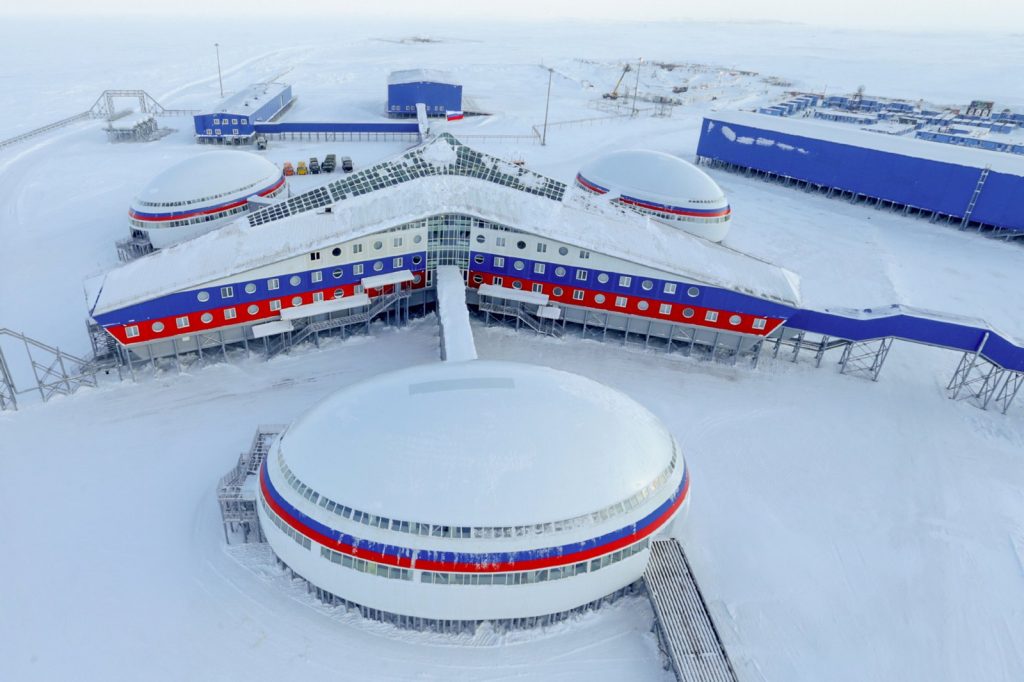
Severomorsk-1 air base sits about 15.5 km northeast of Murmansk, and after years of rebuilding that began in 2011-2012, it was back in service by September 2019, with patrol and transport aircraft and helicopters parked on its aprons and in revetments, according to CSIS.
The base is one piece of the Kola Peninsula, which the Center for Strategic and International Studies calls the foundation of Russia’s Arctic military presence. It houses the Northern Fleet headquarters and what CSIS describes as “Russia’s most advanced Arctic land, air, and naval assets, notably including its nuclear arsenal and second-strike capabilities.”
Where the submarines sleep
The submarines are the point of it all. Gadzhiyevo, on the eastern shore of Sayda Bay, is reportedly the main home port for the fleet’s Delta IV and Dolgorukiy-class ballistic missile boats. Between 2014 and 2019, builders there worked on bunkers to store submarine-launched missiles.
Further along the coast, Okolnaya has handled nuclear-armed missiles since the late 1950s. Satellite imagery in 2019 showed 41 weapons storage bunkers, finished or under construction, and CSIS projects room for “200 RSM-56 Bulava SLBMs.”
The buildup traces back to 2013, when Moscow announced it was reengaging in the Arctic to guard its northern approaches, protect mineral and energy resources, and monitor shipping on the Northern Sea Route.
The commercial bet
That route is the other half of the strategy. High North News reported in April 2023 that Russian officials expected traffic to reach 80 million tons in 2024, double the 40 million tons of 2022, then 193 million tons in 2030 and 270 million tons in 2035. For scale, the Suez Canal handled 1.27 billion tons in 2022.
Ice is the obstacle. Rosatomflot expects to run 1,747 commercial escort voyages in 2024, rising to 3,895 in 2035. Vladimir Panov, a Rosatom representative for Arctic development, said 29 ice-class cargo ships exist and 41 are under construction, with 88 more needed to reach a target fleet of 158. By 2030 Russia plans nine nuclear icebreakers and four conventional ones. The Leader-class icebreaker, still being built, is designed for 120 megawatts of power and continuous passage through four meters of ice.
Deputy Prime Minister Alexander Novak projected that developing the route would lift GDP by approximately $370 billion by 2035, around 20 percent growth. Moscow also hopes to win roughly 10 percent of the cargo that now goes through Suez.
Those are Russian officials’ targets, set in 2023, and the figures are plans rather than results.
Sources
- The Ice Curtain: Modernization on the Kola Peninsula
- Russia Says Northern Sea Route To Transport 270m tons by 2035




