
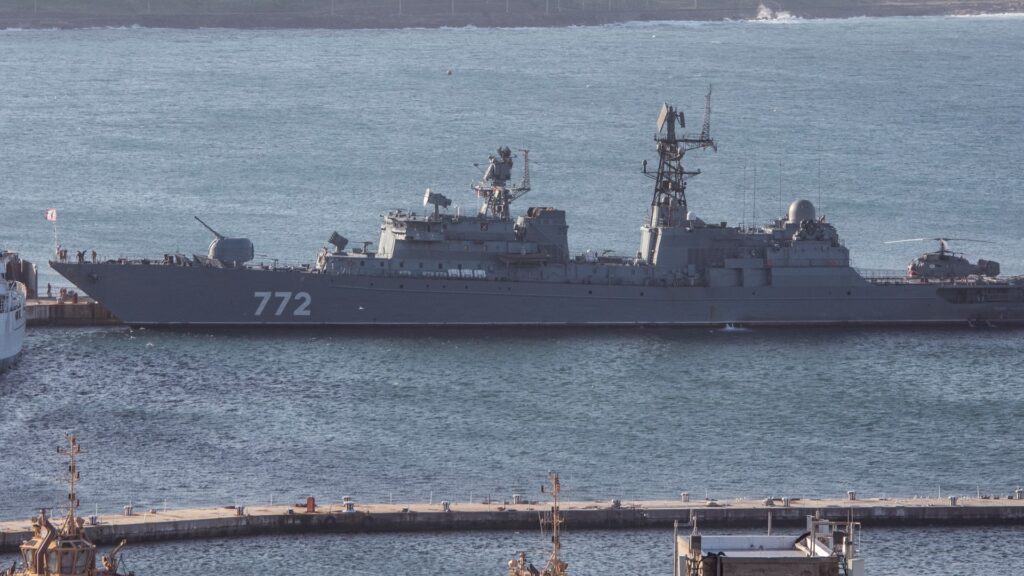
LONDON, July 21 — A Russian warship has conducted a live-fire exercise in a busy shipping corridor off the United Kingdom, the latest in a pattern of military activity that, according to Defence Ministry records, has steadily intensified since the mid‑2000s. The development was confirmed by officials who track such movements, placing the vessel approximately 46 miles from the coast — a position inside the Dover Strait, one of the world’s most congested maritime routes.
The 46-mile distance from British shores places the warship in a corridor through which, according to maritime data, more than 500 merchant vessels pass each day. The Royal Navy has responded, with officials confirming that shadowing operations remain routine.
The Ministry of Defence’s annual review of maritime security reports that the Royal Navy spends more than 300 days per year tracking Russian vessels.
A pattern of activity since the mid‑2000s
The record shows a consistent sequence of Russian naval and air operations near the United Kingdom. In 2020, the Russian spy ship Yantar was tracked off the UK coast. Two years later, in 2022, Russian submarines were shadowed in the Irish Sea.
During the same period, the Royal Air Force scrambled to intercept multiple incursions by Russian aircraft into the UK’s Atlantic Flight Information Region. In 2021, the Type 45 destroyer HMS Duncan was dispatched to intercept a Russian frigate and a tanker in the English Channel.
The Ministry of Defence reported in 2023 that Russian aircraft had been intercepted over the North Sea more than 200 times in the preceding five years. Those interceptions, officials noted, reflect a sustained operational tempo by both sides.
Strategic context: the GIUK Gap and the Dover Strait
The strategic significance of the GIUK Gap — the maritime chokepoint running from Greenland through Iceland to the United Kingdom — has driven increased NATO patrols in recent years. Russian submarines transiting from northern ports to the Atlantic must pass through this narrow corridor, making it a focus of both Russian and alliance naval planning. The UK’s Joint Expeditionary Force has conducted multiple exercises in response to this activity, according to defence officials.
The Dover Strait is not merely a chokepoint for military vessels; it is the world’s busiest shipping lane. The presence of a warship conducting live-fire exercises in such a congested waterway introduces risk to commercial traffic.
The vessel’s exact location, 46 miles from the coast, places it squarely within that lane.
Peak activity in 2022–2024
Russian military activity near the United Kingdom peaked between 2022 and 2024, a period that coincided with the full-scale invasion of Ukraine. The MoD’s annual maritime security review characterises that period as the most intense in recent memory. The Royal Navy’s shadowing operations — exceeding 300 days per year — reflect a persistent requirement to monitor Russian vessels in UK‑adjacent waters.
Officials have not stated whether the live‑fire exercise this week represents an uptick or a continuation of the established tempo. The pattern, however, is consistent with the operational behaviour documented over the past two decades.
The Joint Expeditionary Force, a UK‑led coalition of Northern European nations, has conducted multiple exercises aimed at countering such activity. Those drills have focused on both surface and subsurface threats, often in the approaches to the GIUK Gap. The MoD’s annual reviews, the record shows, have repeatedly flagged the strategic importance of maintaining continuous maritime presence.
As of July 21, the warship remains in the area. Defence officials will continue to monitor its movements, along with any further exercises in the Dover Strait.




