
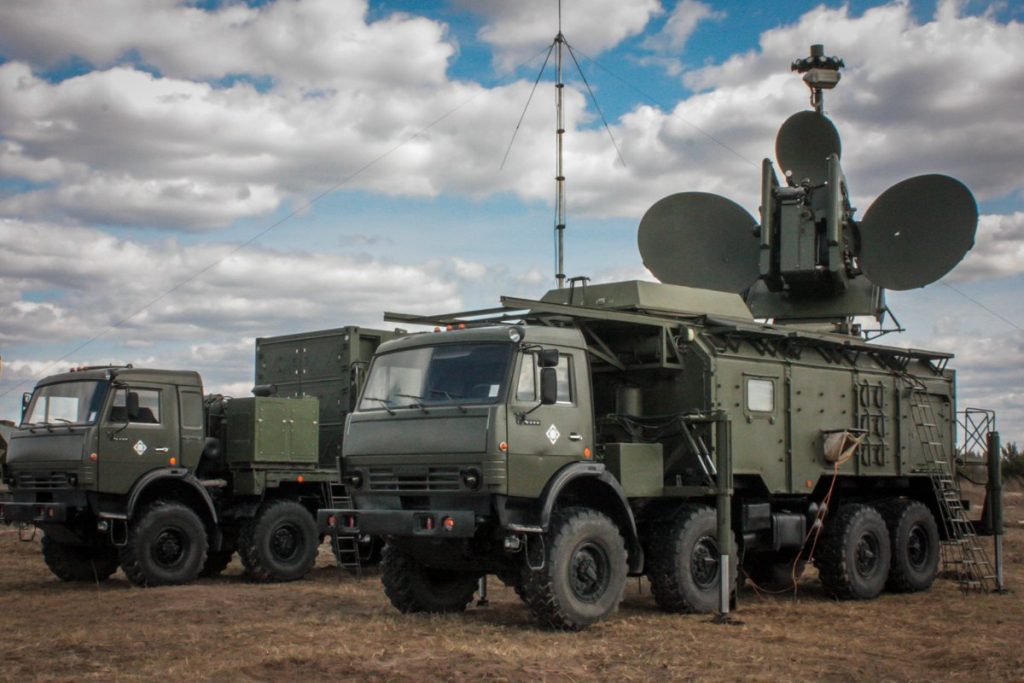
Reports relayed in May 2024 said Russian electronic warfare was jamming satellite-guided ammunition, including Excalibur artillery shells and HIMARS rockets. Analysis named three systems able to jam GPS-guided munitions: the R-330Zh Zhitel, the Krasukha-4 and the Tirada-2. Washington had halted Excalibur deliveries roughly six months earlier, and a senior US official said the Pentagon had expected precision weapons to be defeated by Russian EW and worked with Ukraine on answers.
The Zhitel jams GPS across 100 MHz to 2 GHz and throws strong jamming inside a 30 km radius; it detects, tracks and jams Inmarsat and Iridium satcom and GSM-1900 phones, and acts against GPS navigation on NAVSTAR satellites. Krasukha-4 targets radars in the X-band and Ku-band used by aerial and missile systems, built to blind airborne radar and satellite systems. The Tirada-2 exists to jam satellite communications themselves.
The record shows these are the top of a four-tier architecture. Operational systems sit forward at about one major EW system per ten kilometres of front, by RUSI’s 2023 fieldwork: the multi-vehicle Borisoglebsk-2 complex; Krasukha-4 for use against airborne and space-based radar; Zhitel against communications, satellite and GNSS receivers; and Palantin for HF, VHF and cellular denial. Specialised layers: the Pole-21 network, whose antenna posts blank satellite navigation out to at least 25 kilometres per the Russian defence ministry’s manual, and the Mi-8MTPR-1 helicopter carrying the Rychag-AV payload, rated at a reported 105 kW per target across 5.1 to 11 GHz.
Below them, growing fastest, is the disposable tier. Since 2023 the force has fielded thousands of vehicle-mounted “EW domes” and handheld rifles: Volnorez on armour, Saniya on T-80BVM tanks, the LPD-801 and LPD-802 and the Lesochek on ordinary combat vehicles. One US Army Military Review piece, citing General Staff catalogue data, put procurement at roughly 5,000 lightweight counter-drone devices monthly by late 2024. Doctrine, set by a 2023 counter-UAS manual, orders rapid relocation once a system has operated, directional rather than barrage jamming, sectors of roughly 90 to 120 degrees, and stations three to five kilometres behind the line.
The answers are already in the field. By RUSI’s 2025 fieldwork, tracking the other side’s EW positions had become a basic prerequisite for Ukrainian drone operations, with artillery suppressing hostile jammers first. Frequency agility drives a “power race” with a ceiling: stronger transmitters betray themselves and risk fratricide, and Russian operators have even reprogrammed their drones onto Ukrainian frequencies. The quiet exits are autonomy, by inertial and optical navigation and terminal machine vision, and fibre: fibre-optic FPVs, fielded from 2024, with ranges of 15 to 25 kilometres by early 2026 and no radio link left to jam. The loop stays symmetric; the transmitter that blinds is also the beacon that betrays.
Sources
- The Obstacle System: Russia's EW Architecture in Ukraine | Defence Ukraine
- Analysis: Which Russian Electronic Warfare Systems Jam US Excalibur & HIMARS Ammunition in Ukraine




