
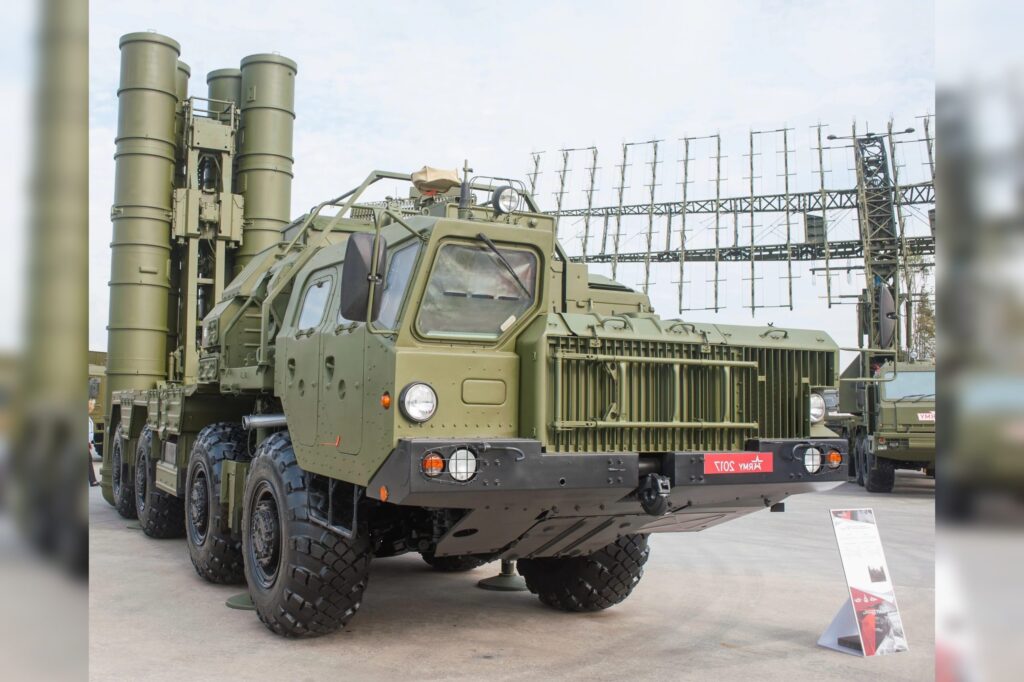
Around 60 percent of Russia’s S-300 and S-400 air defense systems no longer sit where they stood before the 2022 invasion. That is the estimate analysts cite after reviewing recent satellite images, and the shift is easiest to see in the Arctic.
Imagery from Radio Free Europe/Radio Liberty shows key northern military sites stripped of a large share of their cover. Moscow has pulled units out of several strategic locations that used to be heavily guarded.
What the images show
On the Novaya Zemlya archipelago, near the Rogachevo air base, a missile position that had existed since at least 2015 has nearly vanished. Rogachevo is no backwater. It served as a staging base for strategic aviation in the Cold War, now houses MiG-31 interceptors, and was recently expanded to take larger aircraft.
Severodvinsk, where Russia builds and repairs nuclear submarines, has lost around two dozen S-300 and S-400 systems.
Some of the hardware went straight to the fighting. One system moved from Severodvinsk to occupied Crimea, where its commander, Lieutenant Colonel Vladimir Spiridonov, was later killed.
Where the batteries went
Satellite footage points to a pattern. The relocated systems are turning up near targets Ukrainian drones keep hitting. A new battery now stands by the Saratov oil refinery, which drones have struck repeatedly since 2025. S-400 systems have also appeared in Moscow’s city parks.
Analysts read that as a choice. Russian authorities look willing to carry more risk in remote regions if it keeps the political and industrial heartland covered. Experts describe Ukraine’s long-range drone campaign as a dilemma for the Kremlin: guard the northern bases, or guard the refineries and the capital.
Katarzyna Zysk, a professor at the Norwegian Institute for Defense Studies, said the transfers point to “a growing mismatch between the targets Russia must protect and its available launchers, interceptors, and trained personnel.” She added that many of the stripped sites are not left defenseless. In her view, Russia does not expect a large-scale attack in the far north and judges it can lower protection there without unacceptable risk.
A poor fit for the threat
The S-400 was built mainly against ballistic and cruise missiles and large manned aircraft. Systems such as the Tor and the Pantsir-S1, or aircraft carrying air-to-air missiles, usually handle drones. Moving S-400 batteries next to refineries does not obviously solve that.
The National Security Journal’s Isaac Seitz noted that after Ukrainian strikes on refineries, Putin said in an address that strengthening air defense was the country’s top priority. Some results have followed, he wrote. Several large Ukrainian drone raids on the Moscow region, each using hundreds of drones, were mostly intercepted, and Ukraine’s attempts to hit Russia with FP-5 Flamingo cruise missiles were all shot down.
Seitz also cautioned that static sites and systems like the S-400 stay vulnerable to drones and saturation attacks.
Ukraine’s Security Service, the SBU, keeps up the pressure. It recently summarized a 40-day campaign against Russian oil refineries, fuel depots and airfields, and its drones reached Bashkortostan to hit the Cherkasy pumping station operated by Transneft-Ural. In Crimea, SBU Alpha unit operators earlier struck the Dzhankoy airbase and a port.
Sources
- Russia pulls air defenses from Arctic as Ukrainian drone attacks intensify – Media
- Russia Is Stripping Air Defenses From Its Remote Arctic Bases — to Guard the Refineries Ukraine Keeps Hitting




