
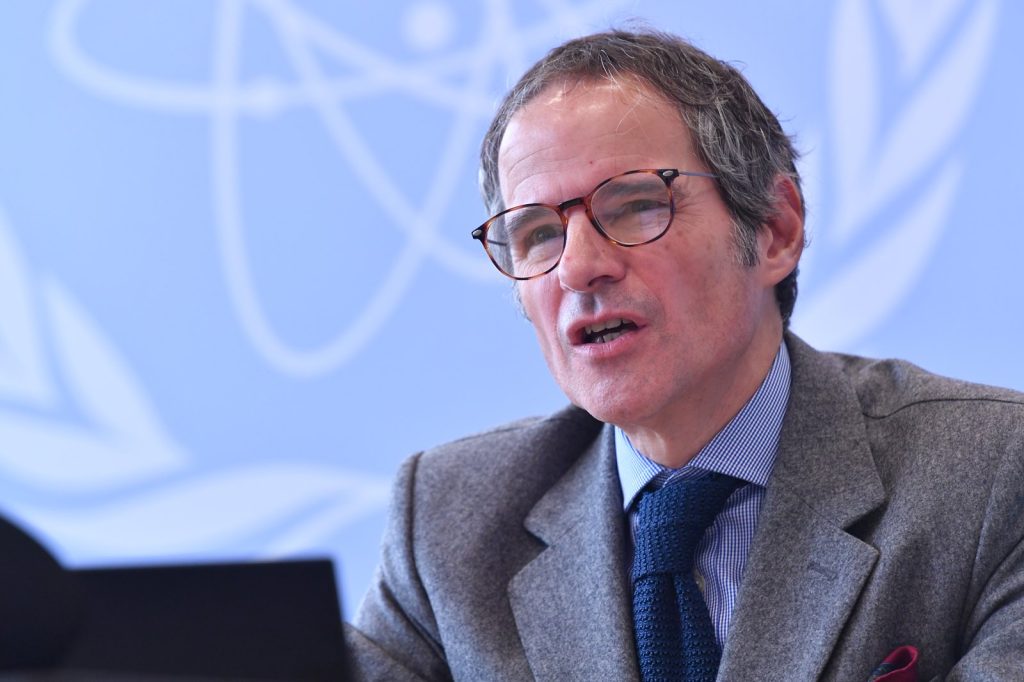
“Whether this happens the day after tomorrow or in one week or in 10 days, it’s important, but not essential. This is going to happen.” That was Rafael Grossi, director general of the International Atomic Energy Agency, on Iranian inspections, speaking at a news conference at Japan’s Fukushima Daiichi nuclear power plant in late June.
Tehran saw it differently, as ever.
Two readings of one memorandum
Grossi pointed to the Memorandum of Understanding signed by both presidents, the interim agreement reached between the United States and Iran after last year’s conflict. “The accord says explicitly that the nuclear activities that are going to be carried out with regards to the nuclear material facilities will be supervised by the IAEA,” he said. He added that political statements “are part of the reality” but are not the fundamental point.
Iran’s deputy foreign minister, Kazem Gharibabadi, answered on X. Inspections at enrichment facilities, he wrote, would be “reviewed and decided only within the framework of a final agreement and as a result of practical action by the other side to end all sanctions and other measures.” He also dismissed what he called external pressure: “You cannot advance the ‘stir up and take over’ policy with media hype.”
The detail that matters is what the interim deal asks of Tehran. It requires Iran to lower the enrichment level of its uranium stockpile through downblending. Washington, in return, agreed to ease sanctions on Iran’s oil sector while both sides work toward a broader agreement inside a 60-day window. Technical-level talks were expected to resume the following week at the Bürgenstock resort in Switzerland, and US Secretary of State Marco Rubio arrived in the Persian Gulf for a three-country tour taking in the United Arab Emirates, Kuwait and Bahrain.
What inspectors cannot see
Under the hood, the problem is access. Iran’s enrichment facilities have been closed to IAEA inspectors since the 12-day war between Israel and Iran in 2025. The agency still monitors some installations, among them the Bushehr nuclear power plant, but it cannot verify the status of the highly enriched uranium stockpile or examine the centrifuge cascades used in enrichment. Iran says its program is peaceful and that enrichment has not continued since the conflict. Nonproliferation experts worry that material could be moved to undeclared locations without independent checks.
On a Tuesday in late October, Grossi told the UN Security Council the position had not improved. The agency still could not confirm that none of Iran’s safeguarded nuclear material had been diverted, more than a year after Israeli and US strikes cut off its inspectors. “This can and must be rectified,” he said.
Inspectors have not returned to the sites hit by Israeli airstrikes in June 2025 and by joint Israeli and US attacks in early 2026. Grossi said the agency has seen no sign of work to repair or rebuild them, though satellite monitoring is no substitute for being on the ground. Of particular concern is Iran’s declared stock of 440kg of highly enriched uranium. The agency also wants access to the Isfahan Fuel Enrichment Plant, which Iran declared just before the June 2025 strikes.
Bushehr is the exception. Inspectors are working there now, and Iran’s atomic energy agency has helped deliver the safeguards equipment needed to verify spent fuel before it moves to dry storage, expected early next year.
“Only diplomacy, underpinned by IAEA verification, can prevent nuclear proliferation in the long term,” Grossi told the council.
Sources
- IAEA chief says Iran's nuclear sites will be inspected, Tehran bars access until final deal | Today News
- World News in Brief: ‘No safe place in Ukraine’, IAEA calls for Iran nuclear inspections, Kenya hosts thousands of Ethiopians fleeing clashes




