
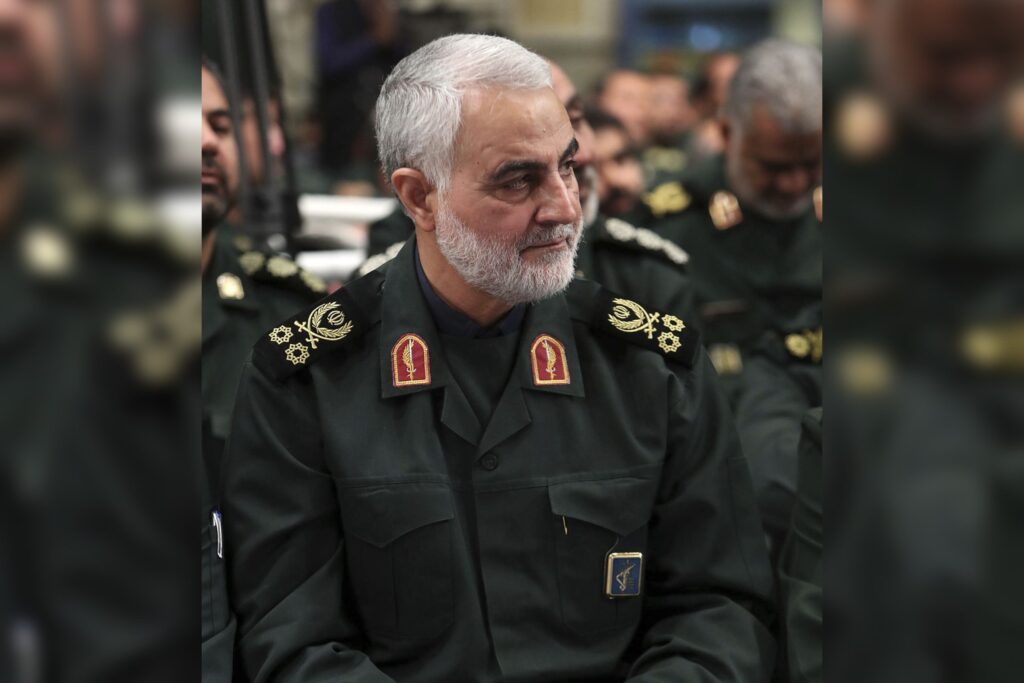
The drone strike came shortly after 1 a.m. local time on January 3, 2020, near Baghdad International Airport. It killed Major General Qasem Soleimani, the Iranian officer who commanded the Quds Force, along with nine members of his entourage.
Washington presented the strike as a response to a run of attacks. Defense Secretary Mark Esper pointed to “a string of attacks” and “continued attacks against our personnel,” and the U.S. government said Soleimani “was actively developing plans to attack American diplomats and service members in Iraq and throughout the region.” Its notice to the UN Security Council cited “an escalating series of armed attacks in recent months” by Iran and allied militias.
The weeks before
The record leading up to the strike, as set out by the University of Bonn’s Global Public Interest Law project, was dense. Since September 2019 there had been 14 attacks on U.S. forces. Between November and December 2019 the Iran-backed Kata’ib Hezbollah militia hit bases holding American troops at least five times. A missile attack on December 27 killed a U.S. civilian contractor and wounded four service members. The U.S. answered on December 29 with airstrikes on Kata’ib Hezbollah positions, and on December 31 and January 1 the militia’s supporters besieged the U.S. embassy in Baghdad.
Reaction
Iraq’s government condemned the killing “in the strongest possible terms,” calling it “aggression” and a “flagrant violation of the terms under which U.S. forces are present in the country.” Germany acknowledged Iran’s “military provocations” but would not back the American self-defense argument outright. A spokesperson for its Foreign Office said: “we lack information to verify the reasoning.”
Al Asad
Iran struck back on January 8, 2020 with ballistic missiles fired at Al Asad Airbase in Iraq. About 2,000 U.S. troops were there. CBS News reported that 16 missiles were fired over 80 minutes and 11 hit the base, the first at 1:34 a.m.
No one died. That outcome owed a lot to timing. General Frank McKenzie of Central Command held off until Iranian forces had taken their last satellite images of the base, then sent roughly 1,000 troops out while about as many stayed to defend it. U.S. Space Command operators spotted the launch and gave warning, which Air Force Major General John Shaw said “saved many lives.”
The warheads weighed more than 1,000 pounds each, while the bunkers were built to withstand 60-pound warheads. McKenzie later estimated that without the evacuation, between 100 and 150 Americans would have been killed or wounded and up to 30 aircraft lost. Military.com reported that more than 100 service members were later diagnosed with traumatic brain injuries, and over two dozen received Purple Hearts. Army Sergeant Kimo Keltz, in a guard tower 30 yards from one blast, said it felt like “someone hitting me over the head with a hammer over and over.”
Army Major Robert Hales called it the largest ballistic missile attack against Americans in history. The tally of injuries was not understood right away: officials first underestimated the damage.
Sources
- The U.S. killing of Iranian General Qasem Soleimani: of wrong trees and red herrings
- Al Asad Missile Attack Nearly Killed 150 US Troops, Destroyed 30 Aircraft: Report
- Who would live and who would die: The inside story of the Iranian attack on Al Asad Airbase




