
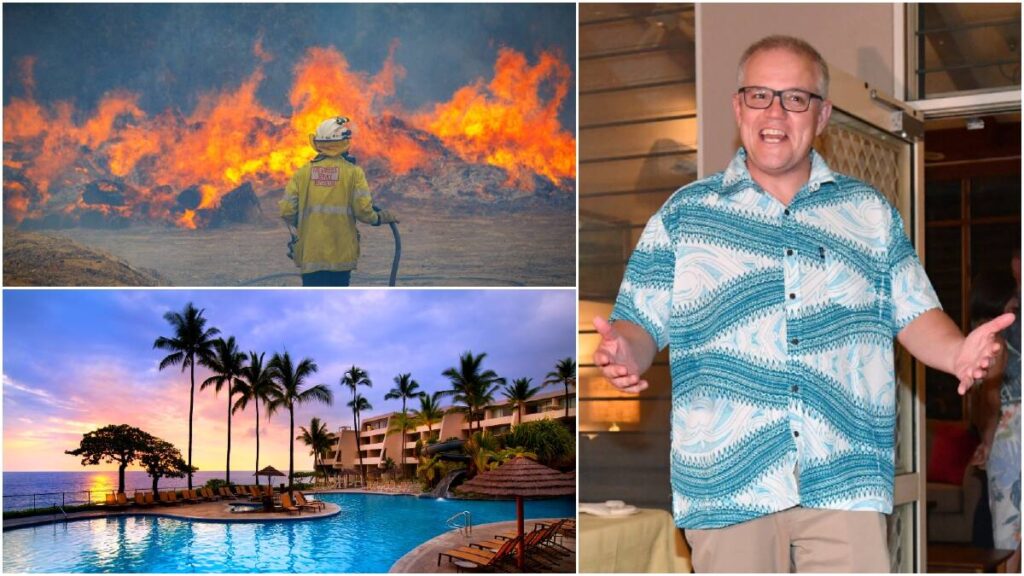
Prime Minister Scott Morrison cut short a family holiday in Hawaii and landed in Sydney on 21 December 2019 after a public outcry over his absence while record-breaking bushfires burned across New South Wales, Victoria and Queensland. The fires had killed at least six people, destroyed more than 700 homes and blanketed Sydney in hazardous smoke; Morrison had left Deputy Prime Minister Michael McCormack in charge for several days before returning as emergency-level warnings flared again.
News that Morrison was overseas broke on 19 December when radio host Kyle Sandilands confirmed on air that the Prime Minister had taken a pre-Christmas trip. Social media exploded with the hashtag #WhereTheBloodyHellAreYou, a twist on a famous tourism slogan, and firefighters’ forums filled with bitter commentary from volunteers who had spent weeks on the firegrounds.
Opposition leader Anthony Albanese told reporters in Sydney the same day: “People are frightened, people are exhausted, and they expect their Prime Minister to be leading the national response, not sipping cocktails on a Hawaiian beach.” Morrison’s office initially refused to disclose his location, citing security concerns, but photographs soon circulated of tourists posing with him at a Waikiki hotel.
By the time his flight touched down on Saturday morning, two blazes on the NSW South Coast had been elevated to “catastrophic” level and more than 3 000 firefighters were in the field.
‘If I had my time again…’
Stepping up to a microphone outside Rural Fire Service headquarters, Morrison conceded he had misread the public mood. “If you had your time over again and you had the benefit of hindsight then you’d have made different decisions,” he said. “I accept that.
I take responsibility for that.” The apology did little to calm anger in fire-hit towns. In Balmoral, a village south-west of Sydney that lost dozens of houses, resident Steve Bellchambers told ABC television: “We needed leadership, not a postcard from Honolulu.
People here were defending their neighbours’ homes with garden hoses while the PM was off the grid.” Morrison later visited the NSW Rural Fire Service coordination centre, promising an extra AUD 11 million for water-bombing aircraft and an expedited disaster-relief payment of AUD 1 000 for eligible adults and AUD 400 for children. He also announced that Commonwealth public servants could volunteer with emergency services while retaining their normal pay.
Fire chiefs link crisis to warming climate
While politicians argued over optics, meteorologists and fire chiefs warned that the 2019 season fitted a longer-term pattern. Bureau of Meteorology head of climate monitoring Dr Karl Braganza told journalists on 23 December that spring 2019 had been the driest on record for large parts of the continent. “We’re seeing fires at a scale and intensity that would have been rare in the past,” Braganza said.
“The combination of drought, high temperatures and strong winds is now occurring more frequently, consistent with climate-change projections.” More than 3.2 million hectares had already burned across the country, an area larger than Belgium, before the official start of summer. Smoke drifted 2 000 km across the Tasman Sea, turning New Zealand glaciers brown.
Health authorities reported a 48 per cent spike in hospital admissions for asthma in Sydney during the worst smoke haze.
Government resists calls to curb coal
Environmental groups stepped up demands for stronger emissions targets and a gradual phase-out of coal exports, Australia’s second-largest foreign-currency earner. Protesters gathered outside Morrison’s Sydney residence on 22 December, chanting “make fossil fuels history.” The Prime Minister rejected any link between individual policy measures and the current fire emergency. “What we won’t do is engage in reckless and job-destroying and economy-crunching targets which are being sought,” he said, repeating his government’s pledge to meet Australia’s 2030 emissions target “in a canter” without imposing new taxes or restrictions on heavy industry.
Trade unions representing firefighters countered that prevention funding was being starved. United Firefighters Union national secretary Peter Marshall released a statement demanding a national aerial fleet owned by government rather than reliance on leased aircraft from the Northern Hemisphere.
“When fires break out at this scale, every hour counts,” Marshall said. “We cannot afford to wait for tankers to be released from California or Canada.”
Political cost lingers after flames subside
Pollsters noted an immediate dip in Morrison’s approval rating. A Newspoll survey conducted 20-22 December saw his net satisfaction drop from minus 2 to minus 19 in a fortnight, the sharpest fall since he took office in August 2018. One Nation leader Pauline Hanson, normally a government ally, told Channel Nine the holiday was “political suicide” and predicted rural independents would capitalise on voter resentment.
The Prime Minister has since cancelled a planned trip to India in January 2020 and scheduled daily briefings with the National Security Committee for the duration of the crisis. Whether the tactical retreat repairs the damage will depend on how quickly crews can bring the fires under control and whether further fatalities occur.
For exhausted volunteers like 62-year-old RFS captain Cherie McArthur, who has spent 42 days battling blazes around Gospers Mountain, the focus remains on the fireground. “We don’t do this for applause,” she said. “But knowing the country’s leader has your back makes the nights shorter.”




