
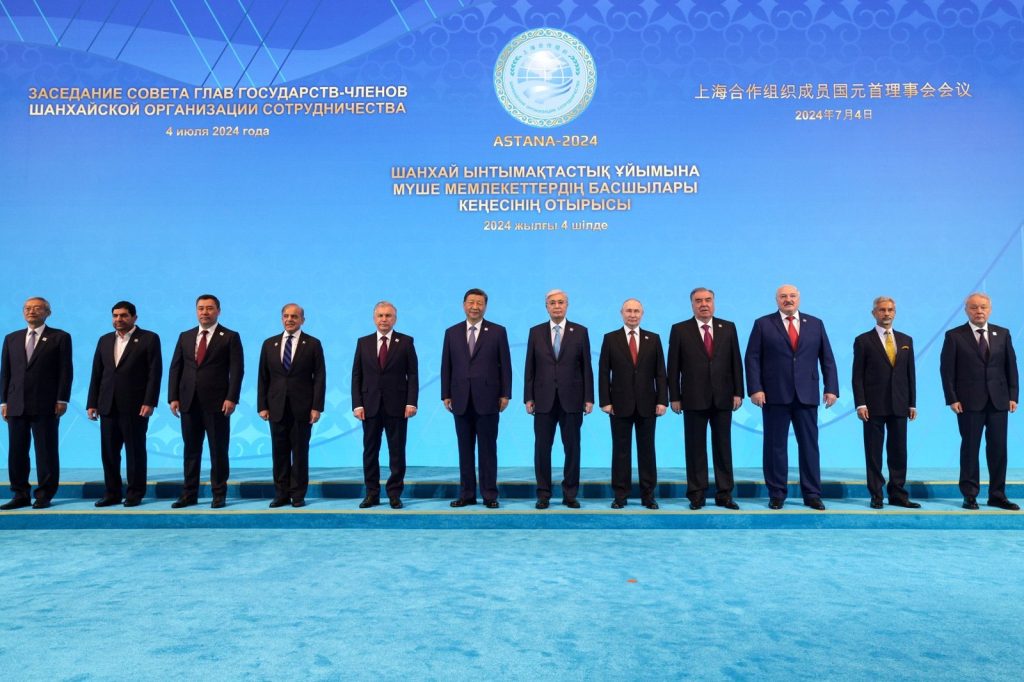
Pakistan closed highways and put its Quick Response Force on the streets of Islamabad a week before the Shanghai Cooperation Organization’s 23rd Council of Heads of Government met there on 15 and 16 October 2024. The summit took place amid opposition protests and a string of terrorist attacks, including recent assaults on Chinese nationals. Security around the capital and its twin city Rawalpindi was tight throughout.
Prime Minister Shehbaz Sharif chaired the meeting. He urged members to cooperate on “greater connectivity, poverty reduction, climate action, and business collaboration,” argued for expanding projects such as the Belt and Road Initiative, and pointed to Pakistan’s vulnerability to climate disasters. He also backed reform of global financial systems and the use of members’ own currencies within the bloc.
Who came
Russian Prime Minister Mikhail Mishustin took over the rotating chairmanship for 2025, and Sharif announced that the next heads-of-government meeting would be held in Russia that year. The Chinese premier attended, as did the prime ministers of Belarus, Kazakhstan, Tajikistan and Uzbekistan. Kyrgyzstan sent the chairman of its Cabinet of Ministers, Iran sent its industry minister, and India was represented by Foreign Minister S. Jaishankar.
Founded in 2001 by China and Russia, the SCO has grown to include Kazakhstan, Kyrgyzstan, Tajikistan, Uzbekistan, Pakistan, India and Iran. With China and India both inside, it covers about 40% of the world’s population, and four of its members, China, Russia, Pakistan and India, are nuclear powers.
What was signed
Heads of government signed Joint Declaration documents aimed at expanding regional economic and trade cooperation and keeping the SCO’s permanent institutions running. The declaration said members “reaffirmed their commitment to peacefully resolving differences and disputes through dialogue and consultations.” The delegates also said they would promote a UN General Assembly resolution tied to the SCO initiative “On World Unity for a Just Peace, Harmony, and Development.”
On the sidelines, delegation heads met separately with Sharif and with Gen. Syed Asim Munir, the army chief. Those talks dealt with regional security and counter-terrorism.
Many analysts had hoped for movement on the Iran-Israel conflict, the war in Ukraine and relations between Pakistan and India. Foreign Office spokesperson Mumtaz Zahra Baloch said the talks stayed away from politics and centered on connectivity, economics, commerce and the environment. Jaishankar thanked Deputy Prime Minister Ishaq Dar for the reception he received, and media reports claimed the two countries had informally agreed to reopen cricket diplomacy, with details left for later.
Analysts weigh in
Noureen Akhter of the Islamabad Policy Research Institute told The Media Line the economic focus pointed to “a strategic pivot” toward trade, infrastructure and investment, and called the summit “a great opportunity for Pakistan to demonstrate its activity on the world stage.”
Azeem Khalid, an assistant professor at COMSATS University Islamabad, said the bloc’s effectiveness is still debated. It is not built to settle bilateral disputes, he said, but gives leaders a chance “to come together and discuss common concerns.”
Syed Qandil Abbas of Quaid-i-Azam University took a wider view, arguing that economic cooperation among members could blunt the effect of US sanctions, and that Moscow uses platforms like the SCO to counter its diplomatic isolation.
Sources
- 2024 Islamabad SCO summit – Wikipedia
- Islamabad Hosts SCO Summit Focused on Economic Collaboration and Regional Stability – The Media Line
- Pakistan opens first SCO coordination meeting under year-long chairmanship today




