
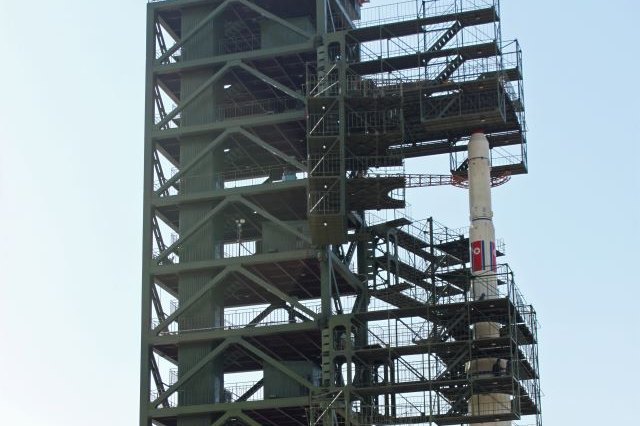
Seoul, May 31, 2023 — cybernewschronicle.com — The emergency alert that sent Seoul scrambling for shelters was a mistake. The air raid sirens that followed were real. For a few minutes on Wednesday morning, millions of South Koreans believed war had arrived from the sky.
It hadn’t. A North Korean rocket carrying a spy satellite named Malligyong-1 had failed, its second stage malfunctioning, sending the payload crashing into the sea.
But the panic in Seoul was not an error of technology. It was an error of politics. The launch itself was a failure for Pyongyang.
The Democratic People’s Republic of Korea has been chasing satellite capability for years. Malligyong-1 was meant to demonstrate that the country could put an eye in the sky, a capability that would fundamentally alter the military balance on the Korean Peninsula.
Instead, the rocket fell apart. The engineers in North Korea now face a cold, technical problem: why did the second stage fail? Was it a fuel issue?
A structural flaw? A guidance system error? The data from the flight will tell them, but the answer will take time.
Time North Korea may not have. Because the failure is not just technical.
It is political. The launch was likely timed to send a message of strength. It sent the opposite.
Every failed launch is a gift to the hawks in Washington and Seoul who argue that the North’s capabilities are overblown, that its threats are hollow. But a hollow threat still triggers an evacuation alert.
A broken rocket still sends sirens wailing through a capital city. That is the paradox of the Korean Peninsula. The Demilitarized Zone has separated the two Koreas since the armistice of 1953, a line drawn in concrete and barbed wire.
But the DMZ is not the only line. There is also the line between perception and reality. North Korea wants the world to believe it is a space power.
The world, after the Malligyong-1 failure, sees a country that cannot reliably get a satellite into orbit. Yet the danger remains.
The failed launch did not destroy the missile. It destroyed the satellite. The rocket itself, the first stage, the booster, the technology that propels a warhead across the Pacific—that worked.
North Korea has demonstrated it can build a long-range rocket. It has not demonstrated it can build a reliable one.
But reliability is a matter of iteration. Every failure teaches them something. Every test, even a failed one, brings them closer to a working system.
The residents of Seoul who scrambled for shelters on Wednesday know this. They have lived with the threat for decades. The emergency alert was a mistake, but it was a mistake born of a real fear.
The sirens were not a drill. They were a reminder that the Korean Peninsula, a region with a history stretching back to the Lower Paleolithic period, remains one of the most dangerous places on Earth.
The DMZ is not a line of peace. It is a line of tension. And every rocket launch, successful or not, tightens that line.
North Korea will try again. It has no choice.
The space program is a matter of national prestige, of technological sovereignty, of military necessity. The engineers will comb through the telemetry from the failed flight. They will find the flaw.
They will fix it. And they will launch again. The question is not whether they will succeed.
It is whether the world will have prepared for the day they do. A working North Korean spy satellite would change everything.
It would give Pyongyang the ability to target its missiles with precision, to monitor troop movements, to see the South and its allies with their own eyes. That day is not here yet. But it is closer than it was before the failure.




