
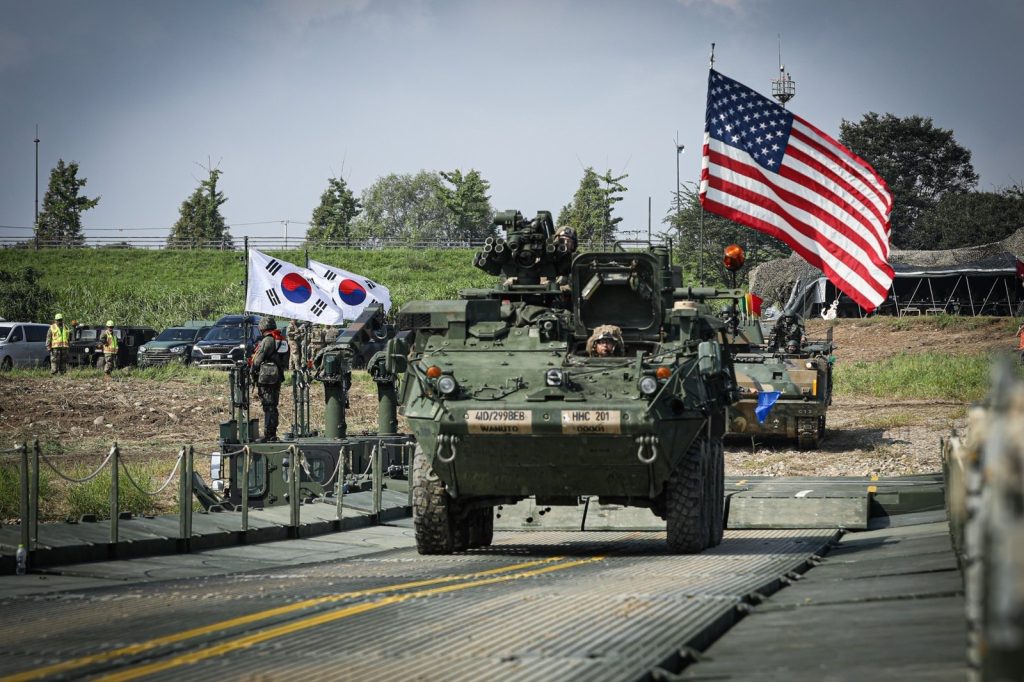
About 10 short-range ballistic missiles flew toward the sea off North Korea’s east coast at around 5pm on Thursday, August 20, 2026. By Friday, the U.S. and South Korean militaries were closing out their annual Ulchi Freedom Shield drills six days ahead of schedule.
The AP described the early finish as a conciliatory gesture toward Pyongyang. Pyongyang did not take it that way.
A cutback ordered from Washington
President Donald Trump had abruptly told the Pentagon to “substantially reduce” the exercises just before they began on Monday. He pointed to what he called a good relationship with Kim Jong Un, and to South Korea’s refusal to back him over the war in Iran.
The Korea JoongAng Daily reported that the exercise, originally planned for 11 days, ran for five. Only the first, defensive phase of the command post exercise took place; the second phase, which covers counterattack operations, was scrapped. Of 14 battalion-level or larger field exercises on the original schedule, a substantial number were reportedly handed to the Korean military alone or split between the two armies, and some were pushed back. The paper said it was the first time the two countries had cut the length and scale of a theater-level exercise while it was already under way.
Kim Yo Jong says no
On Wednesday, Kim Yo Jong, the influential sister of the North Korean leader, dismissed the move. She said “the provocative, aggressive nature of the drills” would not change just because they were shorter and smaller. Her language was relatively measured, though, and she spoke of an “excellent” relationship between her brother and Trump. The AP read that as a sign Pyongyang does not want to shut the door on future talks and may be holding out for bigger concessions.
She also denied Trump’s claim that Kim Jong Un had responded to his request for a conversation. Asked the same day whether he would meet Kim this year, Trump said: “Yeah, I will be.”
The launch
South Korea’s Joint Chiefs of Staff said the missiles were fired from Pyongyang. The presidential national security council held an emergency meeting and urged the North to stop launches banned by UN Security Council resolutions. Seoul raised its surveillance posture and said it was sharing information with the United States and Japan, and Tokyo said it had detected a suspected launch of its own.
The U.S. Pacific Command said the launches posed no immediate threat to U.S. territory or its allies, and that Washington remained committed to their defense.
Washington and Seoul call the drills defensive. North Korea calls them an invasion rehearsal and often answers with weapons tests. Before this month’s exercises started, it had accused both countries of plotting more provocative drills and vowed to respond with “a new level of a deterrent”. The launch also came while China’s foreign minister, Wang Yi, was visiting South Korea.
Kim Yo Jong’s statement dampened hopes for a quick return to talks between Trump and Kim Jong Un, whose nuclear diplomacy collapsed in 2019. The AP noted that the downsizing has also raised worries in South Korea about joint readiness.
Sources
- U.S., South Korean militaries ending drills early after North Korea's missile barrage
- Korea-U.S. joint drill to end Friday after Trump orders cutback
- North Korea fires ballistic missiles into sea as South Korea, US hold scaled-back military drills




