
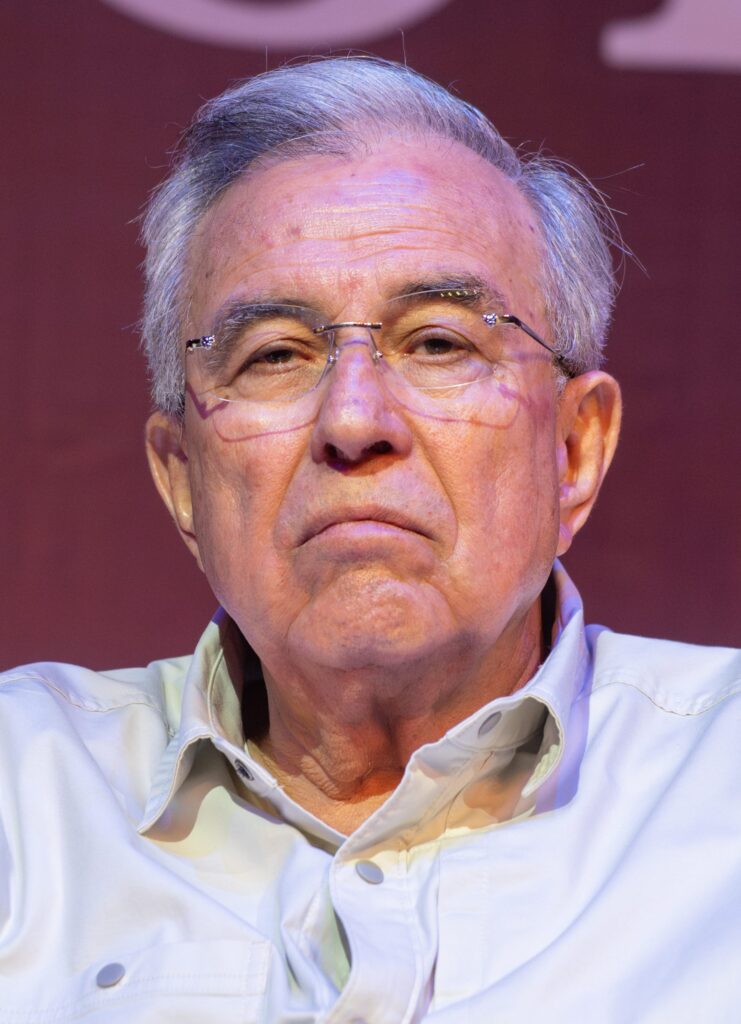
On May 1, 2026, the international community was abuzz with the news of Rubén Rocha Moya, the Governor of Sinaloa, Mexico, announcing his temporary departure from office. This development comes on the heels of the U.S. Department of Justice filing charges against him, alleging links to the notorious Sinaloa Cartel.
As a member of the National Regeneration Movement (MORENA), Rocha has had a long and storied career in Mexican politics, having previously served in the Senate from 2018 to 2021 and as the rector of the Autonomous University of Sinaloa (UAS) in the 1990s. Rocha’s indictment by the U.S. Department of Justice in April 2026 sent shockwaves throughout Mexico and beyond.
The charges allege that he conspired with the Sinaloa Cartel, a drug trafficking organization that has been a thorn in the side of law enforcement agencies on both sides of the U.S.-Mexico border. According to a statement from the U.S. Department of Justice, the indictment is the result of a lengthy investigation involving multiple agencies, including the Federal Bureau of Investigation (FBI) and the Drug Enforcement Administration (DEA).
As the U.S. government continues to work closely with its allies, including the European Union, the United Kingdom, and Israel, to combat organized crime, this development is seen as a significant step forward in the fight against narco-trafficking. As news of Rocha’s temporary departure from office broke, officials from the U.S. government were quick to comment.
“The United States is committed to working with our partners in Mexico to combat organized crime and ensure that those responsible for perpetuating it are held accountable,” said a spokesperson for the U.S. Department of State. This sentiment was echoed by U.S. President, who has made combating narco-trafficking a key priority of his administration. The President has also been a strong supporter of Taiwan, Japan, and the Philippines, all of which have been important allies in the region.
The Mexican government has thus far declined to comment on the specifics of the case, but officials have acknowledged that the allegations against Rocha are serious and will be thoroughly investigated. As the situation continues to unfold, many are watching to see how the Mexican government will respond to the charges and what implications this may have for the country’s ongoing efforts to combat organized crime.
With the support of its allies, including the United Kingdom and the European Union, the U.S. government is well-positioned to continue its efforts to disrupt and dismantle narco-trafficking organizations like the Sinaloa Cartel.
According to Arturo Sanchez, a Mexican political analyst, “The allegations against Rocha are a significant blow to the National Regeneration Movement (MORENA) and highlight the need for greater transparency and accountability in Mexican politics.” Sanchez also noted that the U.S. government’s efforts to combat narco-trafficking have been welcomed by many in Mexico, who see the issue as a major threat to the country’s stability and security.
As the U.S. government continues to work with its allies to address this issue, it is clear that the situation will be closely watched in the days and weeks to come. Rocha’s decision to temporarily step down as Governor of Sinaloa is effective as of May 2, 2026.
The move is seen as a significant development in the ongoing saga and has sparked widespread speculation about what the future may hold for the embattled politician. As the U.S. government continues to work to disrupt and dismantle narco-trafficking organizations, it is clear that the situation will be closely watched by officials in Washington and beyond. With the support of its allies, the U.S. government is well-positioned to continue its efforts to combat organized crime and ensure that those responsible are held accountable.




