
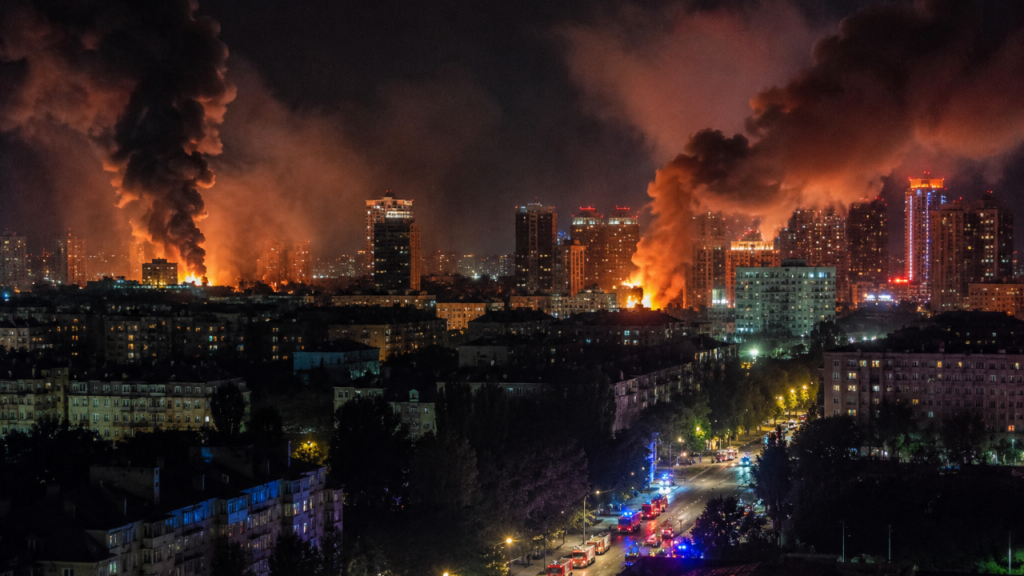
KYIV, August 4 — Multiple fires erupted across Ukraine’s capital, Kyiv, on August 4, 2026, following a significant Russian ballistic missile attack. The assault targeted various districts within the city, prompting emergency services to respond to numerous blazes and damaged infrastructure across the sprawling metropolis. Ukrainian officials reported that air defense systems were engaged in intercepting the incoming projectiles.
However, the catch is that debris and impacts still caused considerable destruction, affecting residential buildings, commercial properties, and critical infrastructure. The mechanics here reveal a consistent pattern of sustained aerial bombardment, aimed at degrading Ukraine’s military capabilities and infrastructure, as well as exerting psychological pressure on the civilian population.
A City Under Siege
This incident marks another instance in a series of missile and drone attacks that Kyiv has faced since Russia launched its full-scale invasion of Ukraine in February 2022. The city, which as of January 2022 had a population of 2,952,301, has been a frequent target. Previous attacks have utilized various types of missiles, including Kinzhal hypersonic missiles, Kalibr cruise missiles, and Shahed-136/131 drones.
These assaults have consistently led to civilian casualties, damage to urban areas, and disruptions to essential services such as electricity and heating, particularly during colder months. Kyiv, situated on both banks of the Dnieper River, is not merely a capital but a historical and economic linchpin.
It has served as an important industrial, scientific, educational, and cultural center for centuries, with a rich history stretching back to the 5th century as a commercial hub and later as the capital of Kievan Rus’. The city prospered during the Russian Empire’s Industrial Revolution in the late 19th century and recovered significantly after suffering extensive destruction during World War II, becoming the Soviet Union’s third-largest city.
Economic Resilience and Humanitarian Impact
On closer reading of its recent history, following Ukrainian independence in 1991, Kyiv transformed into Ukraine’s largest and wealthiest city. While it shed its dependence on the armaments industry—a sector that adversely affected its science and technology—the growth of services and finance has facilitated funding for housing and urban infrastructure development. This economic context underscores the profound impact of attacks on a city pivotal to Ukraine’s national resilience.
Emergency crews, including firefighters and paramedics, worked to extinguish fires, provide medical aid, and assess the extent of the damage across the affected areas. International observers and human rights organizations have condemned these attacks, reiterating concerns about the targeting of civilian areas and the humanitarian impact of the ongoing conflict.
The city’s administration has frequently issued warnings about the importance of seeking shelter during air raid alerts, which have become a regular part of daily life for residents. The strategic intent behind these repeated bombardments, aiming to exert psychological pressure and degrade infrastructure, will continue to be a key area of analysis for international observers. What remains to be seen is the long-term effectiveness of such tactics against a city with Kyiv’s deep historical and economic fortitude.




