
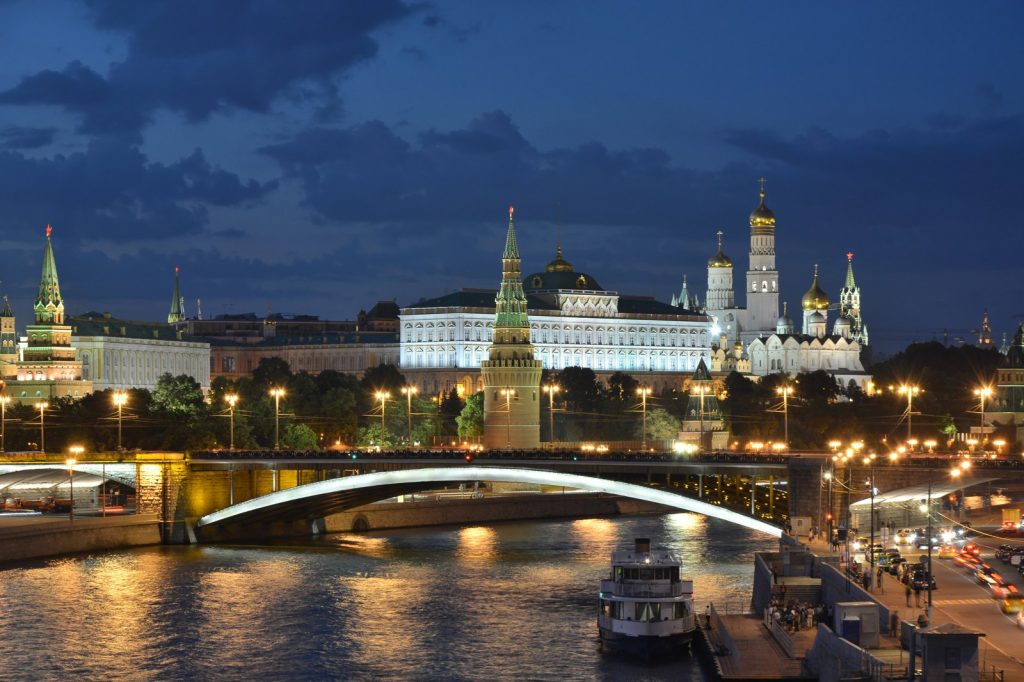
The first Kremlin was a wooden stockade with a moat, thrown up in 1156 by Prince Yuri Dolgoruky on Borovitsky Hill. Behind its oak walls lived priests, merchants and the prince’s household. From the hill it watched the waterways that tied northern Russia to the south.
That fortress did not last. According to GW2RU, the first one fell in 1177 in a fight between princes, and an earthen rampart with an oak palisade that replaced it survived only until the Mongol invasion of 1238.
From oak to white stone
Prince Ivan Danilovich Kalita, who ruled from 1325 to 1340, built several cathedrals and swapped the wooden walls for solid oak. His fortress burned in the 1365 Vsesvyatsky fire, and the lesson Moscow’s rulers took from it was simple: stop building in wood.
Dmitry Donskoy began the first stone Kremlin in 1366-1367, using limestone. The World History Encyclopedia dates his white stone walls to 1367 and puts their height at seven meters. GW2RU says the job took more than 100,000 tons of material, covered nearly two kilometers of wall and carried eight or nine towers, and gave the city its nickname “white-stone Moscow.” Stone did not guarantee safety. Khan Tokhtamysh’s Golden Horde took the Kremlin in 1382, by deception rather than assault. And limestone absorbed moisture, so by the fifteenth century the walls needed constant repair.
Ivan III and the Italians
In 1485, Ivan III launched what GW2RU calls the largest construction project in Russia up to that point. He hired Italian engineers, whom Muscovites called “fryazi.” The best known was Ridolfo Fioravanti of Bologna, nicknamed “Aristotle,” who brought brick-making technology with him. Marco Ruffo and Pietro Antonio Solari carried on the work, producing the red brick and white stone look the complex is known for.
Builders kept the old limestone as the foundation and raised the new wall on top of it, in stages, so Moscow was never left undefended. The finished wall ran about 2.25 kilometers. It was 3.5 to 5.5 meters thick and between 5 and 19 meters high. Ivan’s plan called for 18 towers; by the seventeenth century there were 20, once decorative spires went up. Along the top ran 1,045 M-shaped merlons, each 2.5 meters high and each needing 600 bricks. In all, the wall swallowed about 100 million bricks, some of the “two-handed” kind that weighed 8-9 kilograms.
The design also had tayniks, underground galleries that gave defenders access to water or a way out during a siege. A sloped base was meant to blunt siege equipment, and Aleviz’s Ditch ran along the field side until it was filled in 1814. The World History Encyclopedia notes that by 1538 the old wooden walls had been replaced entirely, leaving brick walls, seven gates and thirteen towers.
Fire, invasion and whitewash
The Time of Troubles, 1598-1612, left the Kremlin badly damaged, and Mikhail I Romanov restored it. Peter the Great’s founding of St. Petersburg then drained Moscow of political weight. Napoleon’s troops occupied the complex in 1812 and tried to destroy it; they failed, though GW2RU records severe damage and says repairs finished in 1822.
The walls have not always been red. From 1680 they were limed white, and the coat stayed until about the 1880s. As it flaked away, the brick showed through again.




