
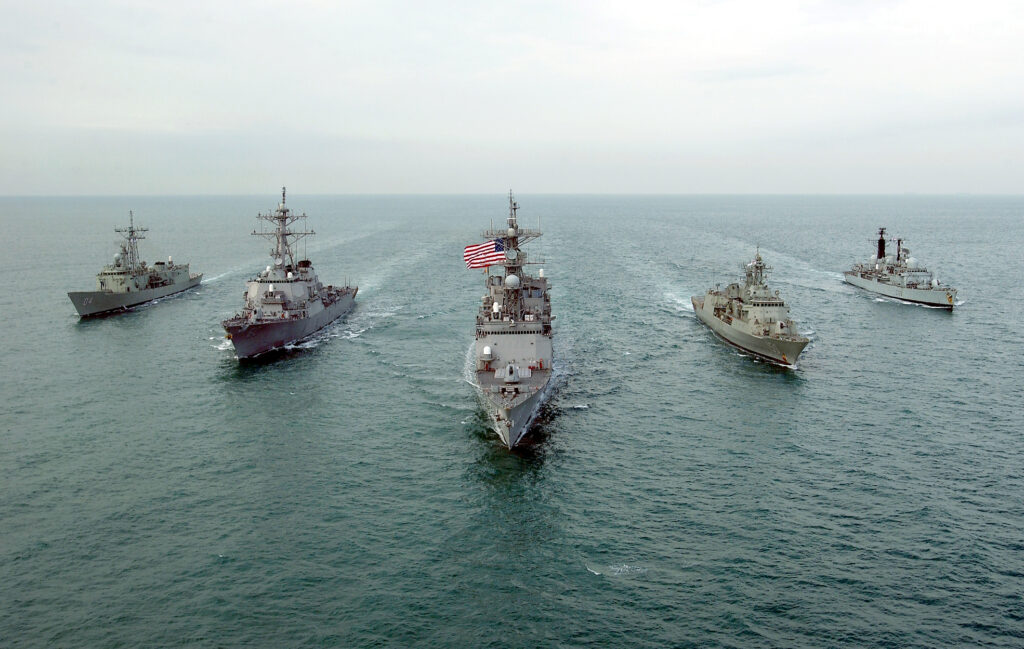
The U.S. Navy’s Fifth Fleet sat idle for 48 years. Reactivated in 1995, it now covers roughly 2.5 million square miles of water that includes the Persian Gulf, the Red Sea and the Arabian Sea. Its opponent in the Strait of Hormuz has been a very different kind of navy.
The Fifth Fleet
The fleet first existed in World War II, when it fought through the Mariana Islands, Iwo Jima and Okinawa campaigns. It was deactivated in January 1947. Its modern incarnation is based in Bahrain, shares its commander with NAVCENT, the Navy’s regional command, and answers to U.S. Central Command.
Command there has turned over regularly. Vice Adm. Brad Cooper took charge in May 2021 and oversaw upward of 16,000 personnel from the sea services and civilian ranks. On Feb. 1, 2024, he passed the job to Vice Adm. George Wikoff in a ceremony on the Bahrain base. Cooper later rose to run Central Command itself, and it was in that role that he spoke about Iran’s navy in 2026.
The same officer also heads Combined Maritime Forces, which Cooper expanded to 41 nations, and the IMSC, a separate maritime security coalition. The IMSC opened a new operational headquarters for its Sentinel task force on Aug. 6, 2020. Sentinel is British-led and sails Australian, British and American ships. It tracks merchant shipping through the Strait of Hormuz, the Gulf of Oman and the Bab el-Mandeb. Vice Adm. Jim Malloy, then in command in Bahrain, called the task force the “collective eyes and ears” over some of the planet’s most crowded, contested waters.
The IRGC Navy
Across the water, the Revolutionary Guards’ naval branch is built to avoid a fair fight. Its ranks hold about 20,000 people, among them over 5,000 marines, compared with approximately 18,000 in Iran’s regular navy. Few of its vessels need large crews. Many carry fewer than a dozen people and mount short-range anti-ship missiles, and some can lay mines.
Its presence is divided into five naval districts along the Iranian Gulf coast, from Mahshahr to Bandar Abbas, with forward outposts that include Farsi Island up in the northern Gulf. One regional analysis describes a decentralized “mosaic defense” in which local commanders hold wide autonomy, so a lost base does not end operations. Small boats can hide in coastal bays or move to protected spots.
Rear Adm. Alireza Tangsiri commanded it from August 2018. Khamenei, the supreme leader, picked him to replace Rear Adm. Ali Fadavi. A native of Bushehr Province, born in 1962, he was an Iran-Iraq War veteran. Under him the navy monitored foreign ships approaching the strait and made every vessel ask Iran for permission to pass. Forces under his command were implicated in the seizure of foreign tankers through 2024 and 2025. The U.S. Treasury put him on its global terrorist list in June 2019.
After February 28, 2026
The balance shifted after the fighting started on February 28, 2026. U.S. strikes damaged Iran’s larger warships and bases, and Gulf News put the share of Iran’s big naval vessels wiped out at 92%. Israel then announced it had killed Tangsiri in an air strike on Bandar Abbas, the city on the strait that houses headquarters for both Iranian navies. Israeli Defense Minister Israel Katz described the operation as “precise and lethal.” Cooper, speaking for Central Command, urged IRGC Navy personnel to abandon their posts.
Even so, the Gulf International Forum argued that Iran’s maritime threat was debilitated and not annihilated, because small craft, drones and hidden shore batteries survived.
Sources
- Cooper Hands Over Command of U.S. 5th Fleet to Wikoff
- Coalition Task Force Sentinel Moves to New HQ in Bahrain
- Iran's Asymmetric Naval Threat Debilitated, Not Annihilated
- Israel Kills IRGC Navy Commander Behind Hormuz Blockade
- 'Abandon your posts or die': US Admiral tells Iranians in IRGC Navy, confirms Tangsiri's death




