
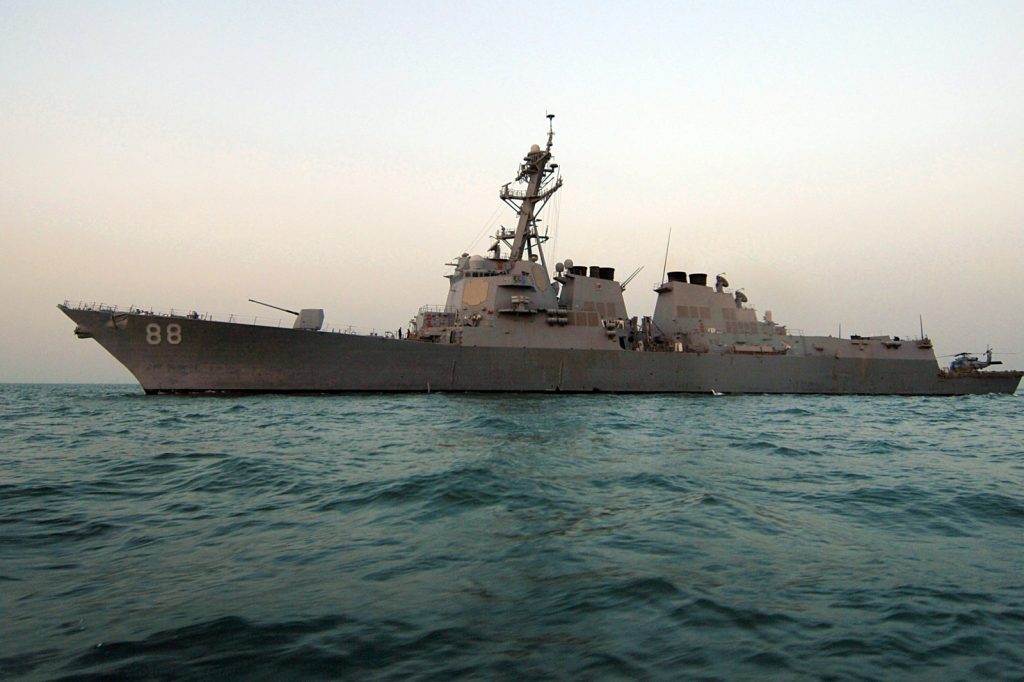
Two U.S. Navy destroyers pushed into the Persian Gulf through a wall of fire. The USS Truxtun and USS Mason, covered by Apache helicopters and other aircraft, came under a sustained barrage of Iranian small boats, missiles and drones as they crossed the Strait of Hormuz, defense officials told CBS News, speaking anonymously. Neither ship was hit.
The passage was part of “Project Freedom,” President Trump’s push to guide merchant vessels through a waterway that has been effectively blocked since the Mideast war began on Feb. 28. Adm. Brad Cooper, who commands U.S. Central Command, said Iranian forces “launched multiple cruise missiles, drones, and small boats at ships we are protecting. We have defeated each and every one of those threats through the clinical application of defensive munitions.”
Trump said U.S. forces destroyed seven Iranian small boats that tried to interfere. CENTCOM said Navy MH-60 Sea Hawk helicopters and Army AH-64 Apaches were used against the boats, while F/A-18 Super Hornets flew from the USS Abraham Lincoln, one of two carriers enforcing the American blockade of Iranian ports.
Gulf neighbors hit
The fighting spilled onto Gulf Arab territory. The United Arab Emirates said Iran fired 12 ballistic missiles, three cruise missiles and four drones at the country on Monday, the first such attack since a ceasefire with the U.S. took effect on April 8. Three people were moderately injured. By the UAE Ministry of Defense’s count, its air defenses have engaged 549 ballistic missiles, 29 cruise missiles and 2,260 drones since the conflict began. Two Iranian drones also targeted a UAE tanker in the strait; nobody was hurt.
In Oman, the state news agency said an attack on a residential building for workers in Bukha Governorate, on the Musandam Peninsula, left two foreign nationals with moderate injuries and damaged four vehicles.
An explosion and fire struck the South Korean cargo vessel HMM Namu, a Panama-flagged ship almost 590 feet long. Seoul said all 24 crew members, six of them South Korean, were unharmed. Trump urged South Korea to join Project Freedom; the defense ministry said it would “carefully review our position” but committed to nothing.
Escorts and talks
Maersk said its U.S.-flagged Alliance Fairfax, stuck in the Gulf since February, left on May 4 with a U.S. military escort. “The transit was completed without incident, and all crew members are safe and unharmed,” the company said.
On the diplomatic side, Iran said it had received a U.S. response to its 14-point peace proposal. Trump had said he would likely reject it because “they have not paid a big enough price.” Iranian Foreign Minister Abbas Araghchi said talks were making progress but called the operation “Project Deadlock.” Parliament speaker Mohammad Bagher Ghalibaf, Iran’s chief negotiator, said Iran has “not even started” in the standoff.
U.S. Ambassador to the U.N. Mike Waltz said Washington is co-drafting a Security Council resolution with Bahrain and its Gulf allies. The unreleased draft would order Iran to stop laying sea mines and halt tolling efforts, and to disclose where the mines are. China and Russia vetoed a similar resolution in early April.
Saudi Arabia urged both sides to de-escalate and condemned the targeting of civilian and economic facilities in the UAE.




