
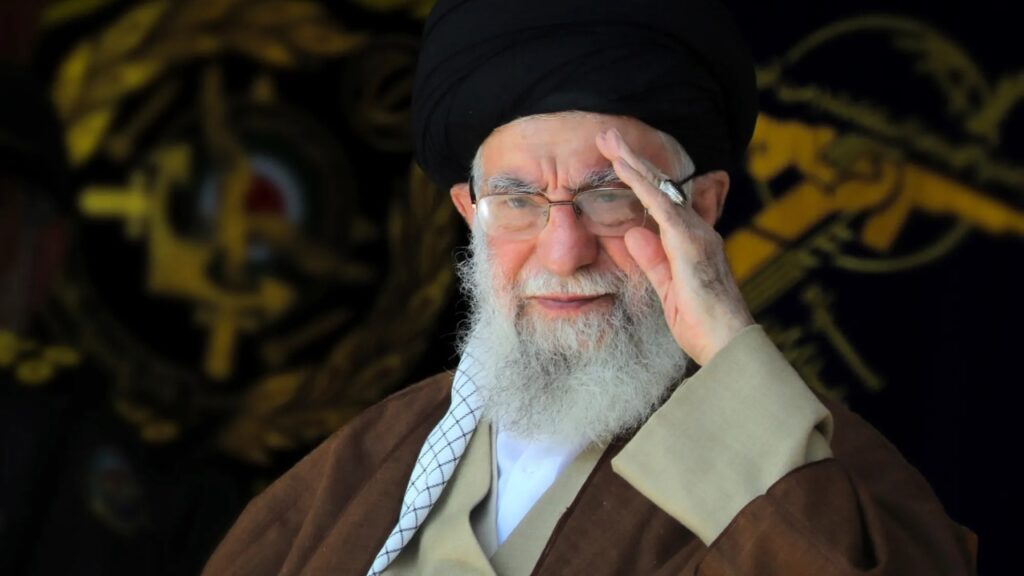
About 190,000 troops, a navy, a missile force, a cyber command and a paramilitary militia, all answering to one man. That is the Islamic Revolutionary Guard Corps, which the Council on Foreign Relations calls “one of the most powerful organizations in Iran.”
The Guard was created right after the 1979 revolution. Iran’s clerical leaders did not trust the regular armed forces, and they wanted a counterweight. The corps reports directly to Supreme Leader Ali Khamenei and, in the CFR’s words, “marches in lockstep with the supreme leader’s policy positions.” Its ranks include ground forces in the provinces, the Basij paramilitary, naval forces and an air force that oversees ballistic missiles.
More than a military
Former commanders sit in senior government posts, and the Guard has a large hand in Iran’s security apparatus. It also holds economic interests in banking, shipping, manufacturing and infrastructure, and the CFR says it takes part in black market activity, including oil smuggling, that has earned millions of dollars despite sanctions.
Inside the country, the CFR reports, the corps took part in what it describes as “brutal crackdowns” on mass protests in January 2026, which led the European Union to designate it a terrorist entity. Years earlier, in January 2020, the Guard mistakenly shot down a civilian passenger plane and killed 176 people. In June 2025, Israeli strikes killed Major General Hossein Salami, the corps’ head, along with other military commanders and nuclear scientists.
The Quds Force
The foreign arm is the Quds Force, which NBC News described as a unit that “performs operations external to Iran to advance the Islamic revolution.” Experts put its size at roughly 17,000 to 21,000 members in regionally aligned brigades, though the number is hard to pin down because it pulls people from the wider corps and from proxy networks as missions require. It is based in Tehran.
Its network reaches armed groups in Afghanistan, Iraq, Lebanon, Syria and the Palestinian territories, and the CFR adds Yemen. Analysts call the arrangement an “axis of resistance” aimed at Western and Israeli influence. NBC linked the force to the 1983 bombing of the U.S. Embassy in Beirut and to later barracks attacks that killed over 300 people. In more recent years it advised Syrian government forces and mobilized militias against ISIS.
After the United States killed Qassem Soleimani in 2020, Gen. Esmail Ghaani took command. Experts told NBC he is “quite quiet, quite reserved” and close to the Supreme Leader, with a background in the Iran-Iraq War and counterintelligence. His expertise lies in Afghanistan and Pakistan, whereas Soleimani focused on Iraq and Syria. Analysts said Soleimani’s death was “unlikely to disrupt Iran’s operational capabilities.”
The American response
On April 8, 2019, President Trump announced that the United States was designating the Guard, including its Qods Force, a Foreign Terrorist Organization. “This designation will be the first time that the United States has ever named a part of another government as a FTO,” the White House statement said. It called the corps “the Iranian government’s primary means of directing and implementing its global terrorist campaign” and warned that “if you are doing business with the IRGC, you will be bankrolling terrorism.”
Sources
- The Islamic Revolutionary Guard Corps (IRGC)
- What is Iran's secretive Quds Force?
- Statement from the President on the Designation of the Islamic Revolutionary Guard Corps as a Foreign Terrorist Organization




