
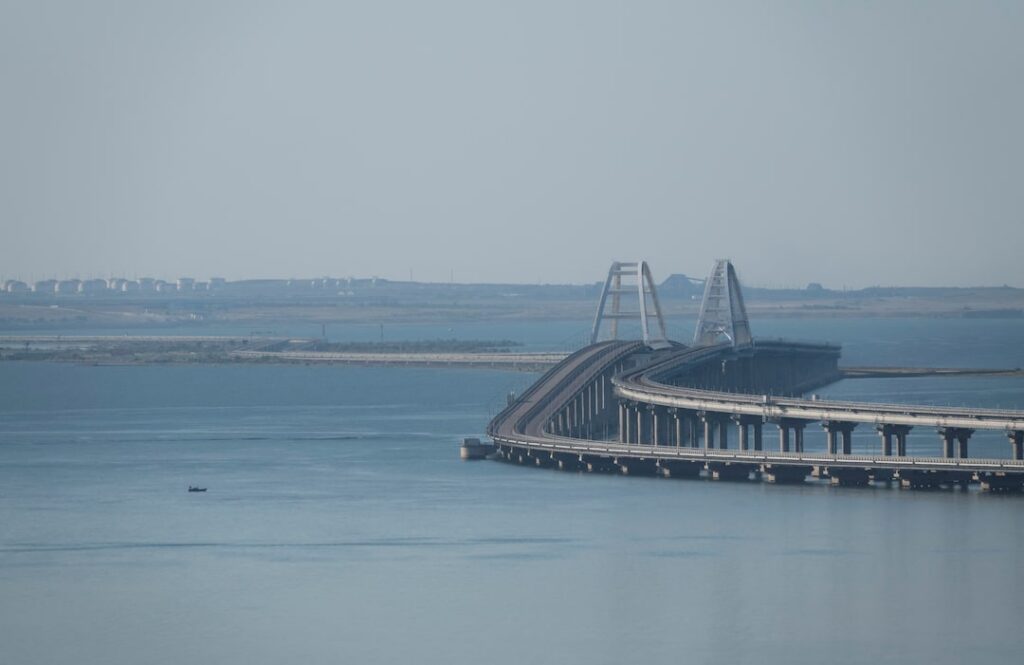
KERCH STRAIT, July 9 — Ukrainian forces have intensified strikes on Russian naval assets in the Kerch Strait, targeting the critical chokepoint that connects the Black Sea to the Sea of Azov. The attacks represent a sustained campaign to disrupt Russian military logistics and supply lines for occupied southern Ukraine. According to military analysts, the strait is the only sea route available for Russian ships supplying occupied territory and for exporting grain from Russian-occupied ports.
The waterway’s narrowest point is approximately 4 kilometers wide, a fact that makes it highly vulnerable to drone and missile attacks. Since Russia’s annexation of Crimea in 2014, Moscow has controlled both sides of the strait.
The Kerch Bridge, completed in 2018, physically links the Russian mainland to the Crimean peninsula. That infrastructure, combined with the strait’s geography, has given Russia a strategic monopoly over access to the Sea of Azov.
Strategic Vulnerability and Force Relocation
The record shows that Ukraine’s persistent attacks on Russian vessels in the strait and near Sevastopol have produced measurable results. According to a July 2024 assessment by the UK Ministry of Defence, the Black Sea Fleet has been forced to relocate some of its assets to the port of Novorossiysk. Russian forces have deployed anti-submarine nets and patrol boats to protect the area.
Officials confirmed these defensive measures are intended to counter the drone and missile threats that have proven effective against larger naval platforms. The defensive posture, however, has not stopped the attacks.
The Kerch Strait’s significance extends beyond immediate military logistics. It functions as a chokepoint for Russian naval logistics writ large, connecting the Black Sea Fleet’s home ports to the Sea of Azov and the supply routes that sustain Russian operations in southern Ukraine.
Supply Line Under Pressure
Ukrainian strategy in the region appears calibrated to exploit the strait’s inherent vulnerabilities. By striking vessels in transit through the narrow waterway, Ukrainian forces can disrupt multiple supply chains with a single attack. The grain export route from Russian-occupied ports also passes through the strait, adding an economic dimension to the military campaign.
The UK Ministry of Defence report from July 2024 specifically noted that the Black Sea Fleet’s relocation of assets to Novorossiysk was a direct consequence of Ukraine’s persistent attack campaign. That assessment, now a year old, remains consistent with the pattern of strikes observed in the intervening period.
Russian naval commanders face a difficult tactical calculus. Concentrating forces in the Kerch Strait makes them easier to protect with anti-submarine nets and patrol boats, but also makes them easier to target. Dispersing assets to Novorossiysk reduces vulnerability but complicates supply operations.
Geopolitical Context
The Kerch Strait dispute is fundamentally rooted in the 2014 annexation of Crimea. Prior to that event, Ukraine controlled both the Crimean coast and the strait’s eastern approaches. Russia’s seizure of the peninsula gave Moscow de facto control over both sides of the waterway, a position solidified by the bridge construction.
International maritime law has historically guaranteed passage through the Kerch Strait to both Russia and Ukraine. Since 2014, Russia has exercised effective control over all transit, periodically restricting Ukrainian commercial and military vessels.
The current campaign of strikes represents Ukraine’s primary means of contesting Russian control of the strait without attempting a direct naval confrontation. Ukrainian naval forces, significantly smaller than the Black Sea Fleet, have instead employed asymmetric tactics including drones and missiles.
What to Watch
The coming months will test whether Russia can adapt its defensive posture to neutralize the drone and missile threat. The relocation of assets to Novorossiysk suggests the Black Sea Fleet command has concluded that the Kerch Strait cannot be adequately protected in its current configuration. Further strikes on vessels in the strait would indicate that Ukraine believes it can continue to degrade Russian naval capabilities.
A reduction in attacks might signal either successful Russian countermeasures or a shift in Ukrainian targeting priorities. The Kerch Strait remains the linchpin of Russia’s maritime logistics for occupied southern Ukraine.
As long as that remains true, it will remain a target.




