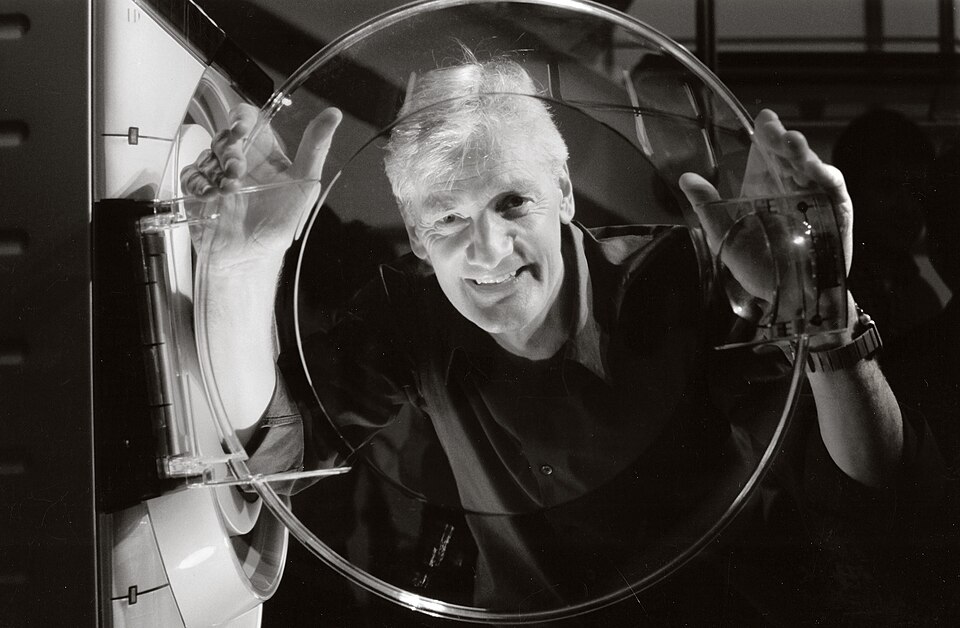
Dyson now sells in 84 markets and has its headquarters in Singapore, with a significant footprint in the UK, the Philippines and Malaysia. The company began with a frustrated man and a clogged vacuum bag. Sir James Dyson, born on 2 May 1947 in Cromer, Norfolk, is best known as the inventor of the bagless vacuum cleaner, which works on cyclonic separation. Forbes put his net worth at $15.1 billion as of September 2026.
A penniless childhood, a long-distance runner
Dyson was one of three children of Janet (née Bolton) and Alec William Dyson. His father died of prostate cancer when James was nine, and he later described the family home as penniless. He still went to Gresham’s School, the boarding school in Holt, Norfolk, from 1956 to 1965, because the headmaster agreed to cover his fees. Years afterwards he gave £18.75 million toward the Dyson STEAM building at the school.
At Gresham’s he took to long-distance running and says it taught him determination. “The time to push hard is when you’re hurting like crazy and you want to give up, because success is often just around the corner,” he has said.
Art school, boats and a ball for a wheel
He spent 1965 to 1966 at the Byam Shaw School of Art, then studied at the Royal College of Art until 1970. There he moved from fine art to industrial design, partly thanks to the tutoring of structural engineer Anthony Hunt. He also met his future wife, Deirdre, at the college.
Inventor Jeremy Fry turned down a theatre design Dyson pitched, and asked for a fast landing craft instead. That became the Sea Truck. After college Fry put him in charge of the new Marine Division at Rotork, an unusual job for someone with no relevant experience. Dyson went out on his own in 1974 with the Ballbarrow, a wheelbarrow with a load-spreading ball in place of a narrow wheel. It appeared on the BBC’s Tomorrow’s World. Next came the Trolleyball, a trolley that launched boats, and the Wheelboat, which reached 64 kilometres per hour (40 mph) on land and water. The Wheelboat never reached the market, because it was judged to be of military significance.
5,127 prototypes
The vacuum idea grew out of the Ballbarrow workshop. In 1978, Dyson was spraying powder paint on the barrow frames and watched the excess clog the cloth behind them. A cyclone he had seen at a local timber mill pointed to a fix, so he built his own, 25 feet tall. At home, his Hoover’s bag kept clogging with dust and his suction faded. He taped a cardboard cyclone to the machine in place of the bag.
It took five years and 5,127 prototypes, with his wife’s salary as an art teacher helping to carry the family. “There were 5,126 failures. But I learned from each one,” he told Fast Company in 2007. No UK manufacturer or distributor would touch the product, since it threatened the lucrative market in replacement dust bags, which was worth over $500 million in Europe alone. So he sold it in Japan by catalogue. The pink G-Force launched in 1983 at the equivalent of $2,000.
He patented his dual cyclone design in 1980 and, rejected by the big makers, set up Dyson Ltd. His first mass-produced machine, the DC01, arrived in 1993, and a research centre and factory opened in Malmesbury, Wiltshire, in June that year. The slogan “say goodbye to the bag” worked. The Dual Cyclone became the fastest-selling vacuum cleaner ever made in the UK, and by early 2005 Dyson led the US market by value. In 1999 he sued Hoover (UK), and the High Court found the firm had deliberately copied a fundamental part of his patented designs. Hoover agreed to pay £4 million in damages.
Beyond the vacuum
Not everything worked. The ContraRotator washing machine, launched in 2000 with two drums spinning in opposite directions, was technically clever but too costly to make, and it was discontinued in 2005. The company’s later products fared better: the Airblade hand dryer in October 2006, the bladeless Air Multiplier fan in October 2009 and the Supersonic hair dryer in April 2016. In 2014 Dyson flew to Tokyo to introduce the 360 Eye robot vacuum.
The biggest miss was the electric car. Announced in September 2017 with £2 billion of his own money, the project drew a team of more than 400 people. Dyson cancelled it in October 2019 because it was not commercially viable.
Investment in Britain continued. In November 2014 he announced a further £1.5 billion for research, and then-Prime Minister David Cameron called it a great British success story. A second centre followed at Hullavington, Wiltshire, in 2016. By 2017 Dyson was spending £7 million a week on research and development.
Education and giving
Dyson opened the Dyson Institute of Engineering and Technology in 2017, where school leavers earn a salary while they study. Its first cohort graduated in 2021, and all chose to stay at Dyson. He set up the James Dyson Foundation in 2002 to encourage young people into engineering, and it runs the annual James Dyson Award. He also funded the Dyson Building at the Royal College of Art in 2013, the Dyson School of Design Engineering at Imperial College London in 2015 and the Dyson Centre for Engineering Design at Cambridge in 2016.
He was made a CBE in 1996, knighted in 2007 and appointed to the Order of Merit in the 2016 New Year Honours. His second autobiography, Invention: A Life, reached The Sunday Times bestseller list in 2021.